- Plants
- ›Vascular Plants
- ›flowering plants
- ›Dicots
- ›begonias, gourds, and allies
- ›gourd family
- ›Benincaseae
- ›Citrullus
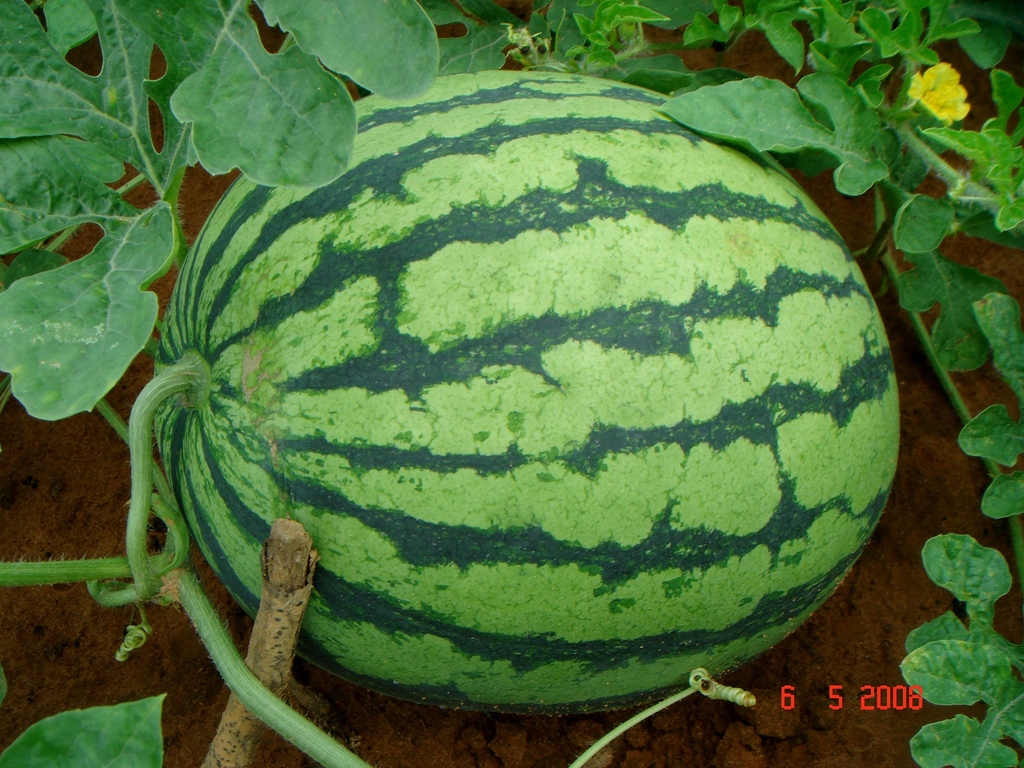
Watermelon
Citrullus lanatus
The watermelon (Citrullus lanatus) is a species of flowering plant in the family Cucurbitaceae. It is a scrambling and trailing vine-like plant cultivated worldwide for its fruit, a large berry with a firm rind and no internal divisions, botanically termed a pepo. The sweet, juicy flesh is usually deep red to pink, with many seeds that are black when mature and white when immature.
The modern watermelon originated in Sudan where it was first domesticated and cultivated. Kordofan melons are the closest relatives and may be progenitors of modern, cultivated watermelons. Watermelons were domesticated in Sudan and cultivated in Egypt by 2000 BCE. Dessert watermelons spread around the Mediterranean world during Roman antiquity. Considerable breeding effort has developed disease-resistant and seedless varieties. Many cultivars are available that produce mature fruit within 100 days of planting. In 2024, China produced 60% of the world's watermelons.
From the article Watermelon on Wikipedia (CC BY-SA), quoted section by section
Description
The watermelon is an annual plant that has a prostrate or climbing habit, spreading out up to 2 metres (7 feet). The leaves are alternate, lobed (sometimes with serrated margins), 6 to 20 centimetres (2+1⁄2 to 8 inches) long, and 4 to 15 cm (1+1⁄2 to 6 in) wide. Young growth is densely woolly with yellowish-brown hairs which disappear as the plant ages. It has branching tendrils. The species is monoecious, with male and female flowers produced on the same plant. Blooming from July to August, the five-petaled flowers are white or yellow and borne on 40-millimetre-long (1+1⁄2 in) hairy stalks. Each flower grows singly in the leaf axils, with five petals fused into a cup. The male flowers predominate at the beginning of the season; the female flowers, which develop later, have inferior ovaries. The styles are united into a single column. The large fruit is a kind of modified berry called a pepo with a thick rind and fleshy center (mesocarp and endocarp). Wild plants have fruits up to 20 cm (8 in) in diameter, while cultivated varieties may exceed 60 cm (24 in). The rind of the fruit is mid- to dark green and usually mottled or striped, and the flesh, containing numerous seeds spread throughout the inside, can be red or pink (most commonly), orange, yellow, green or white. A bitter watermelon, C. …
At the table
Watermelon fruit is 91% water, 6% sugars, and has low content of fat and protein. In a reference amount of 100 grams (3+1⁄2 ounces), watermelon fruit supplies 127 kilojoules (30 kilocalories) of food energy, with no micronutrients in significant content (table). Watermelon pulp contains carotenoids, including lycopene. The amino acid citrulline is produced in watermelon rind.
Wikipedia: “Nutrition”
How it is grown
Watermelons were originally cultivated for their high water content and stored to be eaten during dry seasons, as a source of both food and water. Early watermelons were not sweet, but bitter, with yellowish-white flesh. They were also difficult to open. The modern watermelon, which tastes sweeter and is easier to open, was developed over time through selective breeding. Dessert watermelons spread across the Mediterranean world during Roman antiquity and are mentioned with other sweet fruit in Hebrew texts of the 2nd and 6th century CE. In the 7th century CE, watermelons were being cultivated in India, and by the 10th century had reached China. The Moors introduced the fruit into the Iberian Peninsula, and there is evidence of it being cultivated in Córdoba in 961 and also in Seville in 1158. It spread northwards through southern Europe, perhaps limited in its advance by summer temperatures being insufficient for good yields. The fruit had begun appearing in European herbals by 1600, and was widely planted in Europe in the 17th century as a minor garden crop.
European colonists introduced the watermelon to the New World. Spanish settlers were growing it in Florida in 1576. It was being grown in Massachusetts by 1629, and by 1650 was being cultivated in Peru, Brazil and Panama. …
Wikipedia: “Cultivation history”
In human culture
The watermelon and its emoji 🍉 are used as a symbol of Palestinian resistance, of the Kherson region in Ukraine, and of eco-socialism, as in 'green on the outside, red on the inside'. Since the outbreak of the Gaza war in 2023, watermelon emojis have been more widely used on various social media platforms to show support for Palestine, to circumvent censorship and shadow banning on some platforms (a practice called "algospeak"), avoiding more overt symbols such as Palestinian flags. Because it is mostly water, the watermelon has been used to symbolize abrosexuality, a "fluid" or changing sexual orientation. In the US, the watermelon has also been used as a racist stereotype associated with African Americans. In Chinese culture, watermelons symbolise good fortune and happiness. They are gifted during the Lunar New Year and other festive occasions. They are also commonly eaten during summer as slices.
Wikipedia: “Cultural significance”
Where it lives
Recorded sightings
—
geo-referenced records in GBIF, from museums, herbaria and field observers.
Drag the globe to turn it. Dots are where records exist, not a range map; darker means more records.
In the old herbals & bestiaries

Compendium of Materia Medica
李時珍 · 1596 · p.86

Metamorphosis Insectorum Surinamensium
Maria Sibylla Merian · 1705 · p.54

Garden of Health
1507 · p.99

The Great Herbary with all the figures of the herbs
1532 · p.97

Notable Commentaries on the History of Plants
Leonhart Fuchs · 1542 · p.734

Notable Commentaries on the History of Plants
Leonhart Fuchs · 1549 · p.732

Commentaries on the Six Books of Dioscorides
Pietro Andrea Mattioli · 1560 · p.412

Commentaries on the Six Books of Pedanius Dioscorides on Medical Matter
Pietro Andrea Mattioli · 1565 · p.687

Six Groups of the History of Plants
Rembert Dodoens · 1583 · p.674

Six Groups of the History of Plants
Rembert Dodoens · 1583 · p.674

Six Groups of the History of Plants
Rembert Dodoens · 1583 · p.675

Historia naturalis Brasiliae
Willem Piso / Georg Marcgraf · 1648 · p.167
In the stacks
Searching the stacks…
Every page naming Citrullus lanatus in the Biodiversity Heritage Library →
This page is assembled live from iNaturalist, GBIF, Wikipedia, the Source Library and the Internet Archive. It is not yet part of the hand-edited codex. iNaturalist taxon 70054.