- Plants
- ›Vascular Plants
- ›flowering plants
- ›Dicots
- ›Mints, Plantains, Olives, and Allies
- ›Acanthus Family
- ›Acanthoideae
- ›Acantheae
- ›Acanthinae
- ›Acanthus
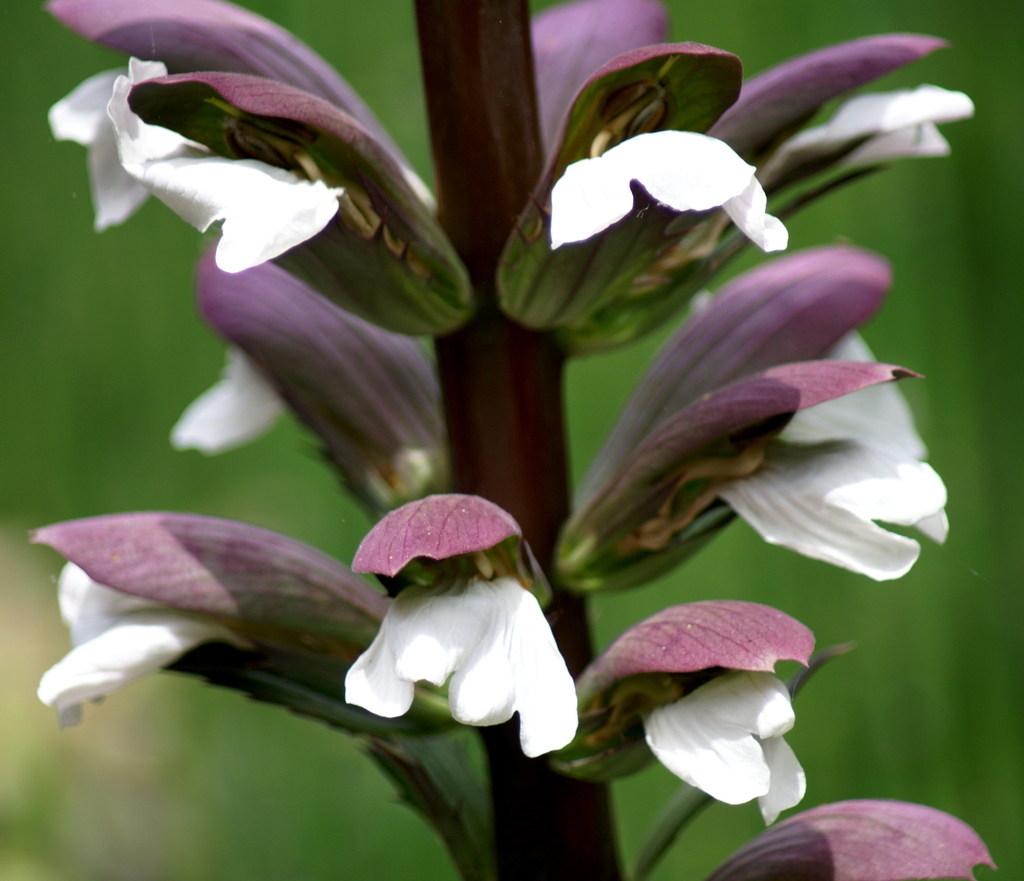
Bear's breeches
Acanthus mollis
Acanthus mollis, commonly known as bear's breeches, sea dock, bear's foot plant, sea holly, gator plant or oyster plant, is a species of plant in the family Acanthaceae and is native to the Mediterranean region. It is a leafy, clump-forming perennial herb, with a rosette of relatively large, lobed or toothed leaves, and purplish and white flowers on an erect spike.
From the article Acanthus mollis on Wikipedia (CC BY-SA), quoted section by section
Description
Acanthus mollis is a leafy, clump-forming perennial herb with tuberous roots. It has a basal rosette of dark glossy green, lobed or divided, glabrous leaves 50 cm (20 in) long and 30 cm (12 in) wide on a petiole 20–30 cm (7.9–11.8 in) long. The flowers are borne on an erect spike up to 200 cm (79 in) tall emerging from the leaf rosette. The sepals are purplish and function as the upper and lower lips of the petals, the upper lip about 4 cm (1.6 in) long and the lower lip 3 cm (1.2 in) long. The petals are about 4–4.5 cm (1.6–1.8 in) long and form a tube with a ring of hairs where the stamens are attached. Flowering occurs in summer and the fruit is a sharply-pointed capsule about 2 cm (0.79 in) long containing one or two brown seeds about 14 mm (0.55 in) long and 8 mm (0.31 in) wide.
Range & habitat
Although native to the eastern and central Mediterranean, Acanthus mollis has spread throughout much of western Europe and certain parts of the Americas, Australia, Syria and New Zealand, where it is regarded as invasive. Acanthus mollis is entomophilous, pollinated only by bees or bumble bees large enough to force their way between the upper sepal and the lower, so that they can reach the nectar at the bottom of the tube.
Wikipedia: “Distribution and ecology”
How it is grown
These plants are usually propagated from tubers and tend to form large, localized clumps which can survive for several decades and look statuesque when well-grown, but its suitability as a garden plant is lessened on account of its aggressive spread (new plants are produced readily both from seed and portions of root) and its susceptibility to attacks from slugs and snails.
Wikipedia: “Use in horticulture”
In human culture
The shape of the leaf of this plant inspired the ancient Greek sculptor Callimachus (fifth c. BCE) to model the capital of the Corinthian column. Since then, the Corinthian order column has been used extensively in Greco-Roman and Classical architecture. For centuries, stone or bronze stylized versions of acanthus leaves have appeared as acanthus decorations on certain styles of architecture and furniture. Virgil described Helen of Troy as wearing a dress embroidered with Acanthus leaves.
Wikipedia: “Cultural depiction”
Where it lives
Recorded sightings
—
geo-referenced records in GBIF, from museums, herbaria and field observers.
Drag the globe to turn it. Dots are where records exist, not a range map; darker means more records.
In the old herbals & bestiaries


In the stacks
Searching the stacks…
Every page naming Acanthus mollis in the Biodiversity Heritage Library →
This page is assembled live from iNaturalist, GBIF, Wikipedia, the Source Library and the Internet Archive. It is not yet part of the hand-edited codex. iNaturalist taxon 70045.