- Plants
- ›Vascular Plants
- ›flowering plants
- ›monocots
- ›screwpines, stemona, and allies
- ›screwpine family
- ›Pandanus
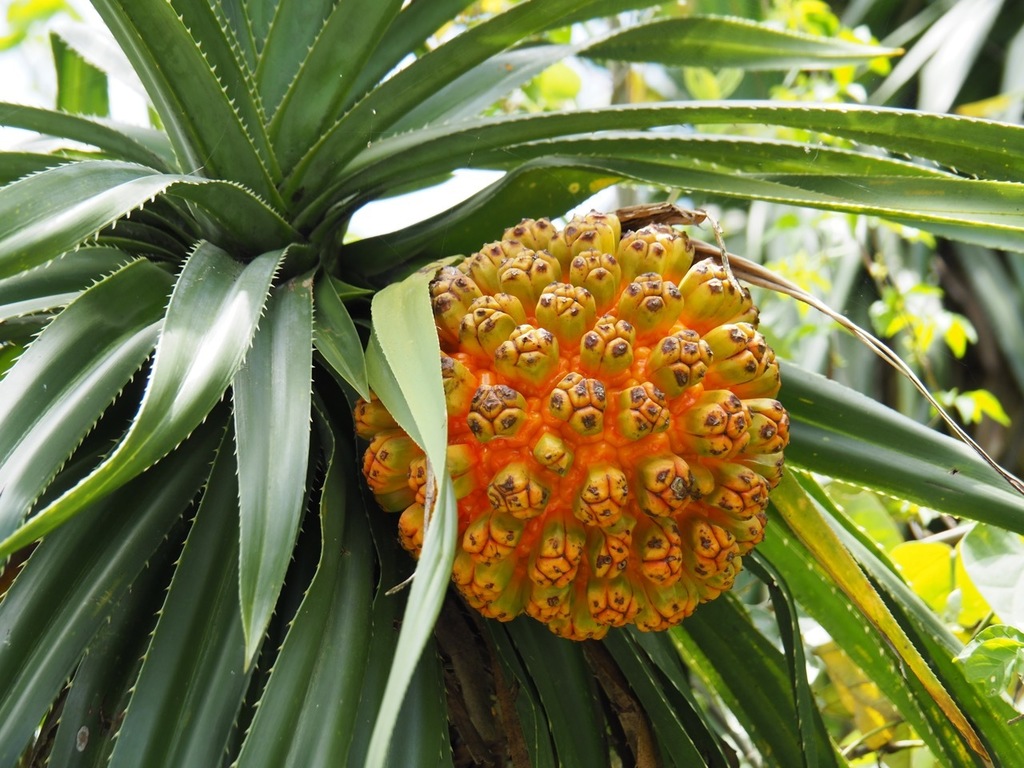
Screw-pine
Pandanus odorifer
Pandanus odorifer is an aromatic monocot species of plant in the Pandanaceae family, native to Polynesia, Australia, South Asia (Andaman Islands), and the Philippines, and is also found wild in southern India and Burma. It is commonly known as screw-pine.
From the article Pandanus odorifer on Wikipedia (CC BY-SA), quoted section by section
Description
It is a small branched, palm-like dioecious tree with a flexuous trunk supported by brace roots. The tree can grow to a height of 4 meters. Leaves grow in clusters at the branch tips, with rosettes of sword-shaped, stiff (leather-like) and spiny bluish-green, fragrant leaves. Leaves are glaucous, 40–70 cm. long. In summer, the tree bears very fragrant flowers, used as perfume. Interestingly, Pandanus lacks a common callose wall around microspore tetrads during pollen development. In Yemen, they are predominantly found alongside flowing streams in the western escarpment foothills; Most common in high rainfall areas. The fragrant male flowers are wrapped in leaves and sold on roadsides and in markets. Only male plants seem to occur in Yemen. Some suggest that it was introduced into Yemen from India where its flowers are used chiefly to make perfume.
At the table
An aromatic oil called kewra and a fragrant distillate called keorra-ka-arak are extracted from the male flowers. They are almost exclusively used in the form of a watery distillate called kewra water. Its flowers have a sweet, perfumed odor that has a pleasant quality similar to rose flowers, although kewra is considered more fruity. The watered-down distillate is quite diluted; it can be used by the tablespoon. The ketaki tree's flower is never used as an offering to the god Shiva. According to Hindu mythology, Shiva cursed the flower that it will never be used to worship him for helping Brahma lie against him, and then to Brahma that he will not be worshipped by people. On Ishigaki Island, south-west of Okinawa, it is customary to use parts of the plant during Bon festivities as an offering. The soft shoots can also be eaten, although the taste is very astringent and the shoots are considered inedible without blanching them first. When they are properly treated however, the taste is similar to that of bamboo shoots. Despite the pineapple-like appearance of the fruit and its sweet aroma, it is very fibrous and while being non-toxic, is generally not considered for consumption.
Wikipedia: “Other uses”
How it is grown
The tree is propagated vegetatively, by the offshoots of young plants that grow around the base of the trunk, but may also be increased by seed. If by the former method, the offshoots should be cut off and set in sand, at a temperature of 65° to 70 °F. The cuttings root slowly, and the plants for a time grow very slowly. The general treatment required for culturing the screw-pine is similar to that of palms. Trees require an abundance of water in summer. According to Ibn al-'Awwam's 12th-century treatise on agriculture, the kadi is cultivated in a manner similar to that of the Judas tree (Cercis siliquastrum).
Wikipedia: “Propagation”
Where it lives
Recorded sightings
—
geo-referenced records in GBIF, from museums, herbaria and field observers.
Drag the globe to turn it. Dots are where records exist, not a range map; darker means more records.
In the stacks
Searching the stacks…
Every page naming Pandanus odorifer in the Biodiversity Heritage Library →
This page is assembled live from iNaturalist, GBIF, Wikipedia, the Source Library and the Internet Archive. It is not yet part of the hand-edited codex. iNaturalist taxon 70023.