- Plants
- ›Vascular Plants
- ›flowering plants
- ›Dicots
- ›Sunflowers, Bellflowers, Fanflowers, and Allies
- ›Sunflowers, Daisies, Asters, and Allies
- ›Thistles and Allies
- ›Cardueae
- ›Thistles and Burdocks
- ›Cirsium
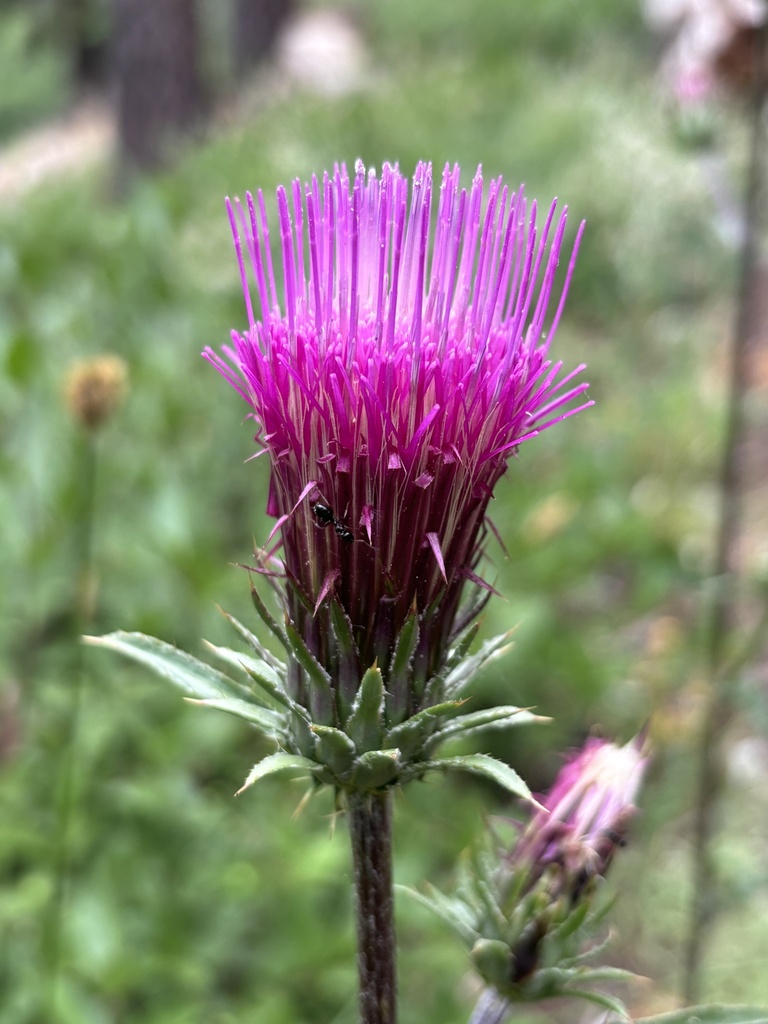
Anderson's thistle
Cirsium andersonii
Cirsium andersonii is a North American species of thistle known by the common names Anderson's thistle and rose thistle. It is native to California, Oregon, and Nevada, where it grows in the woodlands and forest openings of the local high mountain ranges, including the Sierra Nevada and the southern Cascade Range. It has also been reported from Idaho.
This native thistle is a perennial herb growing erect to a maximum height approaching 100 cm (39 in). It produces one to multiple stems, simple or branching, which may be hairless to quite woolly. The deeply lobed and sharply cut leaves are borne on spiny-winged petioles, the longest toward the base of the plant reaching over 30 centimetres (12 inches) long. The inflorescence bears one or more flower heads, each up to 5 centimeters long by 4 wide at the largest. The head is lined with spiny, purple-tipped phyllaries which curve outward. The head contains many red, purplish, or rose pink flowers, each up to 4.5 centimeters long. The fruit is an achene with a brown body 6 or 7 millimeters long topped with a pappus which may be 4 centimeters in length. The flower heads attract hummingbirds.
Where it lives
Recorded sightings
—
geo-referenced records in GBIF, from museums, herbaria and field observers.
Drag the globe to turn it. Dots are where records exist, not a range map; darker means more records.
In the stacks
Searching the stacks…
Every page naming Cirsium andersonii in the Biodiversity Heritage Library →
This page is assembled live from iNaturalist, GBIF, Wikipedia, the Source Library and the Internet Archive. It is not yet part of the hand-edited codex. iNaturalist taxon 69971.