- Animals
- ›Arthropods
- ›Hexapods
- ›Insects
- ›Winged and Once-winged Insects
- ›Ants, Bees, Wasps, and Sawflies
- ›Narrow-waisted Wasps, Ants, and Bees
- ›Ants, Bees, and Stinging Wasps
- ›Formicoidea
- ›Ants
- ›Odorous Ants
- ›Tapinomini
- ›Liometopum
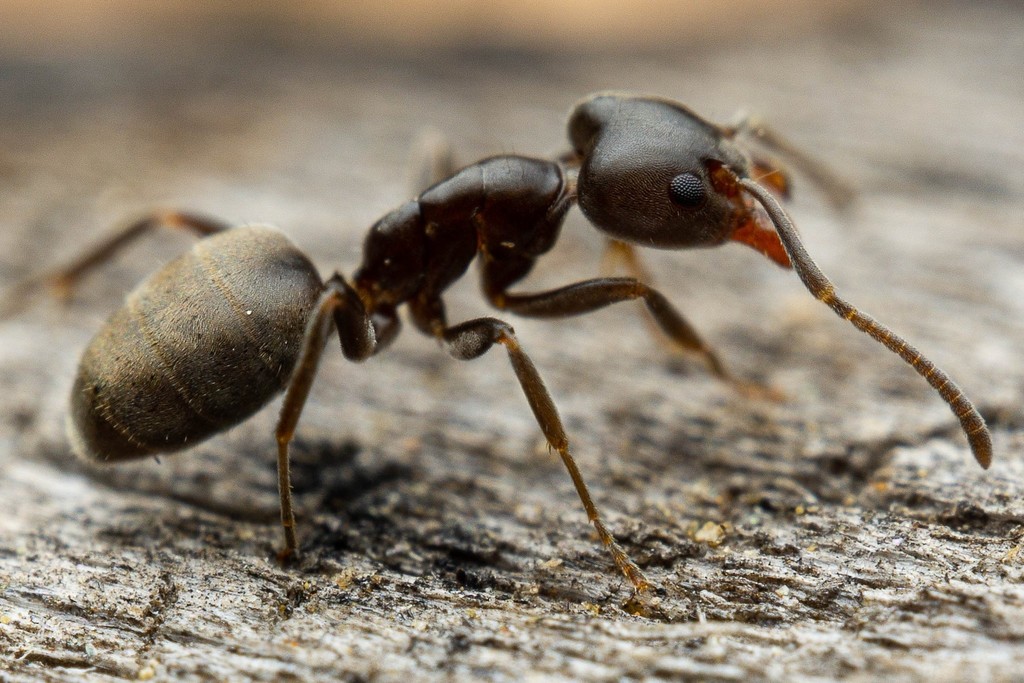
Liometopum luctuosum
Liometopum luctuosum is a species of ant in the subfamily Dolichoderinae. Liometopum luctuosum is often mistaken for carpenter ants (Camponotus spp.) by homeowners and pest management professionals. This mistaken identity is due to morphological and behavioral characteristics they share with carpenter ants; namely polymorphic workers, a smooth convex thoracic profile, and the tendency to excavate wood. L. luctuosum are also often confused with Tapinoma sessile since they have the same coloration, are similar in size, and produce an alarm pheromone with a very similar odor. Consequently, their importance as structural pests may be greatly under reported, especially in California, Oregon, and Washington, United States.
From the article Liometopum luctuosum on Wikipedia (CC BY-SA), quoted section by section
Range & habitat
Liometopum luctuosum has been reported at elevations as low as 59 m, but is typically found at elevations higher than 2400 m in more southern latitudes. Their range extends from temperate habitats as far north as British Columbia, Canada, and to more arid habitats of central Mexico and western Texas. They inhabit pine, oak, Douglas fir, and juniper forests, sagebrush, and high-elevation riparian habitats. This species is often strongly associated with but not limited to pine trees.
Wikipedia: “Habitat”
What it does
Liometopum luctuosum is also an omnivore and has been observed feeding on secretions from both plants and insects such as aphids, membracids and scales, as well as miscellaneous foods such as meat, eggs, fruit and bread.
Wikipedia: “Feeding”
Listen
Looking for field recordings…
Where it lives
Recorded sightings
—
geo-referenced records in GBIF, from museums, herbaria and field observers.
Drag the globe to turn it. Dots are where records exist, not a range map; darker means more records.
In the stacks
Searching the stacks…
Every page naming Liometopum luctuosum in the Biodiversity Heritage Library →
This page is assembled live from iNaturalist, GBIF, Wikipedia, the Source Library and the Internet Archive. It is not yet part of the hand-edited codex. iNaturalist taxon 68989.