- Plants
- ›Vascular Plants
- ›flowering plants
- ›Dicots
- ›Mints, Plantains, Olives, and Allies
- ›broomrape family
- ›Pedicularideae
- ›Pedicularis
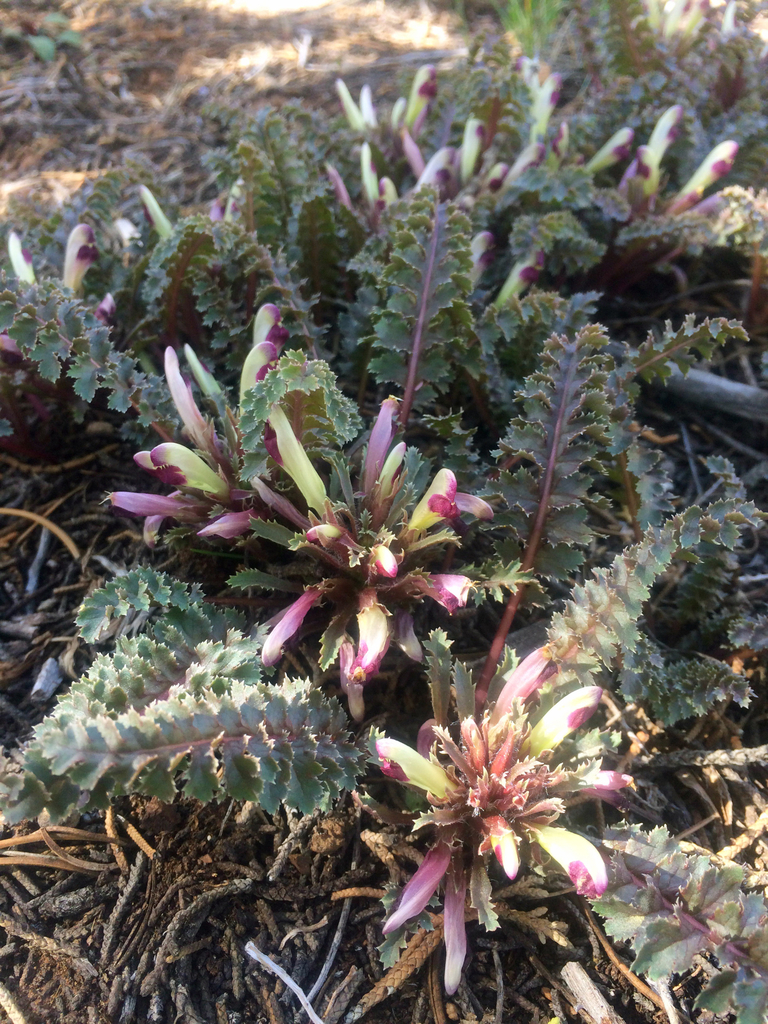
Dwarf Lousewort
Pedicularis centranthera
Pedicularis centranthera is a species of flowering plant in the broomrape family known by the common names dwarf lousewort and Great Basin lousewort. It is native to the western United States from eastern Oregon and California to Colorado and New Mexico, where it grows in sagebrush and other basin and plateau habitat. It is a perennial herb producing several short stems a few centimeters tall from a basal caudex. The leaves are up to 20 centimeters...
From the article Pedicularis centranthera on Wikipedia (CC BY-SA), quoted section by section
Description
Dwarf lousewort is a perennial plant with a tuberous root. Its leaves are in a ground level rosette and usually measure 6–15 centimeters long including the leaf stem, but occasionally can reach 30 cm. The leaf stems are short, just 2–10 millimeters. Lower leaves are narrow and grass-like without divisions or teath. The upper leaves are pinnatifid, divided up and feather like. The divisions of the upper leaves are egg-shaped and have teeth along their edges and a wrinkled texture. The inflorescence is a short raceme bearing many long, protruding, club-shaped flowers. Each flower may exceed 4 centimeters in length and is white or pale purple with dark purple tips on the wide ends of its upper and lower lips. The sepals of the flowers are shorter and hairy. The fruit is a capsule around centimeter long containing seeds with netlike surfaces.
Range & habitat
The native range for dwarf lousewort is the western United States including Arizona, California, Colorado, Nevada, New Mexico, and Utah. In California it grows only in the northeast the Warner Mountains and the Modoc Plateau. In Oregon it similarly is reported in just Lake and Harney counties in the southwest of the state. It is found in the western two-thirds of Nevada and southern Utah. It is reported in many of the counties of Arizona, five in the northwest of New Mexico, and five in western Colorado. It is associated with pinyon–juniper woodlands, ponderosa pine forests, and other yellow pines.
Wikipedia: “Range and habitat”
Where it lives
Recorded sightings
—
geo-referenced records in GBIF, from museums, herbaria and field observers.
Drag the globe to turn it. Dots are where records exist, not a range map; darker means more records.
In the stacks
Searching the stacks…
Every page naming Pedicularis centranthera in the Biodiversity Heritage Library →
This page is assembled live from iNaturalist, GBIF, Wikipedia, the Source Library and the Internet Archive. It is not yet part of the hand-edited codex. iNaturalist taxon 68602.