- Plants
- ›Vascular Plants
- ›flowering plants
- ›Dicots
- ›Mints, Plantains, Olives, and Allies
- ›Plantain Family
- ›Penstemon and allies
- ›Penstemon
- ›Penstemon
- ›Gentianoides
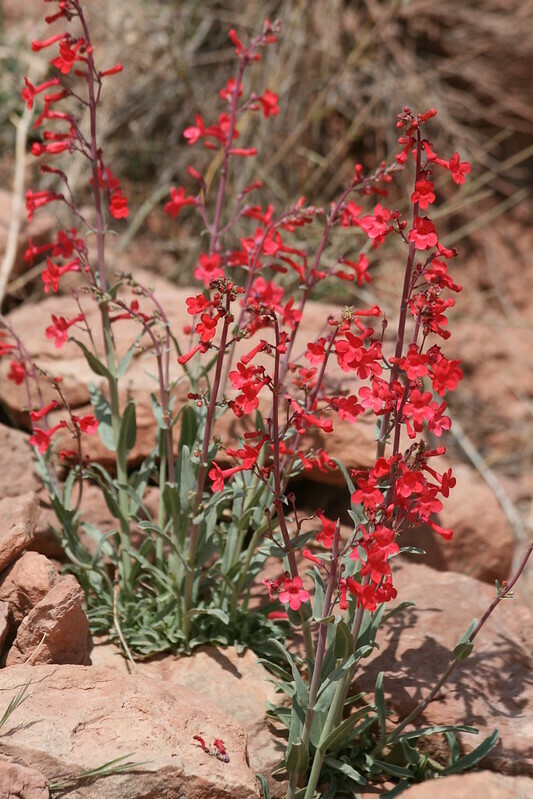
Utah Beardtongue
Penstemon utahensis
Penstemon utahensis, also called Utah penstemon or Utah firecracker, is a species of penstemon native to the southwestern United States, where it grows in scrub, woodland, and canyons. It is a perennial herb growing erect to a maximum height near half a meter. The thick leaves are located around the base of the plant and in opposite pairs along the stem. The upper leaves are narrow and often folded lengthwise, measuring up to 7.5 centimeters long. The showy inflorescence bears many bright red-pink flowers up to 2.5 centimeters in length. They have narrow floral tubes ending in wide, lobed mouths.
From the article Penstemon utahensis on Wikipedia (CC BY-SA), quoted section by section
Description
Utah penstemon is herbaceous plant with stems that grow straight upwards or outwards a short distance before curving to grow upwards to between 15 and 50 centimeters tall. All the stems are hairless and glaucous, covered in natural waxes giving a gray or blue cast to them. They often also have a redish tint and similar to other penstemon species may have a curve on the growing tip before it is fully mature. Each plant usually as a few stems which grow from a branched and woody caudex. Plants have leaves that are thick and described as leathery or fleshy in texture and are often folded lengthwise. They have well developed basal leaves, the ones that grow directly from the base of the plant, and also cauline leaves attached to the stems. The leaves do not have teeth, but do sometimes have rough hairs along their edges or other leaf surfaces, though they can also be hairless. The basal leaves and the lowest leaves on stems are 3.5 to 10 cm long and 0.5 to 2 cm wide, though usually less than 8 cm long. They are oblanceolate, shaped like a spear head reversed with the widest part above the midpoint. On the stems there are two to four leaf pairs attached to opposite sides. The upper leaves are sessile, attached directly to the stems without a petiole. …
Range & habitat
The Utah penstemon is native to five western states, California, Arizona, Nevada, Utah, and Colorado. In these states it largely grows in the Colorado River basin, extending into the deserts of southern California only as far west as the Kingston Range and New York Mountains. In Arizona it can be found in Mohave, Coconino, and Navajo counties. In the Grand Canyon it grows at higher elevations the Supai Formation up to the rim. It is also recorded in the three southern counties of Nevada, Nye, Lincoln, and Clark. To the east it grows in southwest Utah and throughout the Canyon Lands into western Colorado. In Colorado the only records of the plant are near the boarder with Utah in Mesa and Montezuma counties. It can be found at elevations of 400–2,500 meters (1,300–8,200 ft). They grow in sagebrush steppes, pinyon–juniper woodlands, in blackbush scrub, in desert scrublands, and with junipers alone. They are often associated with soils derived from sandstone.
Conservation. When evaluated by NatureServe in 1984 the species was rated apparently secure (G4) at the global level. However, it was rated as vulnerable in Nevada (S3), and imperiled (S2) in California and Colorado. It was not rated in Utah or Arizona.
Wikipedia: “Range and habitat”
How it is grown
It has a reputation for being a difficult species to keep in a garden among penstemon enthusiasts, though valued for its showy red flowers. Its seeds require cool, moist stratification for eight weeks for sprouting.
Wikipedia: “Cultivation”
Where it lives
Recorded sightings
—
geo-referenced records in GBIF, from museums, herbaria and field observers.
Drag the globe to turn it. Dots are where records exist, not a range map; darker means more records.
In the stacks
Searching the stacks…
Every page naming Penstemon utahensis in the Biodiversity Heritage Library →
This page is assembled live from iNaturalist, GBIF, Wikipedia, the Source Library and the Internet Archive. It is not yet part of the hand-edited codex. iNaturalist taxon 68578.