- Animals
- ›Arthropods
- ›Hexapods
- ›Insects
- ›Winged and Once-winged Insects
- ›True Bugs, Hoppers, Aphids, and allies
- ›Plant-parasitic Hemipterans
- ›Scale Insects
- ›Mealybugs
- ›Planococcus
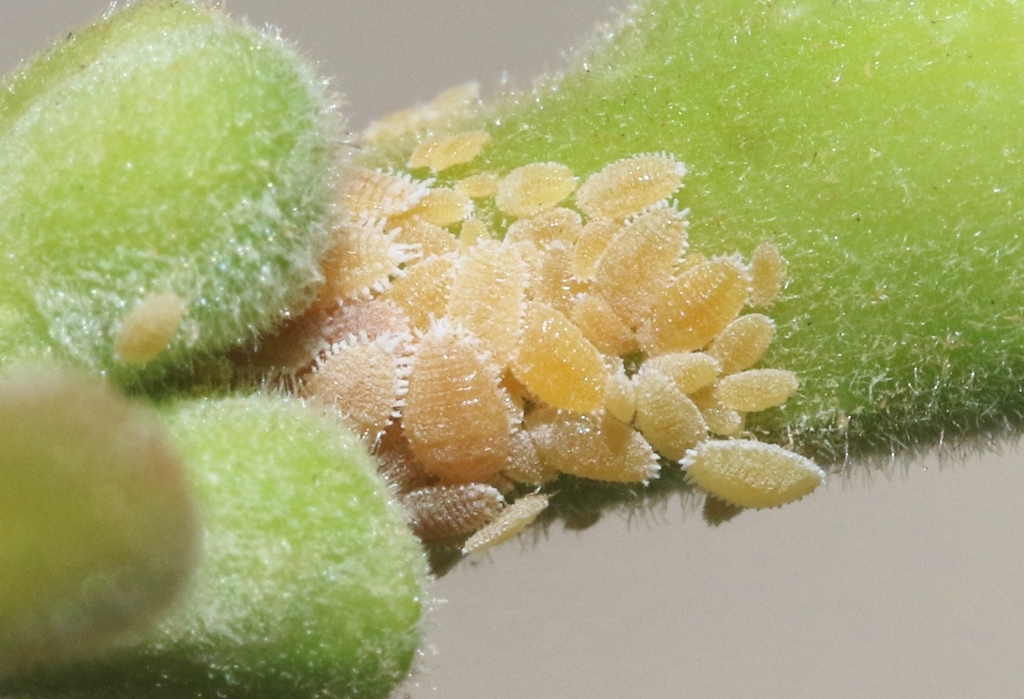
vine mealybug
Planococcus ficus
Planococcus ficus, commonly known as the vine mealybug, is a species of mealybug, belonging to the family Pseudococcidae, native to tropical and subtropical regions. The vine mealybug is found in Europe, Northern Africa, Southern Africa, the Americas, and the Middle East. The vine mealybug is invasive to weedy plants in many different regions of the world.
From the article Planococcus ficus on Wikipedia (CC BY-SA), quoted section by section
Description
Planococcus ficus are bilaterally symmetric, triploblastic, coelomic, protostomes
Female description. Planococcus ficus exhibits sexual dimorphism. Adult females are about 4 mm long, 2 mm wide and 1.5 mm thick. Female P. ficus are wingless and generally larger than males. They have a segmented, humpbacked, pale white or flesh colored body. With a girdle of frilly white projections and a thin dark line of denuded wax running on the dorsal surface, the female bodies are covered in a fine, white, powdery wax secretion.
Male description. Adult male P. ficus are about 1 mm long and have transparent wings. They have a brown body with beaded antenna and filamentous anal setae for flight stabilization. Adult males do not possess mouth parts and use their anal setae for feeding.
Range & habitat
Vine mealybugs are found in tropical and subtropical regions of the world such as Europe, Northern Africa, South Africa, Argentina, the Middle East, and Mexico. The vine mealybug has been reported in over 47 countries and is thought to have originated from Israel. Transportation of the vine mealybug has occurred through the movement of infected plants and agricultural equipment. This has allowed the vine mealybug to be invasive to many different regions of the world. The vine mealybug lives in colonies on host plants and migrates between different parts of the plant depending on seasonal changes. The vine mealybug is usually distributed along the bark of the host plant’s trunk and arms and underground in the roots during the winter seasons. Vine mealybugs then move to the base of the plant’s shoots during the spring and become densely distributed on leaf foliage during summer and fall seasons.
Wikipedia: “Distribution”
What it does
Planococcus ficus are herbivores that feed on all parts of the grape vine plant and weedy plants. They are found on apples, avocados, banana, date palm, fig, mango, and citrus fruits. They specifically feed on the phloem sap of their host plants.
Distribution. Vine mealybugs are found in tropical and subtropical regions of the world such as Europe, Northern Africa, South Africa, Argentina, the Middle East, and Mexico. The vine mealybug has been reported in over 47 countries and is thought to have originated from Israel. Transportation of the vine mealybug has occurred through the movement of infected plants and agricultural equipment. This has allowed the vine mealybug to be invasive to many different regions of the world. The vine mealybug lives in colonies on host plants and migrates between different parts of the plant depending on seasonal changes. The vine mealybug is usually distributed along the bark of the host plant’s trunk and arms and underground in the roots during the winter seasons. Vine mealybugs then move to the base of the plant’s shoots during the spring and become densely distributed on leaf foliage during summer and fall seasons.
Ecological relationships. Many P. ficus form mutualistic relationships with neighboring ant colonies. …
Wikipedia: “Ecology”
Listen
Looking for field recordings…
Where it lives
Recorded sightings
—
geo-referenced records in GBIF, from museums, herbaria and field observers.
Drag the globe to turn it. Dots are where records exist, not a range map; darker means more records.
In the stacks
Searching the stacks…
Every page naming Planococcus ficus in the Biodiversity Heritage Library →
This page is assembled live from iNaturalist, GBIF, Wikipedia, the Source Library and the Internet Archive. It is not yet part of the hand-edited codex. iNaturalist taxon 684061.