- Animals
- ›Arthropods
- ›Hexapods
- ›Insects
- ›Winged and Once-winged Insects
- ›Butterflies and Moths
- ›Butterflies
- ›Brush-footed Butterflies
- ›Fritillaries and Longwings
- ›Fritillaries
- ›Euptoieta
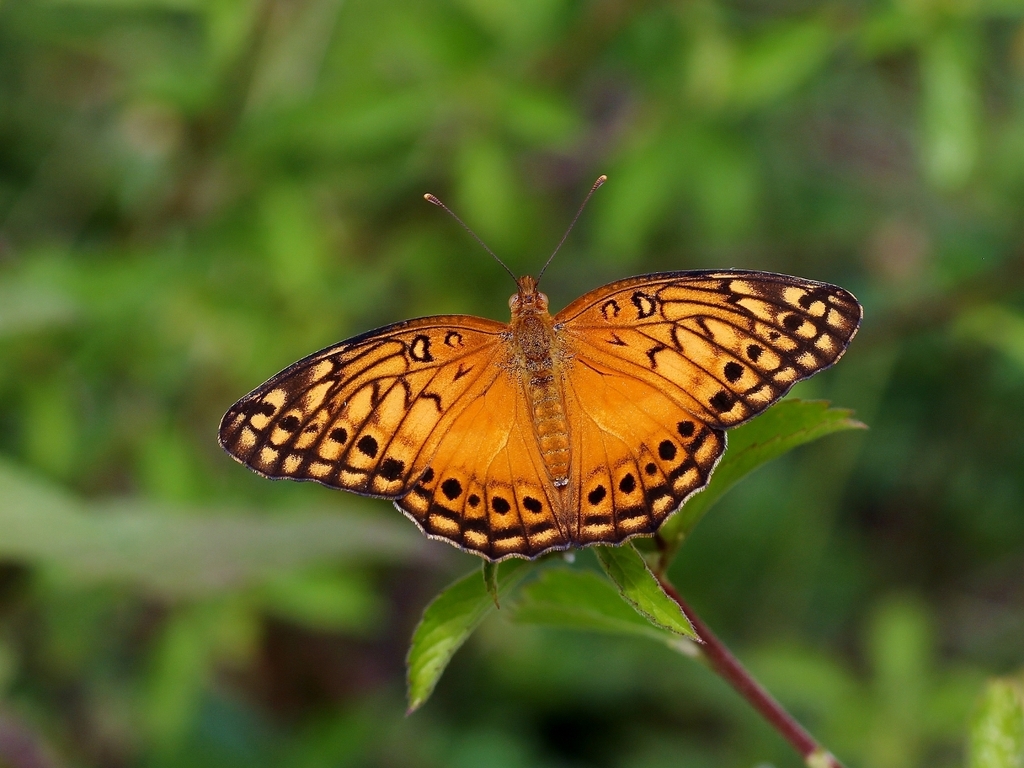
Mexican Fritillary
Euptoieta hegesia
Euptoieta hegesia, the Mexican fritillary, is a North and South American butterfly in the family Nymphalidae.
From the article Euptoieta hegesia on Wikipedia (CC BY-SA), quoted section by section
Description
The upperside of the wings is bright orange with the basal part of the hindwing unmarked. There is a row of submarginal black spots on both the forewing and the hindwing. The underside of the wings is yellow orange with no submarginal black spots. It has a wingspan of 2.5 to 3 inches.
What it does
The larva is shiny red, with middorsal silver spots edged with black. It has a subdorsal row of white spots ringed with black, a spiracular silver line with black edges, and six rows of black spines. The red head has two long black spines with clubbed ends. The chrysalis is dark brown or rarely tan, with gold eyes and short gold lateral and subdorsal cones. On the wing cases, it has a black marking shaped like a "T". It has one to three broods per year.
Wikipedia: “Life cycle”
Listen
Looking for field recordings…
Where it lives
Recorded sightings
—
geo-referenced records in GBIF, from museums, herbaria and field observers.
Drag the globe to turn it. Dots are where records exist, not a range map; darker means more records.
In the stacks
Searching the stacks…
Every page naming Euptoieta hegesia in the Biodiversity Heritage Library →
This page is assembled live from iNaturalist, GBIF, Wikipedia, the Source Library and the Internet Archive. It is not yet part of the hand-edited codex. iNaturalist taxon 68268.