 NL·0455
Herbarium of the Nature Library
- Name
- Paraponera clavata
- Family
- Formicidae
- Native to
- Lowland rainforests from Honduras and Nicaragua through Central America to the Amazon basin
- Habitat
- Tropical rainforest
Bullet ant
Paraponera clavata
Also calledHormiga bala (Spanish) · Tucandeira (Portuguese) · Hormiga veinticuatro (Venezuelan Spanish)
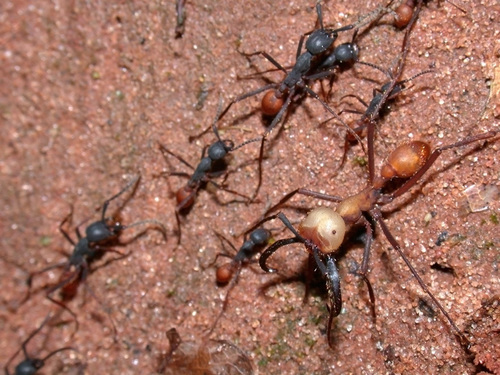
A large rainforest ant whose sting is rated the most painful of any insect, a throbbing pain said to last up to a day. The Sateré-Mawé people of Brazil use it in a coming-of-age ritual.
Paraponera clavata, commonly known as the bullet ant, is a species of ant known for its extremely painful sting. It inhabits humid lowland rainforests in Central and South America. Wikipedia
What it can do
- iSting rated at the top (4+) of Justin Schmidt's sting pain index
- iiVenom contains poneratoxin, a peptide that keeps nerve sodium channels open
- iiiSqueaks (stridulates) and releases a musky odour when disturbed
- ivWorkers forage alone up into the canopy
In the field
Field marks
- aVery large reddish-black ant
- bLarge head with strong jaws
- cClub-shaped tip to the antennae (clavata, 'club-bearing')
- dSingle node between thorax and abdomen with a visible sting
- Not to be confused with
- Giant Amazonian ants (Dinoponera) are larger, all black and lack clubbed antennae. Ectatomma and Neoponera species are smaller.
- Where to see it
- Tree bases along rainforest trails in Costa Rica (La Selva), Panama and Amazonian Peru and Ecuador.
- When
- Year-round
Listen
Looking for field recordings…
Life & habits
- Diet
- Nectar and other insects, which workers carry back from the canopy
- Habitat
- Nests at the base of rainforest trees; forages on trunks and in the canopy
- Size
- Workers about 1.8–3 cm
Colonies of a few hundred to a few thousand ants nest among the roots of a single tree and send solitary foragers into its crown.
Where it lives
Recorded sightings
—
geo-referenced records in GBIF, from museums, herbaria and field observers.
Native range
Lowland rainforests from Honduras and Nicaragua through Central America to the Amazon basin
Drag the globe to turn it. Dots are where records exist, not a range map; darker means more records.
In the stacks
Searching the stacks…
Every page naming Paraponera clavata in the Biodiversity Heritage Library →
Marginalia
In the Sateré-Mawé initiation, young men wear woven gloves filled with sedated bullet ants, stingers pointing inward, for several minutes at a time, repeating the ordeal many times over months.
Curiosity
The Spanish name 'veinticuatro' (twenty-four) refers to the claim that the pain of one sting lasts 24 hours.
Kinship





Photographs: iNaturalist contributors under the licences shown. Records: GBIF.org. Historical plates: Source Library (CC BY-SA 4.0; originals public domain). Summary text: Nature Library editors and Wikipedia (CC BY-SA). Medicinal and edibility notes are historical and educational, not advice. iNaturalist taxon 67986.