- Animals
- ›Arthropods
- ›Hexapods
- ›Insects
- ›Winged and Once-winged Insects
- ›Beetles
- ›Water, Rove, Scarab, Long-horned, Leaf, and Snout Beetles
- ›Scarabaeiform Beetles
- ›Scarabs, Stag Beetles, and Allies
- ›Scarabs
- ›Shining Leaf Chafers
- ›Anomalini
- ›Popilliina
- ›Popillia
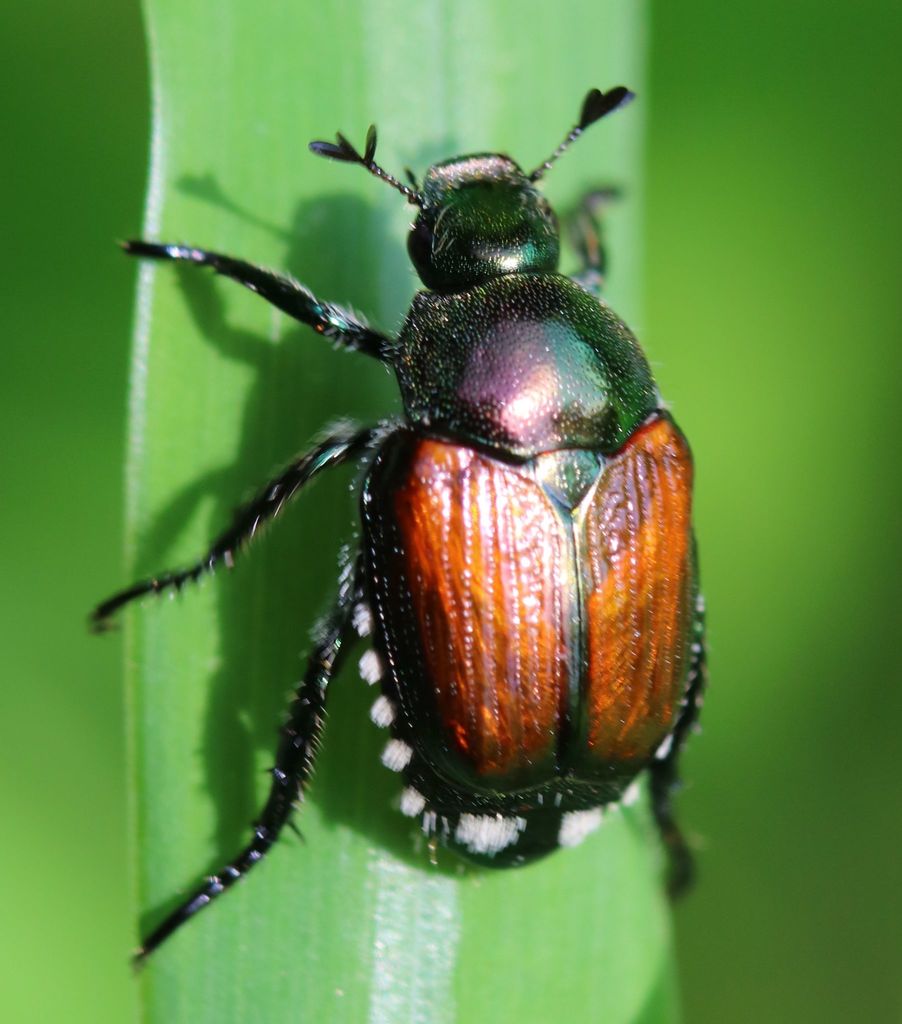
Japanese Beetle
Popillia japonica
The Japanese beetle (Popillia japonica) is a species of scarab beetle. Due to the presence of natural predators, the Japanese beetle is not considered a pest in its native Japan. In North America and some regions of Europe, it is a noted pest to roughly 300 species of plants. Some of these plants include roses, grapes, hops, canna, crape myrtles, birch trees, linden trees, and others.
The adult beetles damage plants by skeletonizing the foliage (i.e., consuming only the material between a leaf's veins), as well as, at times, feeding on a plant's fruit. The subterranean larvae feed on the roots of grasses.
From the article Japanese beetle on Wikipedia (CC BY-SA), quoted section by section
Description
Adults of P. japonica measure 15 mm (0.6 in) in length and 10 mm (0.4 in) in width, with iridescent, copper-colored elytra and a green thorax and head. A row of white tufts (spots) of hair projects from under the wing covers on each side of the body. Males are slightly smaller than females. Grubs are white and lie in curled positions. A mature grub is roughly 1 in (2.5 cm) long.
Range & habitat
Popillia japonica is native to Japan, and is an invasive species in North America and Europe. The first written evidence of the insect appearing within the United States was in 1916 in a nursery near Riverton, New Jersey. The beetle larvae are thought to have entered the United States in a shipment of iris bulbs prior to 1912, when inspections of commodities entering the country began. As of 2015, just nine western states of the United States—Arizona, California, Colorado, Idaho, Montana, Nevada, Oregon, Utah, and Washington—were considered free of Japanese beetles. These states are protected by a federal Japanese beetle quarantine (7 CFR 301.48) and the National Plant Board's U.S. Domestic Japanese Beetle Harmonization Plan, which is intended to keep them uninfested. Since then, some of these states have detected localized infestations and begun eradication programs: Oregon began treating a large infestation found near Portland in 2016, cutting beetle numbers by about 92% since 2016, and Washington launched a multi-year eradication effort after beetles were found in the Yakima Valley in 2020. These beetles have been detected in airports on the West Coast of the United States since the 1940s. …
Wikipedia: “Distribution”
What it does
Eggs are laid individually or in small clusters near the soil surface. Within roughly two weeks, the ova hatch, then the larvae feed on fine roots and other organic material. As the larvae mature, they become C-shaped grubs, which consume progressively coarser roots and may do economic damage to pasture and turf. Larvae hibernate in small cells in the soil, emerging in the spring when soil temperatures rise again. Within 4–6 weeks of breaking hibernation, the larvae pupate. Most of the beetle's life is spent as a larva, with only 30–45 days spent as an imago. Adults feed on leaf material above ground, using pheromones to attract other beetles and overwhelm plants, skeletonizing leaves from the top of the plant downward. The aggregation of beetles alternates daily between mating, feeding, and ovipositing. An adult female may lay as many as 40–60 ova in her lifetime. Throughout the majority of the Japanese beetle's range, its lifecycle takes one full year, but in the extreme northern parts of its range, as well as high-altitude zones as found in its native Japan, development may take two years.
Wikipedia: “Life cycle”
Listen
Looking for field recordings…
Where it lives
Recorded sightings
—
geo-referenced records in GBIF, from museums, herbaria and field observers.
Drag the globe to turn it. Dots are where records exist, not a range map; darker means more records.
In the stacks
Searching the stacks…
Every page naming Popillia japonica in the Biodiversity Heritage Library →
This page is assembled live from iNaturalist, GBIF, Wikipedia, the Source Library and the Internet Archive. It is not yet part of the hand-edited codex. iNaturalist taxon 67760.