- Animals
- ›Chordates
- ›Vertebrates
- ›Amphibians
- ›Frogs and Toads
- ›Poison Frogs
- ›Poison Dart Frogs
- ›Hyloxalinae
- ›Hyloxalus
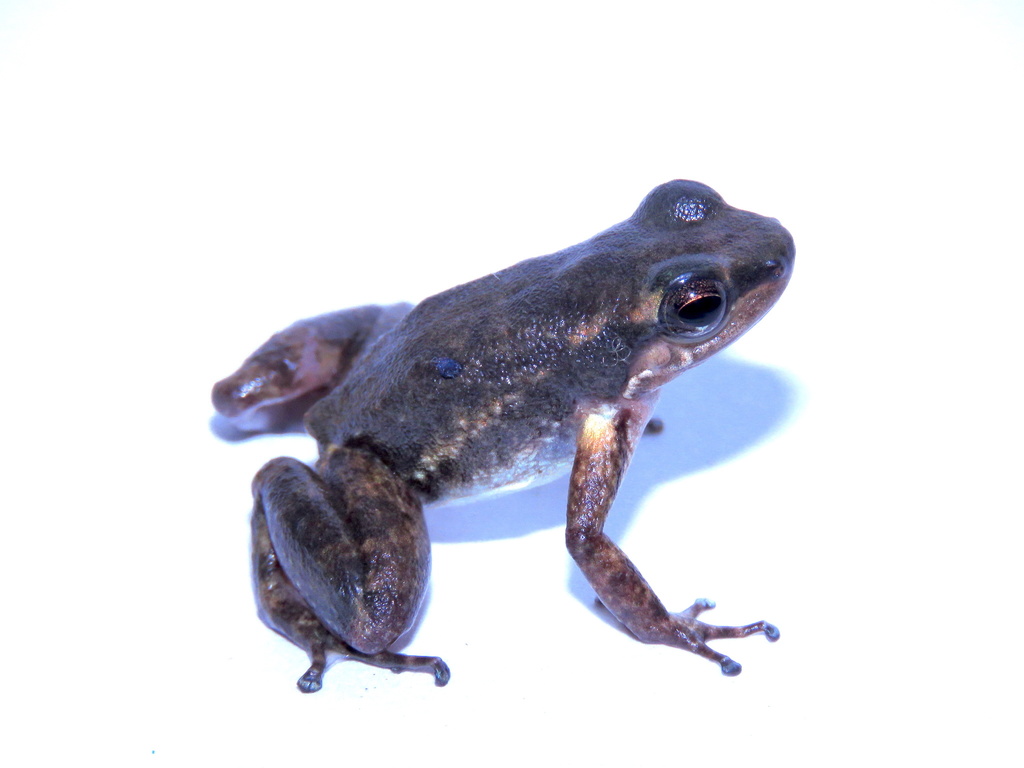
Spotted Rocket Frog
Hyloxalus maculosus
Hyloxalus maculosus, also known as spotted rocket frog, is a species of frogs in the family Dendrobatidae. It is endemic to the eastern slopes of Ecuadorian Andes in Napo and Pastaza provinces at elevations of 342 to 1,225 m (1,122 to 4,019 ft) asl.
From the article Hyloxalus maculosus on Wikipedia (CC BY-SA), quoted section by section
Description
Males measure 20–25 mm (0.79–0.98 in) and females 22–29 mm (0.87–1.14 in) in snout–vent length. Dorsum is reddish-brown, more reddish posteriorly and in the hind limbs. There are brighter reddish-brown spots posterior to eyes and on arms at the arm-body junction. An oblique lateral stripe is present; it is complete but becoming diffused anteriorly or incomplete. Toe webbing is extensive. The male call is a long trill composed of paired pulsed notes. Tadpoles measure up to 37 mm (1.5 in) in total length, and newly metamorphosed juveniles about 10–11 mm (0.39–0.43 in).
Range & habitat
The range of Hyloxalus maculosus is within lowland evergreen forest and foothill evergreen forest vegetation zones. Males have been found calling on rocky streams at both sides of a road and inside water ducts that cross under the road. One male carrying nine tadpoles was found near a tiny pond, on a rocky stream surrounded by pasture. Tadpoles have been found in slow-running water in the ditch. The tadpoles are translucent in color with a brown stripe on the back. There are two pale dots near the oral disk. The International Union for Conservation of Nature assessed Hyloxalus maculosus as "data deficient" in 2008, but Páez-Vacas and her colleagues suggested in 2010 that it should be considered as "Critically Endangered" because of its small range and habitat loss occurring in that range. In 2023, the IUCN released a new assessment, classifying the frog as "endangered". Principal threats include water pollution and deforestation in favor of agriculture, logging, and cattle husbandry. The frog was found near two protected parks, and scientists infer that its range may include both Parque Nacional Llanganates and Parque Nacional Sangay.
== References ==
Wikipedia: “Habitat and conservation”
In human culture
Scientists gave this frog the scientific name maculosus for "spotted" or "mottled," referring to its dorsal coloration.
Wikipedia: “Etymology”
Listen
Looking for field recordings…
Where it lives
Recorded sightings
—
geo-referenced records in GBIF, from museums, herbaria and field observers.
Drag the globe to turn it. Dots are where records exist, not a range map; darker means more records.
In the stacks
Searching the stacks…
Every page naming Hyloxalus maculosus in the Biodiversity Heritage Library →
This page is assembled live from iNaturalist, GBIF, Wikipedia, the Source Library and the Internet Archive. It is not yet part of the hand-edited codex. iNaturalist taxon 65697.