- Animals
- ›Chordates
- ›Vertebrates
- ›Amphibians
- ›Frogs and Toads
- ›Poison Frogs
- ›Poison Dart Frogs
- ›Colostethinae
- ›Epipedobates
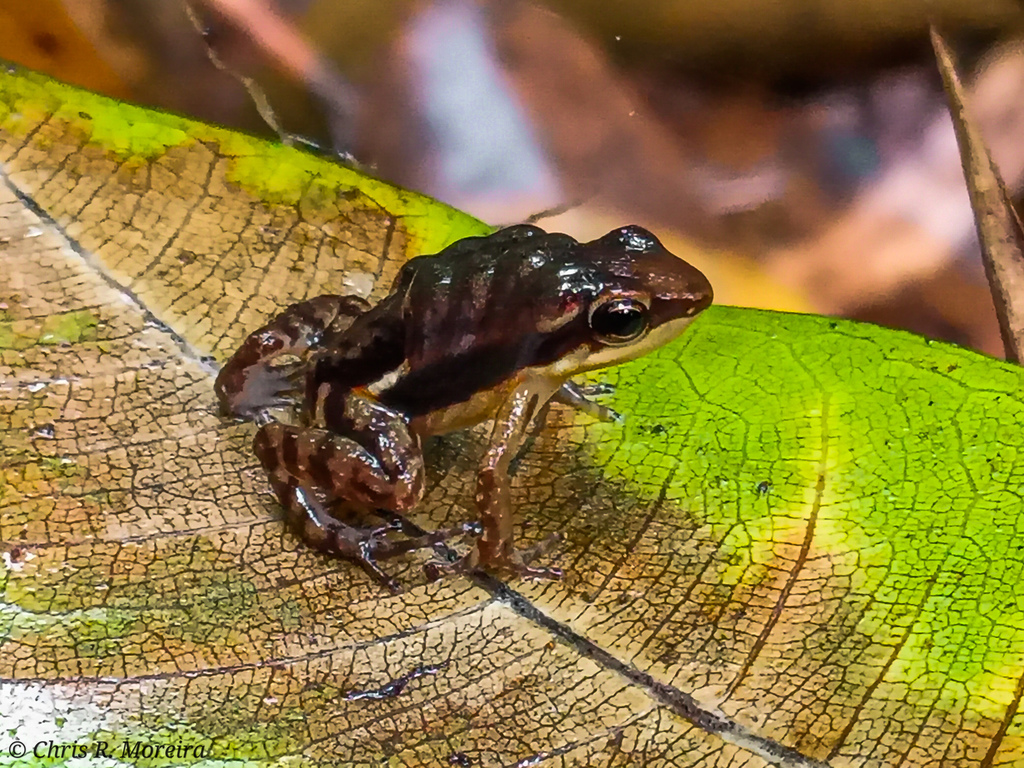
Machalilla Poison Frog
Epipedobates machalilla
Epipedobates machalilla, formerly Colostethus machalilla, is a slender species of frog in the family Dendrobatidae. Endemic to West Ecuador, it lives in dry and low forests and was first described by Luis A. Coloma in 1995. With a decreasing population, IUCN have classed it as Near Threatened.
From the article Epipedobates machalilla on Wikipedia (CC BY-SA), quoted section by section
Description
Epipedobates machalilla has a snout–vent length of 14.4 to 16 millimetres (0.57 to 0.63 in) for males and 15.0 to 17.6 millimetres (0.59 to 0.69 in) for females. Their heads are longer than they are wide, and the tympanum is small. The forelimbs have a moderate length and the fingers are unwebbed. The toes do not have lateral fringes and the terminal discs are expanded. The skin of the dorsum is dark-coffee in colour with a cream-yellow or cream-white stripe that shows some pink coloration toward the posterior. The upper surfaces of the hind legs are light brown in color; the forelegs are orange. The frog has a gold iris and cream ventral surfaces.
Range & habitat
Epipedobates machalilla is endemic to West Ecuador, where it lives in dry and low forests. It mainly occurs in Azogues, Bolívar, El Oro, Guayas, Los Rios and Manabí and has been seen in the Choco rainforest. The species occurs at altitudes between 10 and 515 metres (33 and 1,690 ft). Recently, the population has been declining due to agriculture and logging. The frog's range includes at least three protected parks: Parque Nacional Machalilla, Reserva Jouneche, Reserva Ecológica Manglares Churute.
== References ==
Wikipedia: “Distribution”
Listen
Looking for field recordings…
Where it lives
Recorded sightings
—
geo-referenced records in GBIF, from museums, herbaria and field observers.
Drag the globe to turn it. Dots are where records exist, not a range map; darker means more records.
In the stacks
Searching the stacks…
Every page naming Epipedobates machalilla in the Biodiversity Heritage Library →
This page is assembled live from iNaturalist, GBIF, Wikipedia, the Source Library and the Internet Archive. It is not yet part of the hand-edited codex. iNaturalist taxon 65451.