- Animals
- ›Chordates
- ›Vertebrates
- ›Amphibians
- ›Frogs and Toads
- ›Poison Frogs
- ›Poison Dart Frogs
- ›Colostethinae
- ›Colostethus
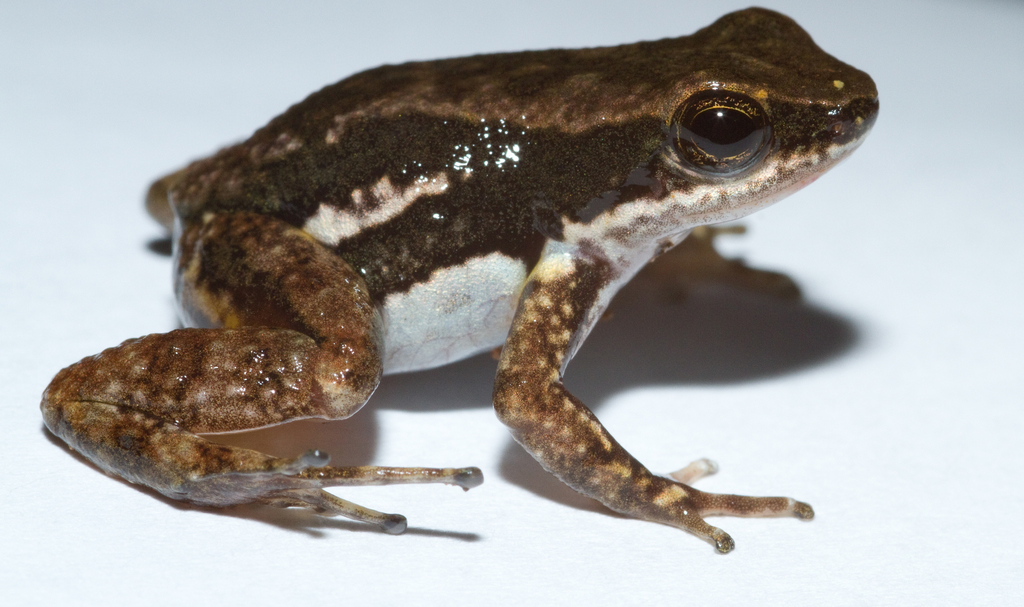
Panama Rocket Frog
Colostethus panamansis
Colostethus panamansis, also known as the Panama rocket frog or (ambiguously) common rocket frog, is a species of poison dart frog. It is found in northwestern Colombia and Panama. It is one of the best studied poison dart frogs; however, until 2004 Colostethus panamansis was considered a synonym of Colostethus inguinalis, and consequently the older literature uses that name.
From the article Colostethus panamansis on Wikipedia (CC BY-SA), quoted section by section
Description
Adult males measure 19–27 mm (0.75–1.06 in) in snout–vent length and adult females 25–29 mm (0.98–1.14 in). One way scientists distinguish this frog from similar species is that the adult male has a light-colored throat instead of a black throat. The skin of the dorsum is a mix of light and dark brown. There is a dark brown stripe beginning at the eye going down each side of the body, with a white stripe within it. The tympanum is dark brown in color. There is some yellow or yellow-gold coloration on the bottoms of the hind legs and where the forelegs meet the body. The adult male frog usually has a light-colored ventrum, either uniform or with minimal speckles. The female frogs' ventral areas can vary.
Range & habitat
Colostethus panamansis is found in several parts of Panama and in Parque Nacional Natural Los Katios in Colombia. It is found living near streams in forested lowland and hilly country, usually at elevations below 800 metres (2,600 ft). Scientists did observe some frogs in Los Katios, about 900 metres (3,000 ft) above sea level.
Wikipedia: “Distribution and habitat”
What it does
Both male and female frogs show territorial behavior, with males fighting other males and females fighting other females. Both will attack frogs of the species C. pratti. The female lays her eggs in clutches among leaf litter. When they hatch, she carries them around on her back for up to nine days when she immerses herself in a fast flowing stream and they become detached and continue their development in the water. One female was spotted with forty tadpoles on her back at once, so it is inferred that the female carries the entire clutch in one trip rather than returning to the egg-laying site. Scientists are not certain how the tadpoles are nourished given that the trip can take her nine days. Their yolk sacs are notably small. C. panamansis and C. pratti are the only two species in Colostethus known to practice maternal care. In all other species in the genus, it is the male frog who carries the tadpoles after hatching.
Wikipedia: “Reproduction”
Listen
Looking for field recordings…
Where it lives
Recorded sightings
—
geo-referenced records in GBIF, from museums, herbaria and field observers.
Drag the globe to turn it. Dots are where records exist, not a range map; darker means more records.
In the stacks
Searching the stacks…
Every page naming Colostethus panamansis in the Biodiversity Heritage Library →
This page is assembled live from iNaturalist, GBIF, Wikipedia, the Source Library and the Internet Archive. It is not yet part of the hand-edited codex. iNaturalist taxon 65194.