- Animals
- ›Chordates
- ›Vertebrates
- ›Amphibians
- ›Frogs and Toads
- ›Poison Frogs
- ›Poison Dart Frogs
- ›Colostethinae
- ›Ameerega
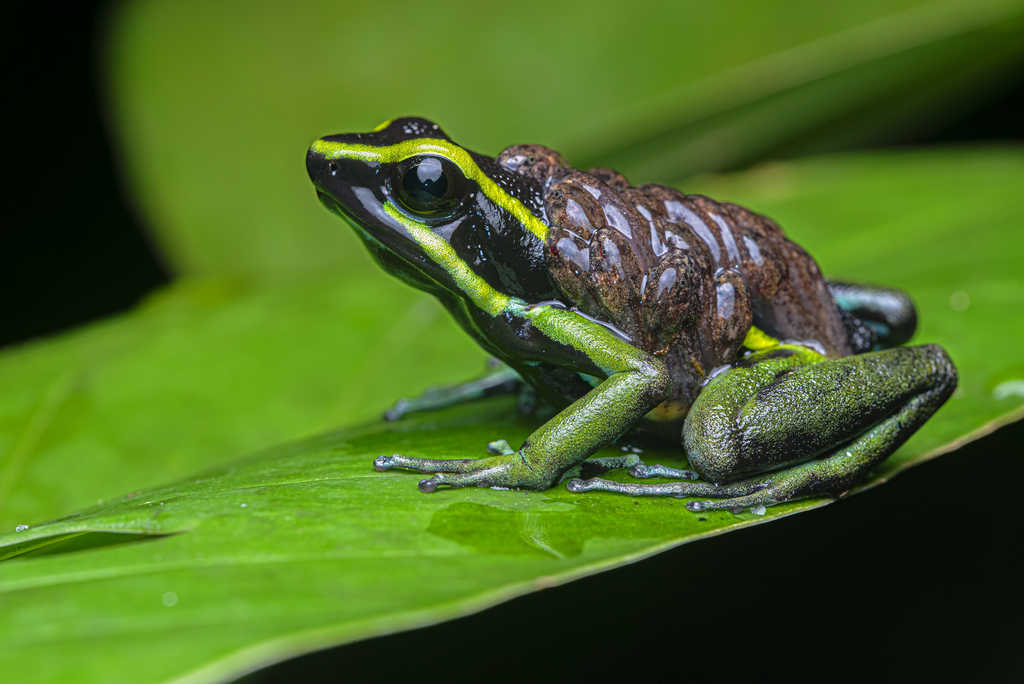
Three-striped Poison Frog
Ameerega trivittata
Ameerega trivittata, formerly Epipedobates trivittatus, is a species of frog in the family Dendrobatidae commonly known as the three-striped poison frog. It is found in Bolivia, Brazil, Colombia, Guyana, Peru, Suriname, Venezuela, possibly Ecuador, and possibly French Guiana.
Its natural habitats are subtropical or tropical moist lowland forest floors and intermittent freshwater marshes. A. trivittata is diurnal and terrestrial. Its distinctive features include its large size (up to 50 mm), granular skin, lack of webbing between digits, and distinctive striped markings. The colour of these markings varies; typically the stripes are green, but yellow and orange specimens occur, as well. It lays terrestrial eggs, which are hidden in clutches under leaves. The males take care of the eggs and carry the tadpoles on their backs to pools once they have hatched. The species is currently threatened by habitat loss.
From the article Ameerega trivittata on Wikipedia (CC BY-SA), quoted section by section
Description
The male three-striped poison frog has a snout–vent length of about 42 mm (1.65 in) and the female reaches about 55 mm (2.17 in). It has a slightly protruding snout with no teeth, finely granulated skin on its dorsal surface and smooth skin on its flanks and ventral surface. The digits are unwebbed and the first finger is longer than the second finger. The colouring of this species varies somewhat between locations but in general it has a black back and sides, a black belly suffused blue posteriorly and yellowish-green or light-brown limbs. Two yellowish-green lateral stripes run from the snout to the hind legs.
Listen
Looking for field recordings…
Where it lives
Recorded sightings
—
geo-referenced records in GBIF, from museums, herbaria and field observers.
Drag the globe to turn it. Dots are where records exist, not a range map; darker means more records.
In the stacks
Searching the stacks…
Every page naming Ameerega trivittata in the Biodiversity Heritage Library →
This page is assembled live from iNaturalist, GBIF, Wikipedia, the Source Library and the Internet Archive. It is not yet part of the hand-edited codex. iNaturalist taxon 64906.