- Animals
- ›Chordates
- ›Vertebrates
- ›Amphibians
- ›Frogs and Toads
- ›Poison Frogs
- ›Poison Dart Frogs
- ›Dendrobatinae
- ›Adelphobates
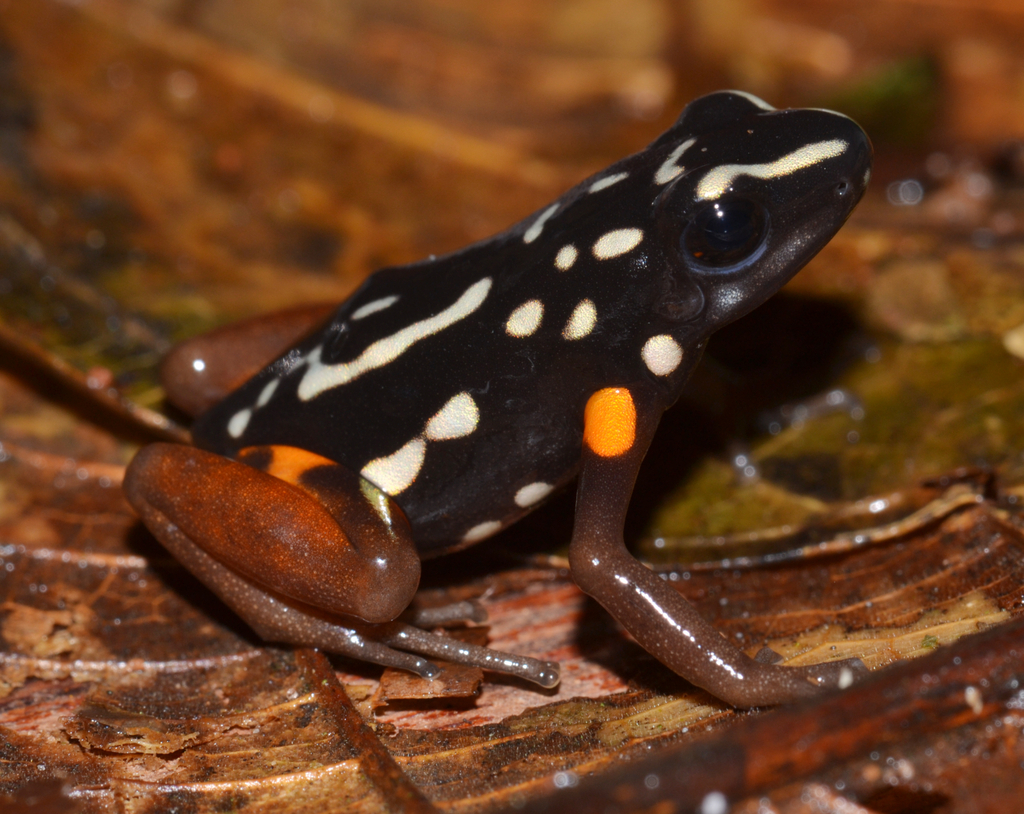
Brazil-nut Poison Frog
Adelphobates castaneoticus
The Brazil-nut poison frog (Adelphobates castaneoticus) is a species of frog in the family Dendrobatidae. It is endemic to the state of Pará in Brazil. The frog is believed to have received its common name from the fact that its tadpoles sometimes develop in the hard capsules of the Brazil nut tree, which are common in its range. The nuts fall to the forest floor where they are broken open by agoutis and other animals seeking the seeds, and empty husks fill with water.
From the article Brazil-nut poison frog on Wikipedia (CC BY-SA), quoted section by section
Description
The Brazil-nut poison frog is a very small frog with a snout-to-vent length of 18 to 23 mm (0.7 to 0.9 in); females are usually larger than males. The dorsal surface is of a shiny black colour with spots and markings of white or various shades of yellow. There is a bright yellow or orange spot where the foreleg joins the body and two more similarly coloured spots on either side of the knee joint on the hind leg, which combine to make a single large spot when the animal is stationary. A further spot on the underside of the calf is only visible from below.
Range & habitat
The Brazil-nut poison frog is endemic to the rainforest of central Brazil. It is known from several localities in the state of Pará; from Cachoeira Juruá, Xingu River, the type locality; from Taperinha some 300 km (186 mi) to the north west; and from Flona Tapajos, Santarém. These locations are some distance apart and it is likely that this frog has a more widespread distribution than is known but has passed undetected in other parts of its range. It lives among the leaf litter on the forest floor and sometimes climbs into low vegetation.
Wikipedia: “Distribution”
In human culture
Scientists named this frog "Brazil-nut poison frog" because of its tendency to bring its tadpoles to the empty husks of Brazil nut fruits. Scientists have noted the multi-species interaction necessary for this breeding act. First, the tree must produce and shed the fruit. Then a mammal, such as an agouti, must eat the edible portion of the nut while leaving the husk behind. Then the husk must fill with rainwater. Then, insects, toads, and frogs deposit their larvae within the water. This creates a complex small ecosystem where larvae of many species, most capable of eating each other, must compete to survive. Scientists note that not only size but also the timing of deposition affects which species emerges from this situation alive.
Wikipedia: “Etymology”
Listen
Looking for field recordings…
Where it lives
Recorded sightings
—
geo-referenced records in GBIF, from museums, herbaria and field observers.
Drag the globe to turn it. Dots are where records exist, not a range map; darker means more records.
In the stacks
Searching the stacks…
Every page naming Adelphobates castaneoticus in the Biodiversity Heritage Library →
This page is assembled live from iNaturalist, GBIF, Wikipedia, the Source Library and the Internet Archive. It is not yet part of the hand-edited codex. iNaturalist taxon 64830.