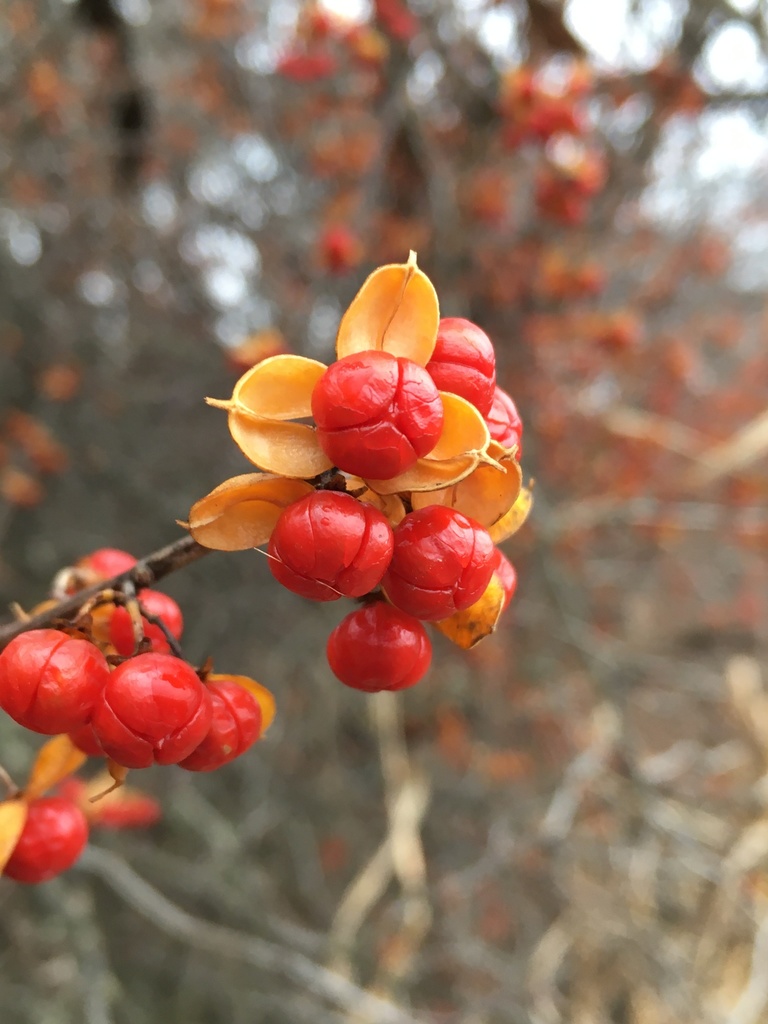
Asian bittersweet
Celastrus orbiculatus
Celastrus orbiculatus is a woody vine of the family Celastraceae. It is commonly called Oriental bittersweet, as well as Chinese bittersweet, Asian bittersweet, round-leaved bittersweet, and Asiatic bittersweet.
It is native to China, where it is the most widely distributed Celastrus species, and to Japan and Korea. It was introduced into North America in 1879, and is considered to be an invasive species in eastern North America. It closely resembles the native North American species, Celastrus scandens, with which it will readily hybridize.
From the article Celastrus orbiculatus on Wikipedia (CC BY-SA), quoted section by section
Description
The defining characteristic of the deciduous plant is its vines: they are thin, spindly, and have silver to reddish brown bark. They are generally between 1 and 4 cm (0.4 and 1.6 in) in diameter. However, if growth is not disturbed, vines can exceed 10 cm (3.9 in) and when cut, will show age rings that can exceed 20 years. When Celastrus orbiculatus grows by itself, it forms thickets; when it is near a tree the vines twist themselves around the trunk as high as 40 ft (12 m). The encircling vines have been known to strangle the host tree to death or break branches from the excess weight, which is also true of the slower-growing American species, C. scandens. The leaves are round and glossy, 2–12 cm (0.8–4.7 in) long, have toothed margins and grow in alternate patterns along the vines. Small green flowers are borne on axillary cymes. The fruit is a three-valved capsule, which dehisces to reveal bright red arils that cover the seeds. All parts of the plant are poisonous.
Range & habitat
Due to systematic disturbances to eastern forests for wood production and recreation, Oriental bittersweet has naturalized to landscapes, roadsides, and woodlands of eastern North America. In the United States, it can be found as far south as Louisiana, as far north as Maine, and as far west as the Rocky Mountains. It prefers mesic woods, where it has been known to eclipse native plants.
Wikipedia: “Range and habitat”
What it does
A determining factor regarding Oriental bittersweet's ability to outcompete native plant species is its ability to form mutualistic associations with mycorrhizal fungi, specifically arbuscular mycorrhizal fungi. Oriental bittersweet growth is highly dependent on the absorption of phosphorus. In a recent study, growth was found to be greater when arbuscular mycorrhizal fungi were present in soil with low phosphorus concentrations, compared to when the plant was placed in an environment with high soil phosphorus concentrations with no arbuscular mycorrhizal fungi were present. The results from this study show the importance of symbiotic relationships in allowing Oriental bittersweet to effectively uptake nutrients from its surroundings. Additionally, the symbiotic relationship with mycorrhizae allows this invasive species to utilize less of its energy in root biomass to absorb necessary nutrients. This may be crucial in allowing Oriental bittersweet to act as an effective invasive species as it is able to allocate more energy to its aboveground biomass instead of its belowground biomass. This is significant because the plant's invasiveness depends heavily on photosynthetic ability and reproductive capacity. The symbiotic relationship established with fungi only occurs with arbuscular mycorrhizal fungi, while no such relationship has been observed with ectomycorrhizal fungi. …
Wikipedia: “Mutualistic interactions”
At the table
Despite the modest toxicity of its fruit, some livestock browse on the leaves without effect. Its vines, which are durable and tough, are a good source of weaving material for baskets. The fibrous inner bark can be used to make strong cordage.
Wikipedia: “Uses”
In medicine
Bicelaphanol A is a neuroprotective dimeric-trinorditerpene isolated from the bark of Celastrus orbiculatus.
Wikipedia: “Phytochemicals”
How it is grown
Celastrus orbiculatus is cultivated as an ornamental plant. In the UK, it has gained the Royal Horticultural Society's Award of Garden Merit.
Wikipedia: “Cultivation”
Where it lives
Recorded sightings
—
geo-referenced records in GBIF, from museums, herbaria and field observers.
Drag the globe to turn it. Dots are where records exist, not a range map; darker means more records.
In the stacks
Searching the stacks…
Every page naming Celastrus orbiculatus in the Biodiversity Heritage Library →
This page is assembled live from iNaturalist, GBIF, Wikipedia, the Source Library and the Internet Archive. It is not yet part of the hand-edited codex. iNaturalist taxon 64540.