- Plants
- ›Vascular Plants
- ›flowering plants
- ›Dicots
- ›Legumes, Milkworts, and Allies
- ›Legumes
- ›Faboideae
- ›Trifolieae
- ›Trifolium
- ›Trifolium
- ›Trifolium
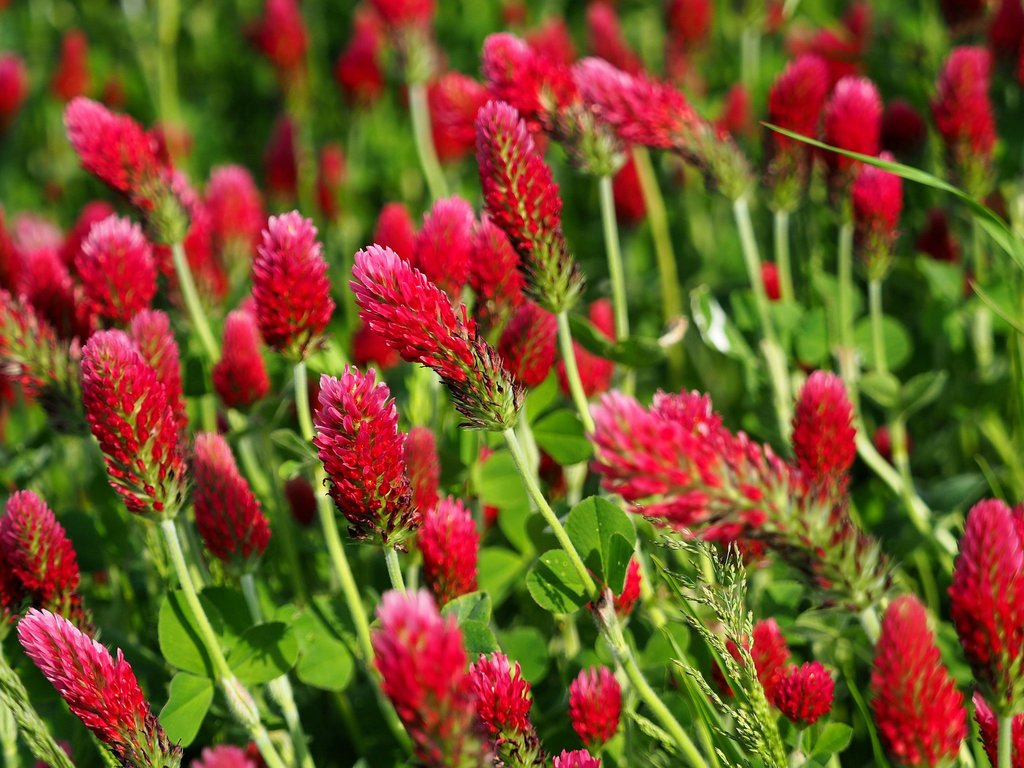
crimson clover
Trifolium incarnatum
Trifolium incarnatum, known as crimson clover or Italian clover, is a species of clover in the family Fabaceae, native to most of Europe. The species name incarnatum means "blood red".
From the article Trifolium incarnatum on Wikipedia (CC BY-SA), quoted section by section
Description
This upright annual herb grows to 20–50 centimetres (8–20 in) tall, unbranched or branched only at the base. The leaves are trifoliate with a long petiole, each leaflet hairy, 8–16 millimetres (3⁄8–5⁄8 in) across, with a truncated or bilobed apex. The flowers are produced throughout the spring and summer, creamy white to rich red or crimson, congested on an elongated spike inflorescence 3–5 cm (1+1⁄4–2 in) tall and 1.5 cm broad; the individual flowers are up to 10–13 mm long and have five petals. The banner of each flower does not sit upright, but folds forward.
Range & habitat
The species is native to most of Europe and southwest Asia. In mild winter areas, crimson clover typically behaves as a winter annual. The seeds germinate in the first rains of late summer or autumn. The plants grow through the winter, and have a major flush of flowering in late spring. In dry summer climates like the Mediterranean, the plants die after maturing seeds. In sites having sufficient summer moisture, plants can continue growth and flowering; and may even behave as short-lived perennials. The plant uses associations with Rhizobium bacteria to fix nitrogen.
Wikipedia: “Distribution and habitat”
At the table
Away from its native areas, crimson clover has been introduced to many other areas, including northwestern Africa, Australia, Chile, India, Japan, Pakistan and the United States. Crimson clover is commonly used in agriculture as a nitrogen-fixing cover crop. The plant is widely grown as a protein-rich forage crop for cattle and other livestock, and is suitable to be made into hay. It is commonly grazed by domestic and wild ruminants. It is often used for roadside erosion control, as well as beautification, however it can exclude other desirable spring and early-summer species of native vegetation in the area where it is planted. It is sown as quickly as possible after the removal of a grain crop at the rate of 20–22 kg/ha. It is found to succeed better when only the surface of the soil is stirred by the scarifier and harrow than when ploughed. It grows rapidly in spring, and yields an abundant crop of greenery. Only one cutting, however, can be obtained, as it does not shoot again after being mown. Crimson clover flowers and seedling sprouts are edible, and similar in taste and appearance to alfalfa sprouts. They can be added as an ingredient in salads, sandwiches, and other dishes, made into tisanes, and can be dried and ground into flour. …
Wikipedia: “Cultivation and uses”
Where it lives
Recorded sightings
—
geo-referenced records in GBIF, from museums, herbaria and field observers.
Drag the globe to turn it. Dots are where records exist, not a range map; darker means more records.
In the stacks
Searching the stacks…
Every page naming Trifolium incarnatum in the Biodiversity Heritage Library →
This page is assembled live from iNaturalist, GBIF, Wikipedia, the Source Library and the Internet Archive. It is not yet part of the hand-edited codex. iNaturalist taxon 64268.