- Plants
- ›Vascular Plants
- ›flowering plants
- ›Dicots
- ›Sunflowers, Bellflowers, Fanflowers, and Allies
- ›Sunflowers, Daisies, Asters, and Allies
- ›Asteroideae
- ›tarweeds, silverswords, and allies
- ›Eriophyllinae
- ›Lasthenia
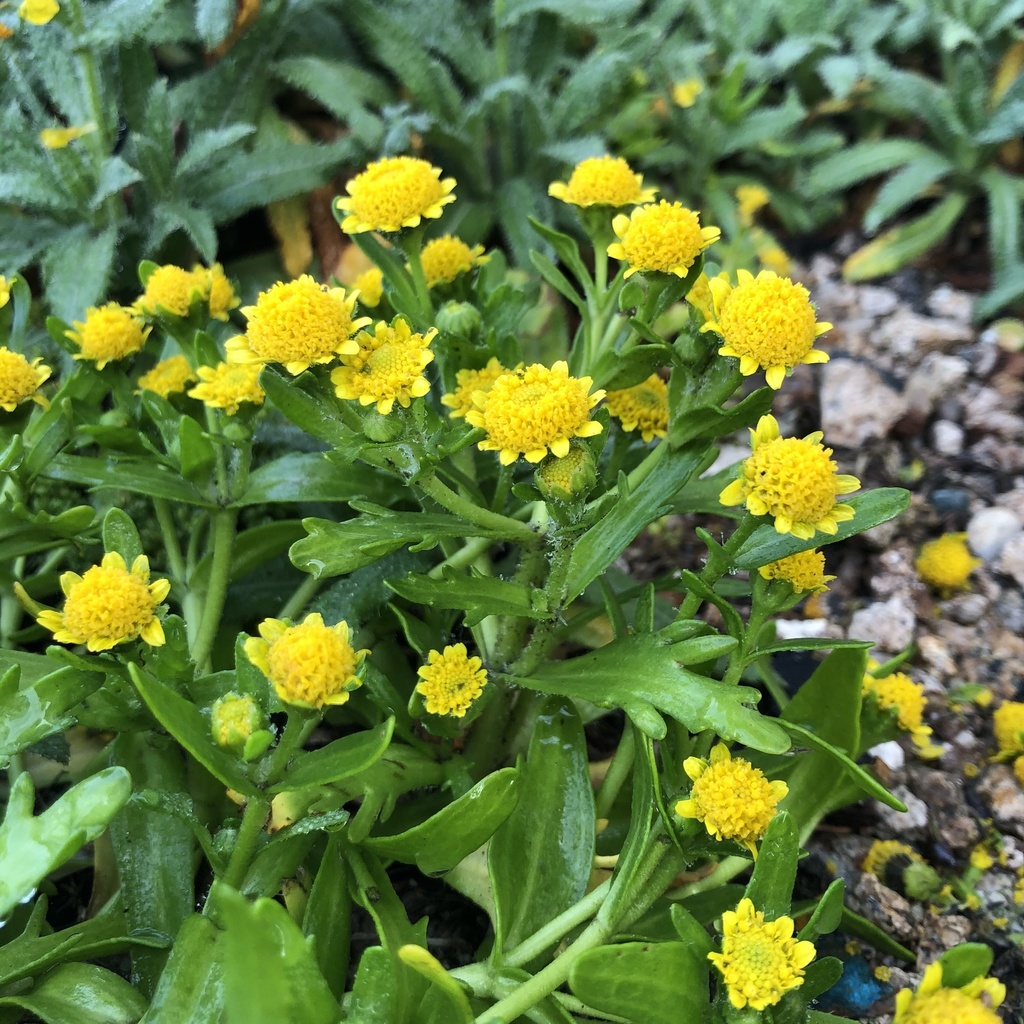
maritime goldfields
Lasthenia maritima
Lasthenia maritima is a species of flowering plant in the family Asteraceae known by the common names maritime goldfields and seaside goldfields.
From the article Lasthenia maritima on Wikipedia (CC BY-SA), quoted section by section
Description
Lasthenia maritima is an annual herb with short, decumbent to prostrate stems lined with fleshy lobed or unlobed leaves up to 9 centimeters long. The inflorescence bears flower heads lined with hairy phyllaries and ringed with 7 to 12 gold ray florets each about 3 millimeters long. The fruit is a small, hairy achene often topped with a brownish pappus.
Range & habitat
It is native to the coastline of western North America, where it is found almost exclusively on small rocky, coastal islands in the Pacific Ocean between Vancouver Island in British Columbia to the Farallon Islands off the coast of the San Francisco Bay Area in California. This species probably evolved from Lasthenia minor, and it is adapted to the unique conditions on these maritime islands: high winds, saline sea spray, and thin soils that are often disturbed by the activities of the seabirds that roost and nest on these rocks and made acidic and nitrogen-rich from their droppings. Though limited in distribution, this is one of the more common plants on the Farallon Islands of California, where it is an important part of the ecology of seabirds and where it is locally known as Farallon weed.
Wikipedia: “Distribution”
Where it lives
Recorded sightings
—
geo-referenced records in GBIF, from museums, herbaria and field observers.
Drag the globe to turn it. Dots are where records exist, not a range map; darker means more records.
In the stacks
Searching the stacks…
Every page naming Lasthenia maritima in the Biodiversity Heritage Library →
This page is assembled live from iNaturalist, GBIF, Wikipedia, the Source Library and the Internet Archive. It is not yet part of the hand-edited codex. iNaturalist taxon 64253.