- Plants
- ›Vascular Plants
- ›flowering plants
- ›Dicots
- ›beeches, oaks, walnuts, and allies
- ›beech family
- ›Quercus
- ›Quercus
- ›Quercus
- ›Dumosae
- ›Quercus dumosa
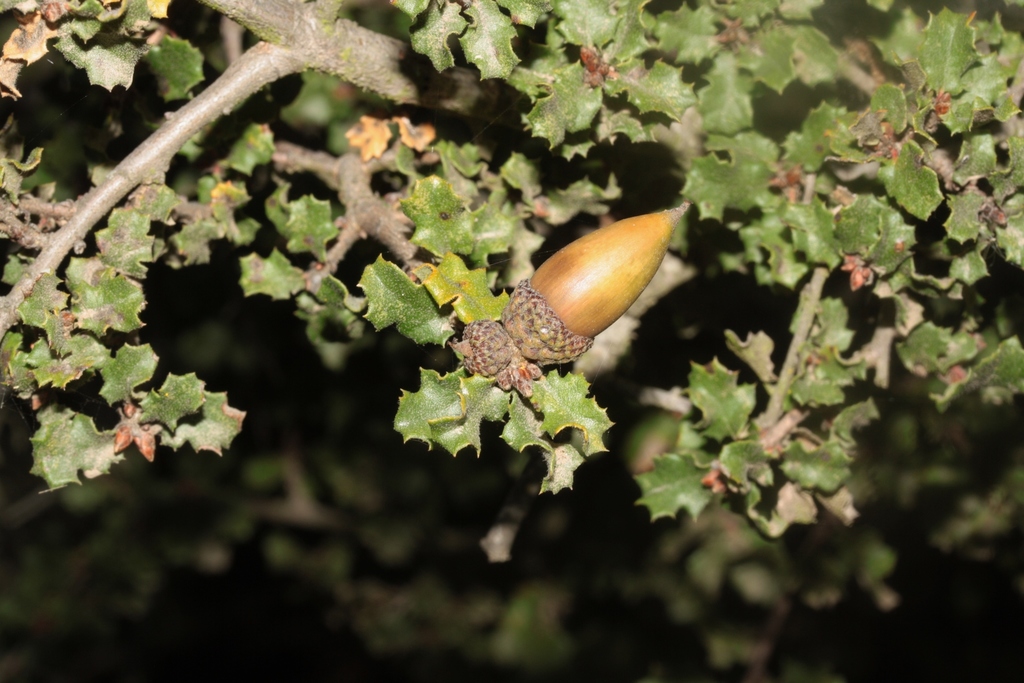
Nuttall's scrub oak
Quercus dumosa
Quercus dumosa, commonly known as Nuttall's scrub oak or coastal sage scrub oak, is a species of scrub oak belonging to the white oak group (subgenus Quercus, section Quercus). It is a shrub typically reaching heights of 1–3 m (3.3–9.8 ft), characterized by a scraggly and rounded appearance, with dense tangled reddish branches, small dark green leaves with distinct teeth, curly trichomes on the lower leaf surfaces, and narrow acute acorns.
Native to the United States and Mexico, it is a rare species found in chaparral and coastal sage scrub on sandy soils often within sight of the ocean, and is found in disjunct populations ranging from Santa Barbara County, California south to the vicinity of Punta Colonet, Baja California. It is perhaps one of the rarest and most threatened species of oak in California, as the human development of coastal southern California has left very little habitat intact.
From the article Quercus dumosa on Wikipedia (CC BY-SA), quoted section by section
Description
Quercus dumosa is an evergreen shrub typically growing 1–3 m (3.3–9.8 ft) tall, with some plants up to 5 m (16 ft) tall observed in the canyons of San Diego County, and others occasionally taking the form of low, matted clumps. It has a rounded and scraggly appearance, with tangled, slender reddish or grayish twigs and branches. The branches are often sharply angled. The bark is smooth when young, but eventually becomes scaly. The dark-green leaves are brittle and leathery, and fall off when disturbed. The leaves have a short petiole 1–2 mm (0.039–0.079 in) long. The leaf blade is usually 10–20 mm (0.39–0.79 in) long and has an undulate or cupped appearance, with a cordate base. The leaf margins may be abruptly pointed with spines or teeth or shallowly lobed, and rarely entire (smooth). One of the most distinctive characters of Quercus dumosa are the trichomes (hairs) most prominent on its lower leaf surfaces. It has erect, twisted (curly), multi-rayed trichomes up to 0.5 mm (0.020 in) long, a feature unlike any other scrub oaks. The trichomes at least require a dissecting scope or 10 power hand lens to clearly discern, but compared to other scrub oaks these trichomes are clearly visible to the naked eye.
The male flowers are minute catkins that bloom from February through April. The fruit is a narrow acute acorn up to 1.5 centimetres (5⁄8 in) wide. …
Range & habitat
Quercus dumosa is native to the U.S. state of California and the Mexican state of Baja California. It is found near the coast from southern Santa Barbara County and disjunctly to the south through Orange County and San Diego County into northwestern Baja California. In Santa Barbara County, it is found in Mission Canyon on the south slope of the Santa Ynez Mountains and above Carpinteria. In Orange County, it is found on the coast in the San Joaquin Hills and the Dana Point headlands. In San Diego County it is found from the central coast to around 10 km (6.2 mi) inland, south to the Mexico–United States border. It extends from there into northwestern Baja California, south along the coastal hills to the Punta Banda, into the vicinity of San Vicente, and reaches its southern limit near the Colonet peninsula. It is found from sea level to about 300 m (980 ft) in elevation.
Wikipedia: “Distribution”
What it does
Quercus dumosa grows primarily in sandy soils such as sandstone near the coast. Its habitat is often chaparral. This oak sprouts vigorously from its stump and root crown after wildfire and develops a large canopy within a few years after a fire event. It sometimes co-dominates with Ceanothus species as early as four years after a fire. This oak also does well in the absence of fire.
Wikipedia: “Ecology”
In human culture
Quercus dumosa was originally described in 1842 by Thomas Nuttall from a type specimen collected in the "hills near Santa Barbara". For about 140 years after Nuttall's description, the concept of Quercus dumosa broadened to encompass nearly all of the scrub oaks in the white oak group of California and Baja California. Traditional taxonomies heavily relied on the leaf form as the distinguishing feature. As most of the California scrub white oak species have a similar leaf form, this resulted in a very broad concept of Q. dumosa (Q. dumosa sensu lato) that neglected other characters like acorn morphology and leaf vestiture. The species concept of Q. dumosa has narrowed as taxonomic developments changed focus to patterns of variation in the trichomes, acorns, and habitats of white scrub oaks. These developments followed with a number of species being segregated out from Q. dumosa sensu lato:
Quercus cornelius-mulleri was the first species to be segregated out. It has minute overlapping trichomes and is found along the desert edges of mountains in southern California and Baja California. Quercus berberidifolia is the most widespread member to be recognized from Q. dumosa sensu lato. It has minute flat stellate trichomes with 7 to 8 rays, a relatively flat and waxy leaf, and usually barrel-shaped, rounded or blunt acorns. …
Wikipedia: “Taxonomic history”
Where it lives
Recorded sightings
—
geo-referenced records in GBIF, from museums, herbaria and field observers.
Drag the globe to turn it. Dots are where records exist, not a range map; darker means more records.
In the stacks
Searching the stacks…
Every page naming Quercus dumosa in the Biodiversity Heritage Library →
This page is assembled live from iNaturalist, GBIF, Wikipedia, the Source Library and the Internet Archive. It is not yet part of the hand-edited codex. iNaturalist taxon 64137.