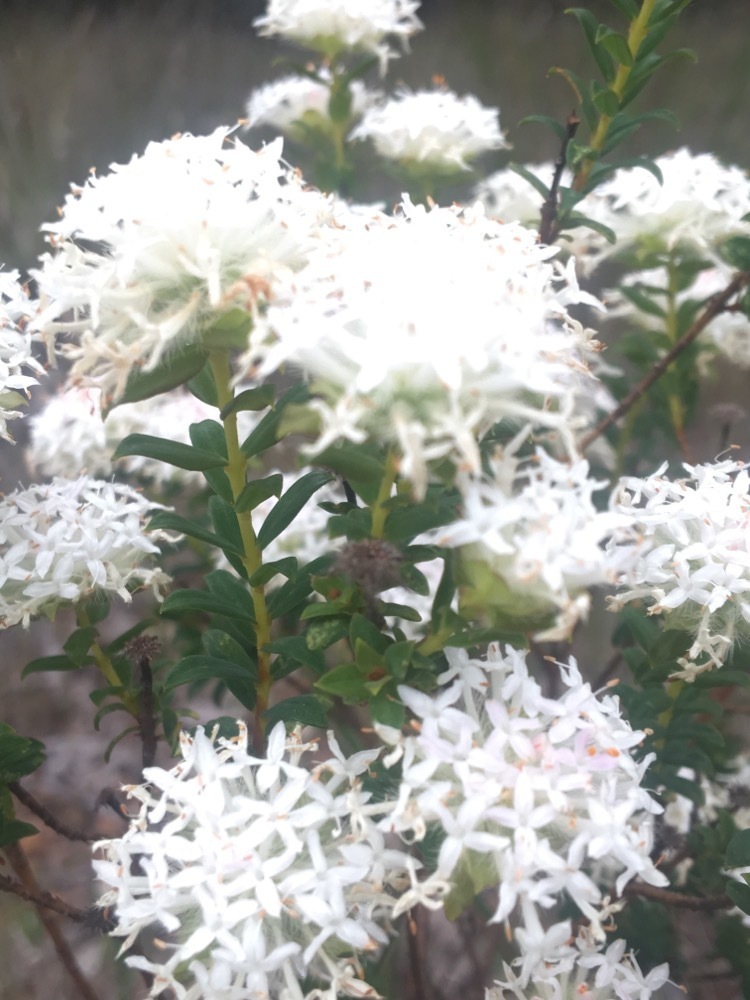
Pimelea ciliata
Pimelea ciliata, commonly known as white banjine, is a species of flowering plant in the family Thymelaeaceae. It is a small shrub with white flowers and is endemic to Western Australia.
From the article Pimelea ciliata on Wikipedia (CC BY-SA), quoted section by section
Description
Pimelea ciliata is a small shrub usually 0.5–1 m (1 ft 8 in – 3 ft 3 in) high with almost linear or egg-shaped to narrowly obovate leaves, 5–22 mm (0.20–0.87 in) long, 1.5–7 mm (0.059–0.276 in) wide, margins sometimes rolled under or upward on a short petiole about 1 mm (0.039 in) long, ending with a pointed apex. The leaves are arranged in alternating pairs at right angles to the ones above and below so that the leaves are in 4 rows along the stems (decussate), upper surface is darker than the underside. The stems at the apex are orange-red to brownish becoming grey as they age. The erect inflorescence consists of several light pink or white bisexual flowers, smooth inside, pedicel 1–2 mm (0.039–0.079 in) long, four to six egg-shaped bracts, 8–13 mm (0.31–0.51 in) long, 5–10 mm (0.20–0.39 in) wide with small hairs on the edges. The flower stamens are marginally or greater in length than the sepals. Flowering occurs from August to December.
Range & habitat
White banjine grows in the south-west corner of Western Australia near Bindoon to near Margaret River and south-east to the Porongurup Range mostly on hills and breakaways in clay, sand, loam, granitic and lateritic soil.
== References ==
Wikipedia: “Distribution and habitat”
Where it lives
Recorded sightings
—
geo-referenced records in GBIF, from museums, herbaria and field observers.
Drag the globe to turn it. Dots are where records exist, not a range map; darker means more records.
In the stacks
Searching the stacks…
Every page naming Pimelea ciliata in the Biodiversity Heritage Library →
This page is assembled live from iNaturalist, GBIF, Wikipedia, the Source Library and the Internet Archive. It is not yet part of the hand-edited codex. iNaturalist taxon 637560.