- Plants
- ›Vascular Plants
- ›flowering plants
- ›Dicots
- ›Mints, Plantains, Olives, and Allies
- ›figwort family
- ›Myoporeae
- ›Myoporum
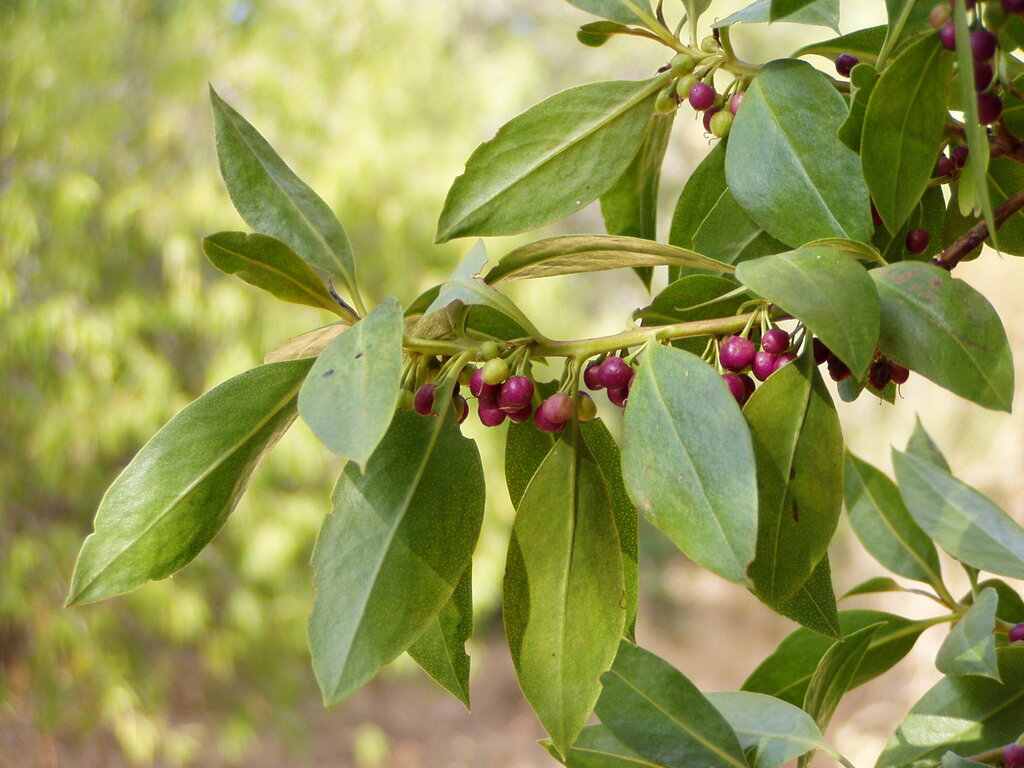
Ngaio
Myoporum laetum
Myoporum laetum, commonly known as ngaio ( NY-oh, Māori: [ˈŋaio]) or mousehole tree, is a species of flowering plant in the family Scrophulariaceae and is endemic to New Zealand. It is a fast growing shrub or small tree with lance-shaped leaves, the edges with small serrations, and white flowers with small purple spots and 4 stamens.
From the article Myoporum laetum on Wikipedia (CC BY-SA), quoted section by section
Description
Ngaio is a fast-growing evergreen shrub or small tree that sometimes grows to a height of 10 metres (30 ft) with a trunk up to 0.3 metres (1 ft) in diameter, or spreads to as much as 4 metres (10 ft). It often appears dome-shaped at first but as it gets older, distorts as branches break off. The bark on older specimens is thick, corky and furrowed. The leaves are lance-shaped, usually 52–125 millimetres (2–5 in) long, 15–30 millimetres (0.6–1 in) wide, have many translucent dots in the leaves and edges that have small serrations in approximately the outer half. The flowers are white with purple spots and are borne in groups of 2 to 6 on stalks 7–15 millimetres (0.3–0.6 in) long. There are 5 egg-shaped, pointed sepals and 5 petals joined at their bases to form a bell-shaped tube 3.5–4.5 millimetres (0.1–0.2 in) long. The petal lobes are 4.5–5.5 millimetres (0.18–0.22 in) long making the flower diameter 15–20 millimetres (0.6–0.8 in). There are four stamens that extend slightly beyond the petal tube and the ovary is superior with 2 locules. Flowering occurs from mid-spring to mid-summer and is followed by the fruit which is a bright red drupe 6–9 millimetres (0.2–0.4 in) long.
Range & habitat
Ngaio grows very well in coastal areas of New Zealand including on the Chatham Islands. It grows in lowland forest, sometimes in pure stands, others in association with other species such as nīkau (Rhopalostylis sapida).
Wikipedia: “Distribution and habitat”
What it does
Myoporum laetum has been introduced to several other countries including Portugal, South Africa and Namibia. It is considered an invasive exotic species by the California Exotic Pest Plant Council.
Wikipedia: “Ecology”
At the table
Early European settlers to New Zealand used ngaio oil as a sheep dip, to protect sheep from parasites.
Wikipedia: “Early European uses”
Toxicity
The leaves of this tree contain the liver toxin ngaione, which can cause sickness and or death in stock such as horses, cattle, sheep and pigs.
How it is grown
Ngaio is a hardy plant that will grow in most soils but needs full sun. It can also tolerate exposure to salt spray. It can be grown from seed or from semi-hard cuttings.
Wikipedia: “Horticulture”
Where it lives
Recorded sightings
—
geo-referenced records in GBIF, from museums, herbaria and field observers.
Drag the globe to turn it. Dots are where records exist, not a range map; darker means more records.
In the stacks
Searching the stacks…
Every page naming Myoporum laetum in the Biodiversity Heritage Library →
This page is assembled live from iNaturalist, GBIF, Wikipedia, the Source Library and the Internet Archive. It is not yet part of the hand-edited codex. iNaturalist taxon 63611.