- Plants
- ›Vascular Plants
- ›flowering plants
- ›Dicots
- ›Legumes, Milkworts, and Allies
- ›Legumes
- ›Faboideae
- ›Dalbergieae
- ›Arachis
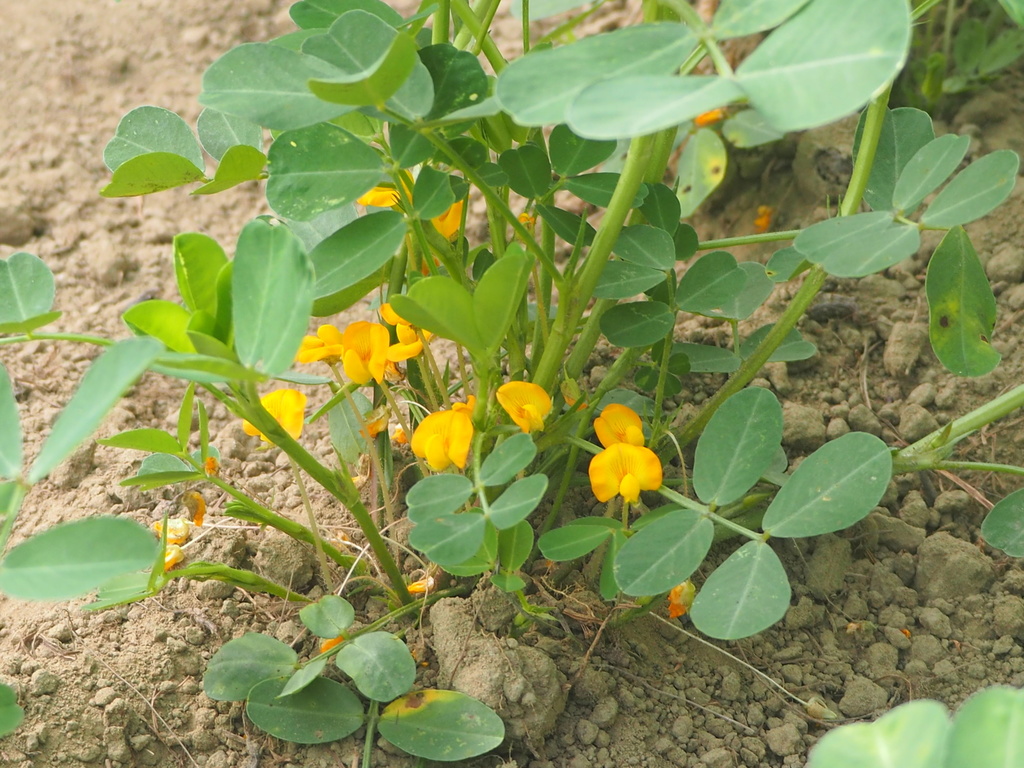
Peanut
Arachis hypogaea
The peanut (Arachis hypogaea), also known as the groundnut, goober (US, via Kikongo), goober pea, pindar (US, via Kikongo) or monkey nut (UK), is a legume crop grown mainly for its edible seeds, contained in underground pods. It is widely grown in the tropics and subtropics by small and large commercial producers, both as a grain legume and as an oil crop. Underground fruiting (geocarpy) is atypical among legumes, which led botanist Carl Linnaeus to name the species hypogaea, from Greek 'under the earth'.
The peanut belongs to the flowering plant family Fabaceae (or Leguminosae), commonly known as the pea family, and is native to South America. Like most other legumes, peanuts harbor symbiotic nitrogen-fixing bacteria in root nodules, which improve soil fertility, making them valuable in crop rotations.
From the article Peanut on Wikipedia (CC BY-SA), quoted section by section
At the table
Raw Valencia peanuts are 4% water, 48% fat, 25% protein, and 21% carbohydrates (table). In a reference amount of 100 grams (3.5 oz), peanuts provide 2,385 kilojoules (570 kilocalories) of food energy, supply 9 g (0.32 oz) of dietary fiber, and are a rich source (defined as more than 20% of the Daily Value, DV) of several B vitamins, vitamin E, and various dietary minerals, such as manganese, magnesium, and phosphorus. The fats are mainly polyunsaturated and monounsaturated (83% of total fats when combined; table source). Some studies show that regular consumption of peanuts is associated with a lower specific risk of mortality from certain diseases. However, the study designs do not allow cause and effect to be inferred. According to the US Food and Drug Administration, "Scientific evidence suggests but does not prove that eating 1.5 ounces per day of most nuts (such as peanuts) as part of a diet low in saturated fat and cholesterol may reduce the risk of heart disease."
Wikipedia: “Nutrition”
In human culture
The Arachis genus is native to South America, east of the Andes, around Peru, Bolivia, Argentina, and Brazil. Cultivated peanuts (A. hypogaea) arose from a hybrid between two wild species of peanut, thought to be A. duranensis and A. ipaensis. The initial hybrid would have been sterile, but spontaneous chromosome doubling restored its fertility, forming what is termed an amphidiploid or allotetraploid. Genetic analysis suggests the hybridization may have occurred only once and gave rise to A. monticola, a wild form of peanut that occurs in a few limited locations in northwestern Argentina, or in southeastern Bolivia, where the peanut landraces with the most wild-like features are grown today, and by artificial selection to A. hypogaea. The process of domestication through artificial selection made A. hypogaea dramatically different from its wild relatives. The domesticated plants are bushier, more compact, and have a different pod structure and larger seeds. From this center of origin, cultivation spread and formed secondary and tertiary centers of diversity in Peru, Ecuador, Brazil, Paraguay, and Uruguay. Over time, thousands of peanut landraces evolved; these are classified into six botanical varieties and two subspecies (as listed in the peanut scientific classification table). Subspecies A. h. …
Wikipedia: “History”
Where it lives
Recorded sightings
—
geo-referenced records in GBIF, from museums, herbaria and field observers.
Drag the globe to turn it. Dots are where records exist, not a range map; darker means more records.
In the old herbals & bestiaries


In the stacks
Searching the stacks…
Every page naming Arachis hypogaea in the Biodiversity Heritage Library →
This page is assembled live from iNaturalist, GBIF, Wikipedia, the Source Library and the Internet Archive. It is not yet part of the hand-edited codex. iNaturalist taxon 63205.