- Plants
- ›Vascular Plants
- ›flowering plants
- ›Dicots
- ›honeysuckles, moschatels, and allies
- ›elder family
- ›Viburnum
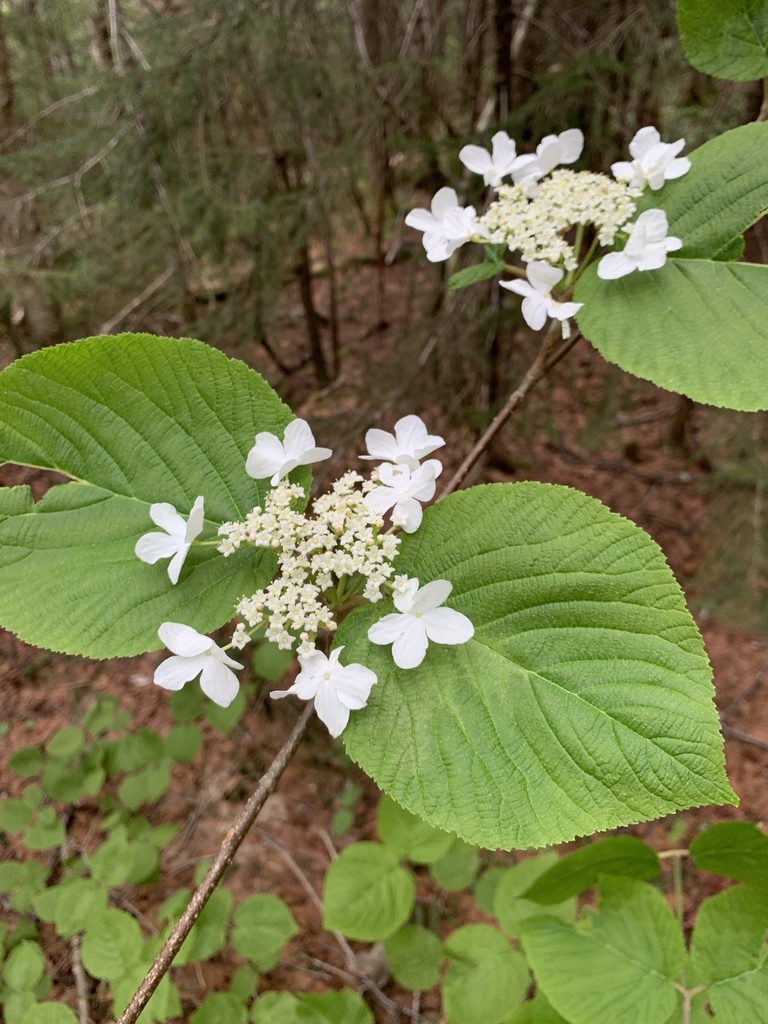
hobblebush
Viburnum lantanoides
Viburnum lantanoides (commonly known as hobble-bush, witch-hobble, alder-leaved viburnum, American wayfaring tree, and moosewood) is a perennial shrub of the family Viburnaceae (formerly in the Caprifoliaceae), growing 2–4 meters (6.6–13.1 ft) high with pendulous branches that take root where they touch the ground. These rooted branches form obstacles which easily trip (or hobble) walkers – hence the common name.
The shrub forms large clusters of white to pink flowers in May–June. The flowers on the outer edge of the clusters are much larger (3–5 cm across). The whole cluster is typically 10 cm across. It has large, cardioid leaves which are serrate, 10–20 cm long. The bark is gray-brown and warty and the fruit is a red drupe, which turns to black when ripe.
From the article Viburnum lantanoides on Wikipedia (CC BY-SA), quoted section by section
Range & habitat
Viburnum lantanoides is found in the eastern U.S. and Canada from Georgia to the Canadian Maritimes. It grows in rich, moist acidic woods, stream banks, and swamps.
Wikipedia: “Distribution and habitat”
Where it lives
Recorded sightings
—
geo-referenced records in GBIF, from museums, herbaria and field observers.
Drag the globe to turn it. Dots are where records exist, not a range map; darker means more records.
In the stacks
Searching the stacks…
Every page naming Viburnum lantanoides in the Biodiversity Heritage Library →
This page is assembled live from iNaturalist, GBIF, Wikipedia, the Source Library and the Internet Archive. It is not yet part of the hand-edited codex. iNaturalist taxon 63166.