- Plants
- ›Vascular Plants
- ›flowering plants
- ›Dicots
- ›Legumes, Milkworts, and Allies
- ›Legumes
- ›Peacock Flower Subfamily
- ›Delonix
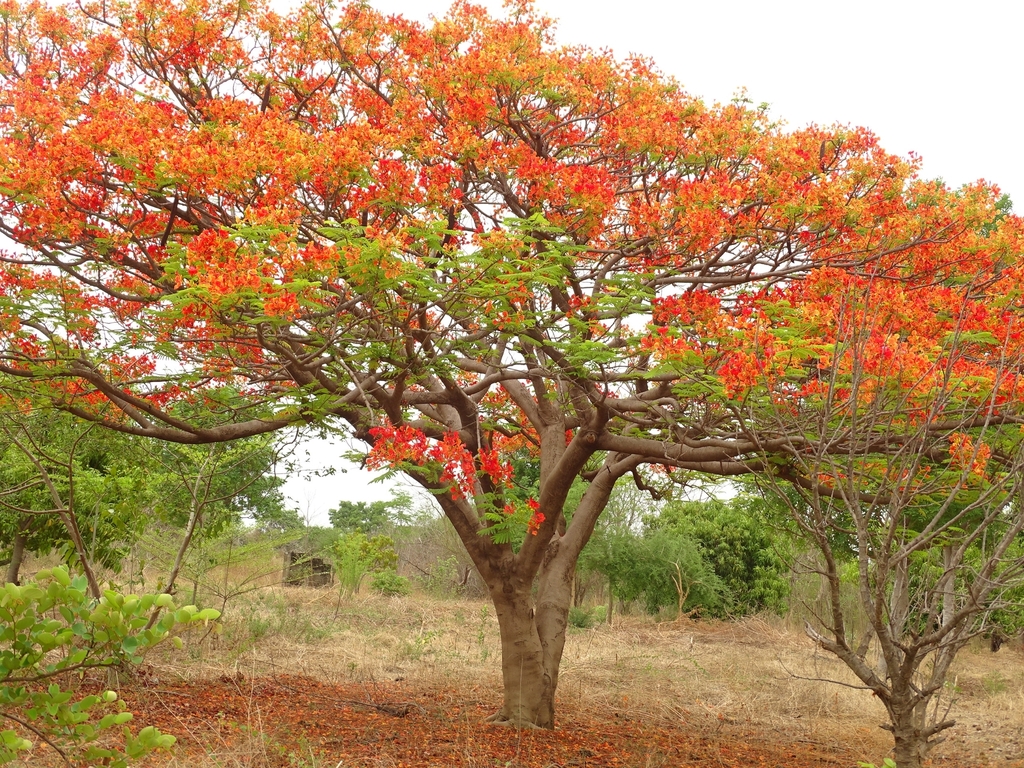
Flamboyant
Delonix regia
Delonix regia is a species of flowering plant in the bean family Fabaceae, subfamily Caesalpinioideae native to Madagascar. It is noted for its fern-like leaves and flamboyant display of orange-red flowers over summer. In many tropical parts of the world it is grown as an ornamental tree. It is a non-nodulating legume.
Although its country of origin was unknown, it had been in widespread cultivation for centuries. Finally, in 1932, a natural colony was discovered on the west coast of Madagascar by J. Leandri.
From the article Delonix regia on Wikipedia (CC BY-SA), quoted section by section
Description
Delonix regia is a medium-sized deciduous tree that grows to about 10 m (33 ft). The bark is light brown. Often creased at branches, it has prominent lenticels. The foliage of one branch is made of 8–25 or more pairs of pinnae, each pinna is lined with 30–60 or more opposite leaflets. One leaflet is oblong with a length of 4–12 millimetres, it is dark green with a dull upper surface and a paler, greyish bottom. The flowers are large, with four spreading scarlet or orange-red petals forming a diameter up to 8–11 cm (3–4 in) long, and a fifth upright petal called the standard, which is slightly larger and spotted with yellow and white. They appear in corymbs along and at the ends of branches. The naturally occurring variety flavida (Bengali: Radhachura) has yellow flowers. The pods are green and flaccid when young, then turn dark-brown and woody as they mature. They can be up to 60 cm (24 in) long and 5 cm (2 in) wide. The seeds are small, weighing around 0.4 grams (6.2 grains) on average. The compound (doubly pinnate) leaves have a feathery appearance and are a characteristic light, bright green. Each leaf is 30–50 cm (12–20 in) long with 20 to 40 pairs of primary leaflets or pinnae, each divided into 10–20 pairs of secondary leaflets or pinnules. …
Range & habitat
Delonix regia is endemic to Madagascar's dry deciduous forests, but has been introduced into tropical and sub-tropical regions worldwide. In the wild it is endangered, but it is widely cultivated elsewhere and is regarded as naturalised in many of the locations where it is grown.
Africa. Trees are planted along streets and villages within Madagascar as an ornamental. Outside Madagascar, it is present in the Horn of Africa, including Somalia, as well as in several Southern African countries such as South Africa, Zimbabwe, Malawi, Zambia and Namibia.
North America. In the continental United States, it grows in South Florida, Central Florida, in the Rio Grande Valley of South Texas and can be found planted as far north as Houston. Hawaii is another location where the species is grown. It also grows in humid parts of Mexico, especially in the southeast states like Campeche, Chiapas, Oaxaca, Tabasco, Veracruz, and Yucatán.
Caribbean and Central America. In the Caribbean it is featured in many Dominican and Puerto Rican paintings. It can also be found in Belize, The Bahamas, Costa Rica, Cuba, Haiti, Honduras, Nicaragua, the U.S. Virgin Islands, Sint Maarten, Trinidad and Tobago, the Cayman Islands, Grenada, Jamaica, Curaçao, Dominica, Saint Vincent and the Grenadines and Saint Lucia. It is the national flower of St. Kitts and Nevis. It can also be found in Bermuda. …
Wikipedia: “Distribution”
At the table
In addition to its ornamental value, it is a useful shade tree in tropical conditions, because it usually grows to a modest height (mostly 5 m or 15 ft, but it can reach a maximum height of 12 m or 40 ft) but spreads widely, and its dense foliage provides full shade. In areas with a marked dry season, it sheds its leaves during the drought, but in other areas it is virtually evergreen.
Wikipedia: “Uses”
In human culture
Delonix regia, natively called the gulmohar (Hindi: गुलमोहर, romanized: gulamōhara, lit. 'the seal of the flower') is the state tree of Delhi. In the Indian state of Kerala, royal poinciana is called kaalvarippoo (കാൽവരിപ്പൂവ്, kālvarippūv) which means "the flower of Calvary". There is a popular belief among Saint Thomas Christians of Kerala that when Jesus was crucified, there was a small royal poinciana tree nearby his Cross. It is believed that the blood of Jesus Christ was shed over the flowers of the tree and this is how the flowers of royal poinciana got a sharp red color. It is also known as Vaaga in many areas of Kerala. Its blossom is the national flower of St. Kitts and Nevis, and in May 2018 the royal poinciana was adopted by the city of Key West as its official tree. Known locally as semarak api, Delonix regia is the city flower of Sepang, Selangor, Malaysia. In Vietnam, this is a popular urban tree and is called Phượng vỹ, or "phoenix's tail". Its flowering season is May–July, which coincides with the end of the school year in Vietnam. Because of this timing, the flower of poinciana is sometimes called the "pupil's flower". The tree is also commonly found on school grounds in Vietnam; however, after several incidents where a tree fell onto students, with one student killed, schools started cutting down or severely pruning the trees. …
Wikipedia: “Cultural significance”
Where it lives
Recorded sightings
—
geo-referenced records in GBIF, from museums, herbaria and field observers.
Drag the globe to turn it. Dots are where records exist, not a range map; darker means more records.
In the old herbals & bestiaries

In the stacks
Searching the stacks…
Every page naming Delonix regia in the Biodiversity Heritage Library →
This page is assembled live from iNaturalist, GBIF, Wikipedia, the Source Library and the Internet Archive. It is not yet part of the hand-edited codex. iNaturalist taxon 62839.