- Plants
- ›Vascular Plants
- ›flowering plants
- ›Dicots
- ›pinks, cactuses, and allies
- ›Amaranth family
- ›saltbush subfamily
- ›Chenopodieae
- ›Rhagodia
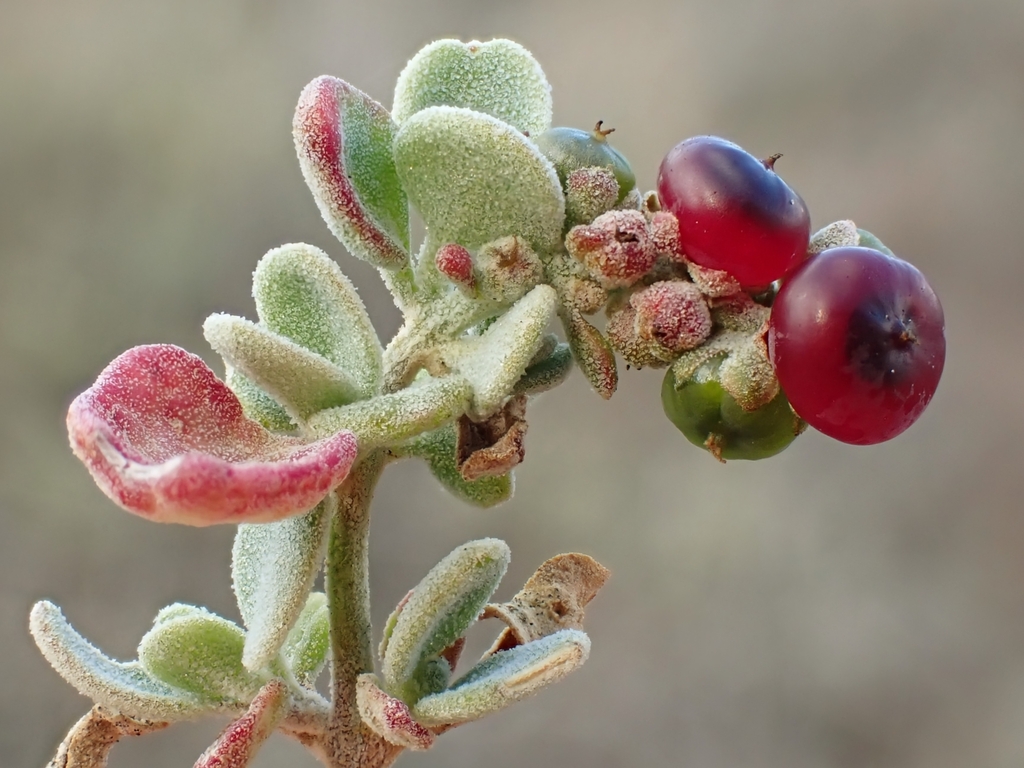
Hedge Salt-bush
Rhagodia spinescens
Chenopodium spinescens (common names: spiny saltbush, berry saltbush, thorny saltbush, creeping saltbush, hedge saltbush) is a species of plant in the family Amaranthaceae and is endemic to all mainland states and territories of Australia where it is known as Rhagodia spinescens.
From the article Chenopodium spinescens on Wikipedia (CC BY-SA), quoted section by section
Description
Chenopodium spinescens is a multi-stemmed dense shrub to 2 metres (7 ft) high, with branches often ending in spines. The leaves are alternate or opposite, and mealy, looking grey green to almost whitish from their covering of saucer-shaped/spherical hairs. The leaf shape is ovate to triangular, and are 5–17 millimetres (0.2–0.7 in) long and 5–17 millimetres (0.2–0.7 in) wide. The leaf petiole is about half the length of the lamina. Male and female flowers are usually on different plants. The flowers have five perianth segments that are tiny and all alike, and five stamens. The ripe fruit are red and succulent. The inflorescence is a panicle or spike, with the flowers' perianth being densely mealy on the outside. The male flowers are globular and 0.5–1 mm in diameter, with their filaments united into a smooth saucer-shaped disc. The female flowers are larger (about 1 mm) and globular to top-shaped. The fruit is a depressed globular pink or red succulent berry, and the seed is approximately 1 millimetre (0.04 in) in diameter with a reticulate coat. In the Northern Territory, it flowers and fruits from February to December, while in Victoria, it flowers from January to April.
Differences from closely related species. The Northern Territory Government website accepts the names R. spinescens (for C. spinescens), R. parabolica (for C. parabolicum) and R. eremaea (for C. …
Range & habitat
In the Northern Territory, it occurs on sandplains, alluvial plains, intermittent sandy watercourses, on sandy edges of salt lakes, and rarely on gravelly hillslopes. In Victoria, it is usually found on heavy, saline or subsaline soils at the edges of lakes, on flats, and in dune swales.
Wikipedia: “Habitat”
How it is grown
The advice for propagation is to take soft, current season growth tips from actively growing plants; store and transport wrapped in wet newspaper and sealed in a plastic bag, and plant after trimming cuttings to a length of 5–10 centimetres (2.0–3.9 in) and dipping in 3000 ppm IBA rooting hormone.
Wikipedia: “Propagation”
Where it lives
Recorded sightings
—
geo-referenced records in GBIF, from museums, herbaria and field observers.
Drag the globe to turn it. Dots are where records exist, not a range map; darker means more records.
In the stacks
Searching the stacks…
Every page naming Rhagodia spinescens in the Biodiversity Heritage Library →
This page is assembled live from iNaturalist, GBIF, Wikipedia, the Source Library and the Internet Archive. It is not yet part of the hand-edited codex. iNaturalist taxon 627162.