- Plants
- ›Vascular Plants
- ›flowering plants
- ›Dicots
- ›Sunflowers, Bellflowers, Fanflowers, and Allies
- ›Sunflowers, Daisies, Asters, and Allies
- ›Asteroideae
- ›groundsels and allies
- ›Senecioninae
- ›Jacobaea
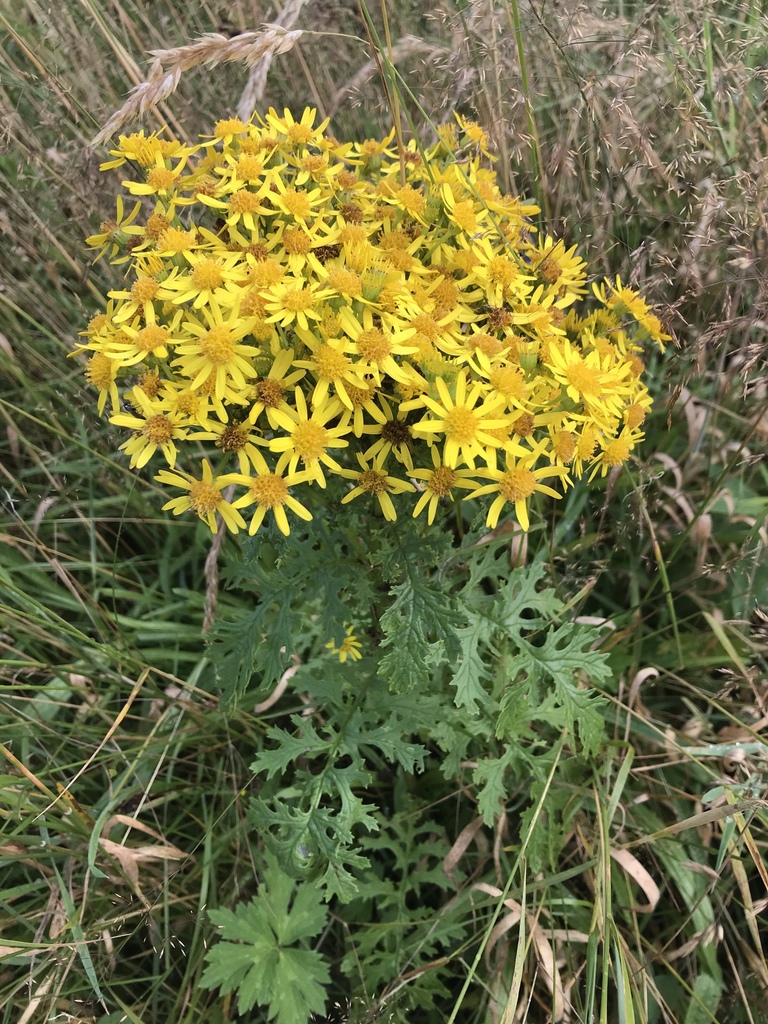
ragwort
Jacobaea vulgaris
Jacobaea vulgaris, synonym Senecio jacobaea, is a very common wild flower in the family Asteraceae that is native to northern Eurasia, usually in dry, open places, and has also been widely distributed as a weed elsewhere.
Common names include ragwort, common ragwort, stinking willie, tansy ragwort, benweed, cushag, St. James-wort, stinking nanny/ninny/willy, staggerwort, dog standard, cankerwort, stammerwort. In the western United States it is generally known as tansy ragwort, or tansy, though its resemblance to the true tansy is superficial.
From the article Jacobaea vulgaris on Wikipedia (CC BY-SA), quoted section by section
Description
The plant is generally considered to be biennial but it has the tendency to exhibit perennial properties under certain cultural conditions (such as when subjected to repeated grazing or mowing). The stems are erect, straight, have no or few hairs, and reach a height of 0.3–2.0 metres (1 ft 0 in – 6 ft 7 in). The leaves are pinnately lobed and the end lobe is blunt. The many names that include the word "stinking" (and Mare's Fart) arise because of the unpleasant smell of the leaves. The hermaphrodite flower heads are 1.5–2.5 centimetres (0.6–1.0 in) diameter, and are borne in dense, flat-topped clusters; the florets are bright yellow. It has a long flowering period lasting from June to November (in the Northern Hemisphere). Pollination is by a wide range of bees, flies and moths and butterflies. Over a season, one plant may produce 2,000 to 2,500 yellow flowers in 20- to 60-headed, flat-topped corymbs. The achenes have dandelion-like groups of prickly hairs called pappuses, which help seed dispersal by the wind. The number of seeds produced may be as large as 75,000 to 120,000, although in its native range in Eurasia very few of these would grow into new plants and research has shown that most seeds do not travel a great distance from the parent plant.
Range & habitat
Ragwort is native to the Eurasian continent. In Europe it is widely spread, from Scandinavia to the Mediterranean. In Great Britain and Ireland, where it is native, it is listed as an injurious weed under the weeds act and Ragwort Control Act. Ragwort is common in disturbed soil such as in waste land, waysides and grazing pastures. Its natural habitat is sand dunes, but it is commonly found along road sides, railways and in light, low fertility soil. It has been introduced in many other regions, and is listed as a weed in many. These include:
North America: The United States, present mainly in the northwest and northeast: California, Idaho, Illinois, Maine, Massachusetts, Michigan, Montana, New Jersey, New York, Oregon, Pennsylvania, and Washington; South America: Argentina; Africa: North Africa; Asia: India and Siberia; Australasia: a widespread weed in New Zealand and Australia.
Wikipedia: “Distribution”
Toxicity
Ragwort contains many different alkaloids, making it poisonous to many animals. (EHC 80, section 9.1.4). Alkaloids which have been found in the plant confirmed by the WHO report EHC 80 are jacobine, jaconine, jacozine, otosenine, retrorsine, seneciphylline, senecionine, and senkirkine (p. 322 Appendix II). There is a strong variation between plants from the same location in distribution between the possible alkaloids and even the absolute amount of alkaloids varies drastically. Ragwort is of particular concern to people who keep horses and cattle. In areas of the world where ragwort is a native plant, such as Britain and continental Europe, documented cases of proven poisoning are rare. Horses and cattle normally recognize and do not eat fresh ragwort due to its taste. However, they may still consume it if there is not enough other food. Further, if ragwort is included in hay or silage, livestock will not be able to recognize it, and it will moreover contaminate the entire batch. The result, if sufficient quantity is consumed, can be irreversible cirrhosis of the liver of a form identified as megalocytosis where cells are abnormally enlarged. …
Wikipedia: “Poisonous effects”
In human culture
The Greek physician Pedanius Dioscorides (c. 40–90 CE) recommended the herb. The two "fathers" of herbalism, Gerard and Culpeper, also recommended the herb. Culpeper was an astrological botanist and thought the plant was "under the command of Dame Venus, and [it] cleanses, digests, and discusses." The poet John Clare had a more positive opinion of the plant, as revealed in this poem of 1831:
Ragwort thou humble flower with tattered leaves I love to see thee come and litter gold... Thy waste of shining blossoms richly shields The sun tanned sward in splendid hues that burn So bright and glaring that the very light Of the rich sunshine doth to paleness turn And seems but very shadows in thy sight. The ragwort, under its Manx name Cushag, is the national flower of the Isle of Man According to one story King Orry chose as his emblem the cushag flower, as its twelve petals represent the isles of the Kingdom of Mann and the Isles: the Isle of Man, Arran, Bute, Islay, Jura, Mull, Iona, Eigg, Rum, Skye, Raasay, and the Outer Hebrides. The ragwort, in fact, usually has thirteen petals. …
Wikipedia: “Literature, poetry and mythology”
Where it lives
Recorded sightings
—
geo-referenced records in GBIF, from museums, herbaria and field observers.
Drag the globe to turn it. Dots are where records exist, not a range map; darker means more records.
In the old herbals & bestiaries


In the stacks
Searching the stacks…
Every page naming Jacobaea vulgaris in the Biodiversity Heritage Library →
This page is assembled live from iNaturalist, GBIF, Wikipedia, the Source Library and the Internet Archive. It is not yet part of the hand-edited codex. iNaturalist taxon 62498.