- Plants
- ›Vascular Plants
- ›flowering plants
- ›Dicots
- ›Buttercups, Poppies, and Allies
- ›buttercup family
- ›Anemones, buttercups, larkspurs and allies
- ›Nigelleae
- ›Nigella
- ›Erobatos
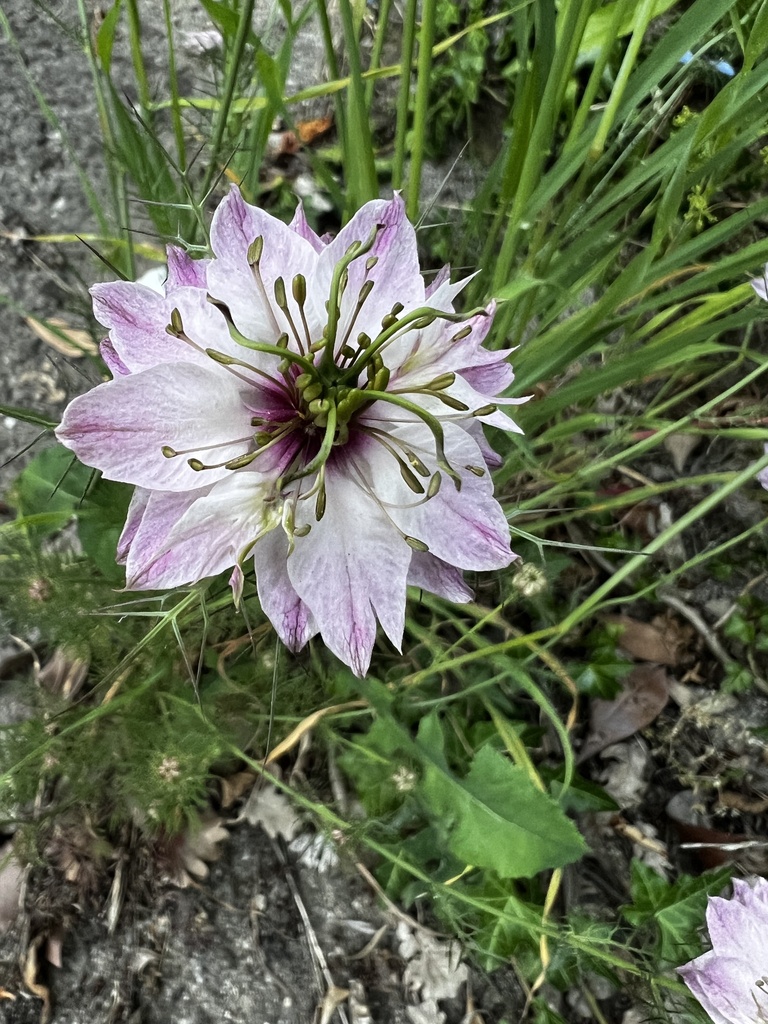
love-in-a-mist
Nigella damascena
Nigella damascena (love-in-a-mist, ragged lady or devil in the bush) is an annual garden flowering plant, belonging to the buttercup family Ranunculaceae. It is native to southern Europe (but adventive in more northern countries of Europe), north Africa and southwest Asia, where it is found on neglected, damp patches of land.
From the article Nigella damascena on Wikipedia (CC BY-SA), quoted section by section
Description
It grows to 20–50 cm (8–20 in) tall, with pinnately divided, thread-like, alternate leaves. The flowers, blooming in early summer, are most commonly different shades of blue, but can be white, pink, or pale purple, with 5 to 25 sepals. The actual petals are located at the base of the stamens and are minute and clawed. The sepals are the only colored part of the perianth. The four to five carpels of the compound pistil have each an erect style. The fruit is a large and inflated capsule, growing from a compound ovary, and is composed of several united follicles, each containing numerous seeds. This is rather exceptional for a member of the buttercup family. The capsule becomes brown in late summer. The plant self-seeds, growing on the same spot year after year.
Toxicity
Damascenine is a toxic alkaloid found in Nigella damascena seed. However, an in vivo study in mice (100 ppm i.p.) and in vitro assessment on human cell lines has not shown any toxicity.
How it is grown
This easily grown plant has been a familiar subject in English cottage gardens since Elizabethan times, admired for its ferny foliage, spiky flowers and bulbous seed-heads. It is now widely cultivated throughout the temperate world, and numerous cultivars have been developed for garden use. 'Persian Jewels' is a mixture of white, pink, lavender and blue flowers. 'Persian Rose' is pale pink. Other cultivars are 'Albion', 'Blue Midget', 'Cambridge Blue', 'Mulberry Rose', and 'Oxford Blue'. 'Dwarf Moody Blue' is around 15 cm (6 in) high. The pale blue ‘Miss Jekyll’ and the double white-flowered 'Miss Jekyll Alba' have gained the Royal Horticultural Society's Award of Garden Merit.
Wikipedia: “Cultivation”
Where it lives
Recorded sightings
—
geo-referenced records in GBIF, from museums, herbaria and field observers.
Drag the globe to turn it. Dots are where records exist, not a range map; darker means more records.
In the old herbals & bestiaries

Maria Sibylla Merian — Der rupsen begin, voedzel en wonderbaare verandering (1712)
Maria Sibylla Merian · 1717 · p.375

Hortus Eystettensis
Basilius Besler · 1640 · p.198

Notable Commentaries on the History of Plants
Leonhart Fuchs · 1542 · p.538

Six Groups of the History of Plants
Rembert Dodoens · 1583 · p.322

History of Rare Plants
Carolus Clusius · 1601 · p.584
In the stacks
Searching the stacks…
Every page naming Nigella damascena in the Biodiversity Heritage Library →
This page is assembled live from iNaturalist, GBIF, Wikipedia, the Source Library and the Internet Archive. It is not yet part of the hand-edited codex. iNaturalist taxon 62313.