- Plants
- ›Vascular Plants
- ›flowering plants
- ›Dicots
- ›Sunflowers, Bellflowers, Fanflowers, and Allies
- ›Sunflowers, Daisies, Asters, and Allies
- ›Asteroideae
- ›asters and allies
- ›Brachyscominae
- ›Brachyscome
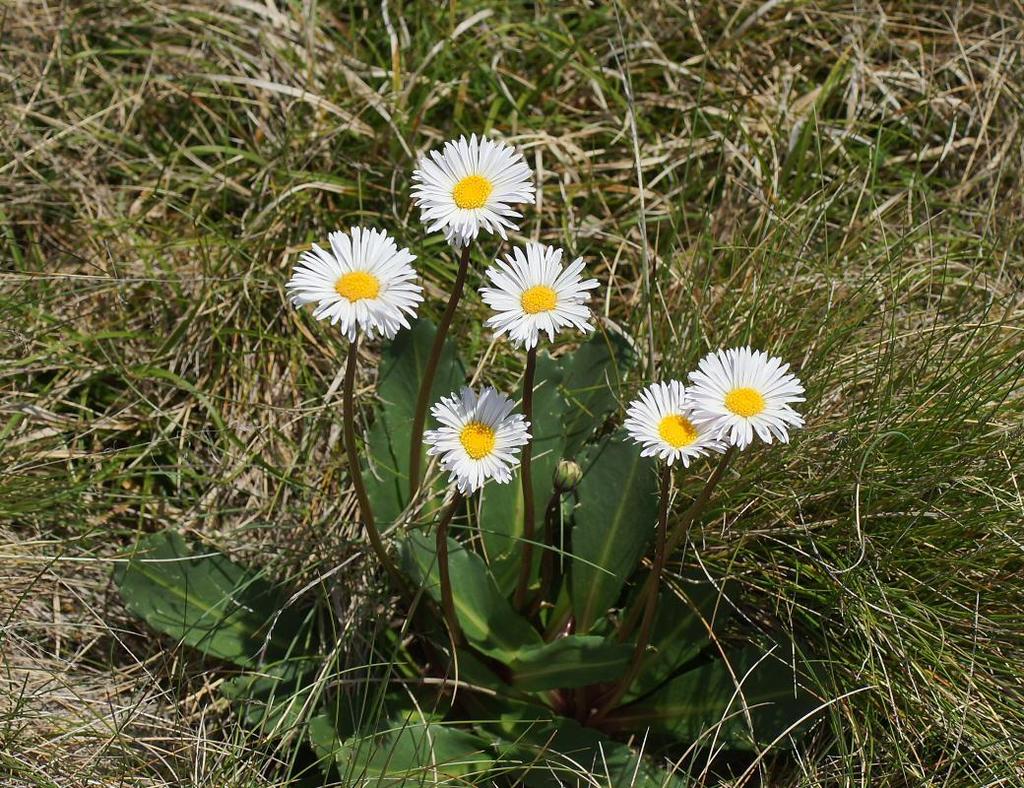
Field Daisy
Brachyscome decipiens
Brachyscome decipiens, commonly known as field daisy, is a perennial herb in the family Asteraceae and is endemic to Australia. It is a small herb with white or pale blue flowers.
From the article Brachyscome decipiens on Wikipedia (CC BY-SA), quoted section by section
Description
Brachyscome decipiens is a herb with leaves that are whorled at the ground. The leaves are egg-shaped to narrowly elliptic, smooth, 2–19 cm (0.79–7.48 in) long, 5–37 mm (0.20–1.46 in) wide. The leaves from ground level are 10–30 cm (3.9–11.8 in) long and smooth. The leaf edges are smooth or toothed near the apex, surface smooth, sometimes purplish near the leaf base. The smooth flower bracts are arranged in two rows, lance or elliptic shape, 5.5–9 mm (0.22–0.35 in) long, 1.5–4 mm (0.059–0.157 in) wide with prominent glandular purple edges. The ligules about 5–11 mm (0.20–0.43 in) long, white on upper side occasionally mauve underneath. The white or pale blue flower heads are 12–18 mm (0.47–0.71 in) in diameter, the peduncle 8–20 cm (3.1–7.9 in) long, broad, smooth and the centre yellow. The brown one-seeded fruit are flattened lengthwise, egg-shaped, 2.3–4.6 mm (0.091–0.181 in) long and 1.2–1.7 mm (0.047–0.067 in) wide. Flowering occurs from September to March.
Range & habitat
Field daisy grows in subalpine and mountainous woodland and swamps in Victoria, Tasmania and New South Wales.
== References ==
Wikipedia: “Distribution and habitat”
Where it lives
Recorded sightings
—
geo-referenced records in GBIF, from museums, herbaria and field observers.
Drag the globe to turn it. Dots are where records exist, not a range map; darker means more records.
In the stacks
Searching the stacks…
Every page naming Brachyscome decipiens in the Biodiversity Heritage Library →
This page is assembled live from iNaturalist, GBIF, Wikipedia, the Source Library and the Internet Archive. It is not yet part of the hand-edited codex. iNaturalist taxon 622834.