- Plants
- ›Vascular Plants
- ›flowering plants
- ›Dicots
- ›pinks, cactuses, and allies
- ›pink family
- ›Sclerantheae
- ›Scleranthus
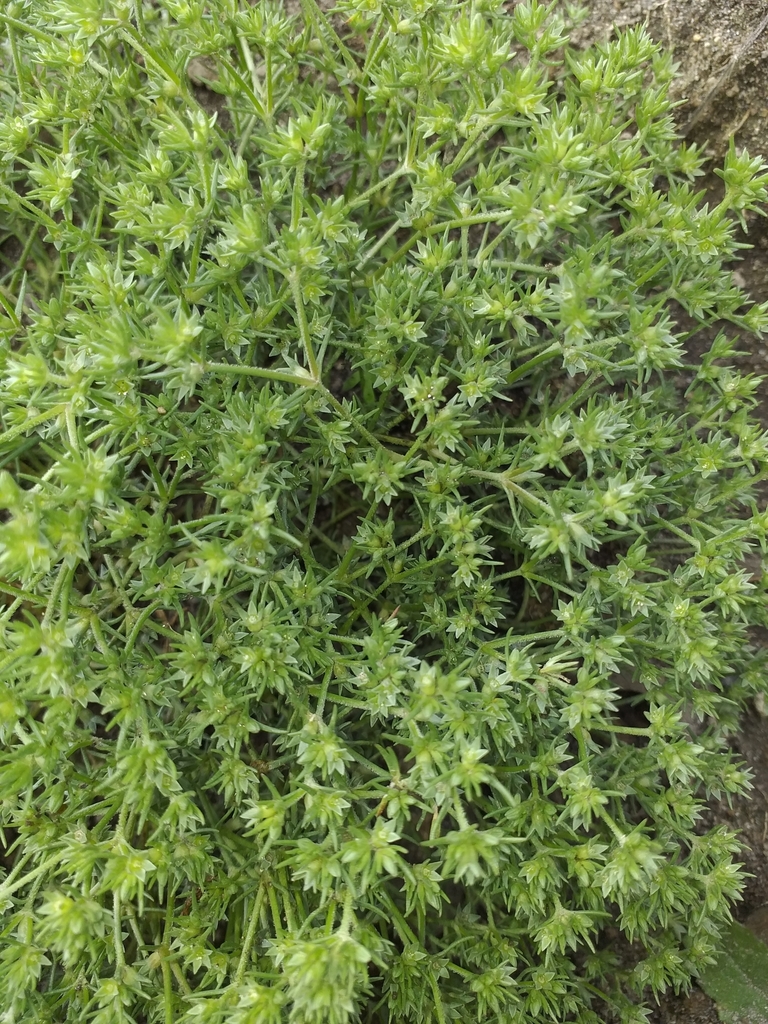
Annual Knawel
Scleranthus annuus
Scleranthus annuus is a species of flowering plant in the family Caryophyllaceae known by the common names German knotweed and annual knawel. It is native to Europe, Asia, and North Africa, and it is known throughout the rest of the temperate world as an introduced species and a common weed. It grows in many types of habitat, often in disturbed areas.
From the article Scleranthus annuus on Wikipedia (CC BY-SA), quoted section by section
Description
Scleranthus annuus is an annual or biennial herb with low, much-branched spreading stems up to 15 cm (6 in) long growing from a taproot. The leaves are needle-like or linear in shape with sharp, stiff points. They are oppositely arranged in pairs about the stem and are fused together at the bases. Flowers occur in pairs or small clusters of up to five. The flowers lack petals but have bell-shaped calyces of green petal-shaped sepals.
Range & habitat
It grows in soil pockets among rocks, on bare places, on disturbed sandy soil on heaths, in arable fields, in sand pits, in quarries, and occasionally on shingle on the coast or beside rivers.
Wikipedia: “Distribution and habitat”
What it does
The plant seems to have three different life strategies; some seeds germinate in the autumn and overwinter as small seedlings; others overwinter as seeds and germinate in the spring, flowering the same year; and some germinate in the spring but do not flower until the following year. The flowering period for all three groups extends from late May to late August. The flowers make little effort to attract insects for pollination (no showy petals, little nectar), and most are self-pollinated.
Wikipedia: “Life cycle”
Where it lives
Recorded sightings
—
geo-referenced records in GBIF, from museums, herbaria and field observers.
Drag the globe to turn it. Dots are where records exist, not a range map; darker means more records.
In the old herbals & bestiaries

In the stacks
Searching the stacks…
Every page naming Scleranthus annuus in the Biodiversity Heritage Library →
This page is assembled live from iNaturalist, GBIF, Wikipedia, the Source Library and the Internet Archive. It is not yet part of the hand-edited codex. iNaturalist taxon 61935.