- Plants
- ›Vascular Plants
- ›flowering plants
- ›Dicots
- ›Mints, Plantains, Olives, and Allies
- ›Mint Family
- ›Nepetoideae
- ›Mentheae
- ›balms, mints, and thymes
- ›Acanthomintha
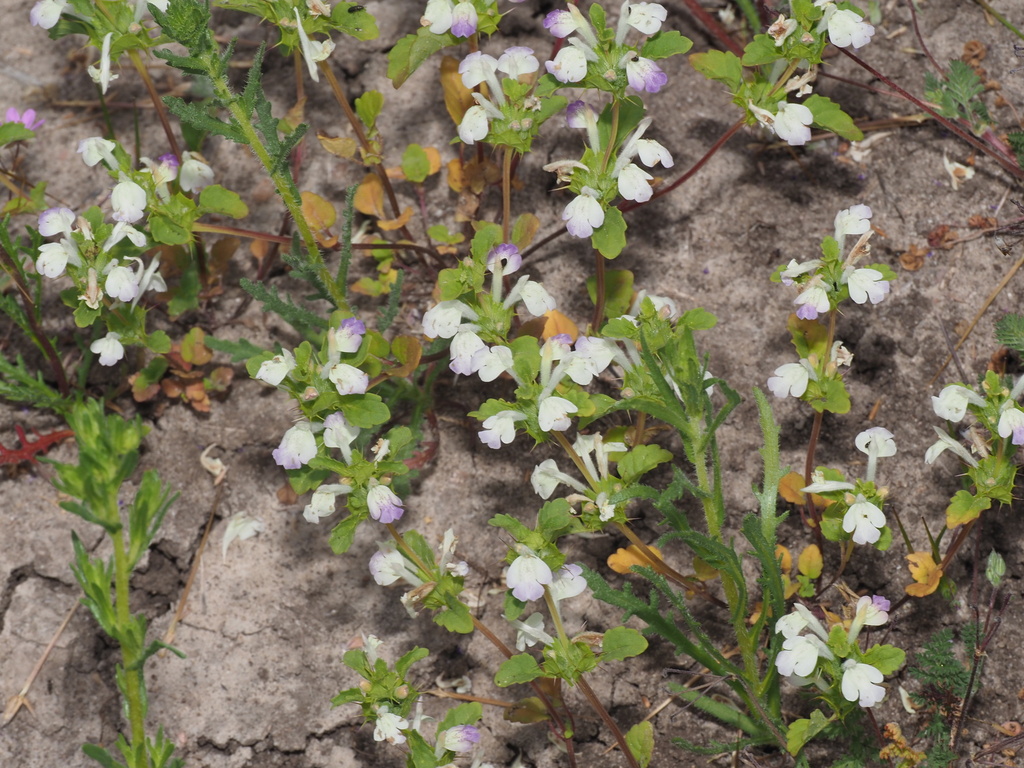
San Diego Thornmint
Acanthomintha ilicifolia
Acanthomintha ilicifolia, known by the common name San Diego thornmint, is a rare species of flowering plant in the mint family. It is native to Baja California and San Diego County, California, where it is a resident of the chaparral and coastal sage scrub plant communities and vernal pools.
Acanthomintha ilicifolia has been extirpated from many of the sites where it was previously noted in San Diego County. It is a federally listed threatened species in the United States under the Endangered Species Act of 1973 (ESA). This species is also listed as endangered under the California Endangered Species Act which means that killing or possessing the plants is prohibited within California unless authorized by the California Department of Fish and Game.
From the article Acanthomintha ilicifolia on Wikipedia (CC BY-SA), quoted section by section
Description
Acanthomintha ilicifolia is a petite annual herb growing up to about 15 centimeters (6 in) in maximum height. It has rounded to oval serrated leaves up to 1.5 cm (5⁄8 in) long. The inflorescence is a cluster of flowers with oval-shaped bracts nearly a centimeter long which are edged with long spines. Each flower is about a centimeter wide and white, often tinted purple to pink, with a hooded upper lip and a slightly longer lower lip. The flowers of the San Diego thornmint distinguish it from the other members of its genus by the hairless anthers and style. It germinates in late winter, flowers in April–May, and sets its seeds in June–July. Each flower can produce a maximum of 4 seeds, with each plant producing between 70 and 200 seeds. The species has been shown to have a seed bank. Seed age is associated with germination, with higher rates of germination recorded among older seeds.
Range & habitat
This species is generally limited to San Diego County, California, and select areas of Baja California, Mexico. The distribution is higher in the United States, with over 80 historical occurrences listed in 2009 versus 13 occurrences in Mexico. It is found in chaparral, coastal sage scrub, and grassland habitats. It grows in gabbro and calcareous clay soils, usually on gentle slopes between 15 and 20 degrees.
Wikipedia: “Distribution and habitat”
What it does
While relatively little is known about the pollination of the species, it is believed to be pollinated by bees and checkered beetles. Two other members of the Acanthomintha genus, the San Mateo thornmint (Acanthomintha duttonii) and heartleaf thornmint (A. obovata ssp. cordata), are known to self-pollinate, and there is evidence of this for the San Diego thornmint as well.
Wikipedia: “Ecology”
Where it lives
Recorded sightings
—
geo-referenced records in GBIF, from museums, herbaria and field observers.
Drag the globe to turn it. Dots are where records exist, not a range map; darker means more records.
In the stacks
Searching the stacks…
Every page naming Acanthomintha ilicifolia in the Biodiversity Heritage Library →
This page is assembled live from iNaturalist, GBIF, Wikipedia, the Source Library and the Internet Archive. It is not yet part of the hand-edited codex. iNaturalist taxon 61548.