- Animals
- ›Arthropods
- ›Hexapods
- ›Insects
- ›Winged and Once-winged Insects
- ›Dragonflies and Damselflies
- ›Damselflies
- ›Calopterygoidea
- ›Broad-winged Damselflies
- ›Calopteryx
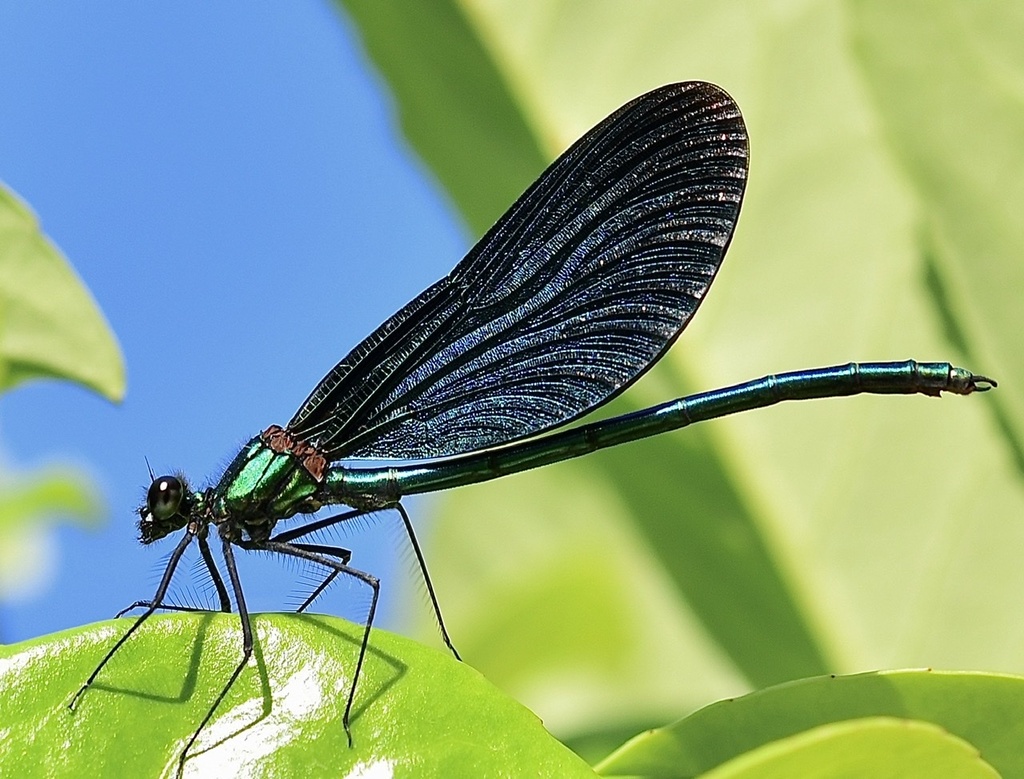
Beautiful Demoiselle
Calopteryx virgo
The beautiful demoiselle (Calopteryx virgo) is a species of damselfly belonging to the family Calopterygidae. The species has been found in Europe, North Africa, and Western Asia, and is often found by fast-flowing waters.
From the article Beautiful demoiselle on Wikipedia (CC BY-SA), quoted section by section
Range & habitat
Beautiful demoiselle is distributed across all of Europe with the exception of the southwestern Iberian Peninsula, the Balearic Islands, Sardinia, Sicily, and Iceland. In the north, it extends to the Arctic Ocean, much farther north than the banded demoiselle. Its southern populations can be found as far south as Morocco and Algeria. The beautiful demoiselle is mostly found in lowland locations. Regular findings come from areas up to a maximum height of 980 m above sea level; occasionally, they may be found up to 1,200 metres in altitude, such as in the Alps. A related insect found in Japan formerly treated as another subspecies C. v. japonica, is now accepted as a separate species Calopteryx japonica.
Wikipedia: “Distribution”
What it does
Males are territorial, and will perch on bankside plants and trees where they wait for females or chase passing insects, often returning to the same perch multiple times. Males can stray well away from water, and females live away from water unless laying eggs or seeking a mate. Sexually mature beautiful demoiselles often display pronounced territorial behaviour, occupying territories that they defend against other males. Their defense consists mostly of threatening gestures, spreading their wings, and being clearly visible. Optimal territories correspond to optimal nesting places for the females. They are characterised by an increased flow and a suitable oviposition substrate in the potential breeding sites. The size of the territories and their distance apart is dependent on the population density as well as availability of suitable habitat. Males who do not occupy a territory may stay in bankside vegetation and try to fill vacant spots. Especially when only a few males are present, territorial defense is very aggressive. With a higher number of competing males, aggression decreases significantly. The males will defend their territories from exposed perches in the vegetation which extend over the water, sometimes on vegetation or rocks cushions amid the waters. …
Wikipedia: “Behaviour”
Listen
Looking for field recordings…
Where it lives
Recorded sightings
—
geo-referenced records in GBIF, from museums, herbaria and field observers.
Drag the globe to turn it. Dots are where records exist, not a range map; darker means more records.
In the stacks
Searching the stacks…
Every page naming Calopteryx virgo in the Biodiversity Heritage Library →
This page is assembled live from iNaturalist, GBIF, Wikipedia, the Source Library and the Internet Archive. It is not yet part of the hand-edited codex. iNaturalist taxon 61536.