- Plants
- ›Vascular Plants
- ›flowering plants
- ›monocots
- ›Agaves, Orchids, Irises, and Allies
- ›agave and allies
- ›Dragon tree subfamily
- ›true and false Solomon's seals
- ›Polygonatum
- ›Polygonatum
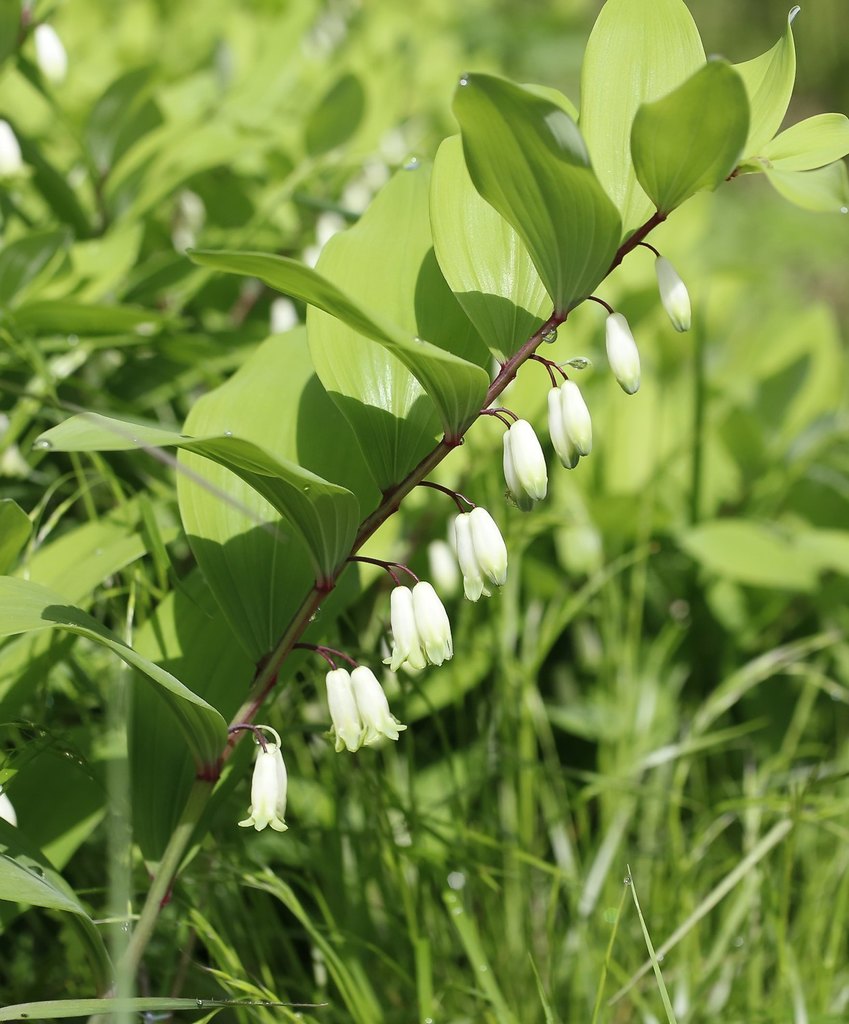
Scented Solomon's-seal
Polygonatum odoratum
Polygonatum odoratum (syn. P. officinale), the angular Solomon's seal or scented Solomon's seal, is a species of flowering plant in the family Asparagaceae, native to Europe, the Caucasus, Siberia, the Russian Far East, China, Mongolia, Korea, Nepal and Japan. In the United Kingdom it is one of three native species of the genus, the others being P. multiflorum and P. verticillatum.
The genus name Polygonatum comes from the Greek words "poly", meaning "many", and "gonu", meaning "knee joint". This is in reference to the plant's jointed rhizomes. The Latin specific epithet odoratum means "scented".
From the article Polygonatum odoratum on Wikipedia (CC BY-SA), quoted section by section
Description
Polygonatum odoratum is a colonizing herbaceous perennial growing to 85 cm (33 in) tall by 30 cm (12 in) wide, with alternate, simple leaves on arching stems. The scented tubular flowers are white with green tips, borne in spring and hanging from the underside of the stems. Its fruit persists for an average of 68.4 days, and bears an average of 2.6 seeds per fruit. Fruits average 80.9% water, and their dry weight includes 21.9% carbohydrates and 1.7% lipids.
How it is grown
Polygonatum odoratum, like its relative lily of the valley, is cultivated in moist, shaded situations, where it will spread by underground stolons. Cultivars include 'Flore pleno' and 'Variegatum'.
Wikipedia: “Cultivation”
Where it lives
Recorded sightings
—
geo-referenced records in GBIF, from museums, herbaria and field observers.
Drag the globe to turn it. Dots are where records exist, not a range map; darker means more records.
In the stacks
Searching the stacks…
Every page naming Polygonatum odoratum in the Biodiversity Heritage Library →
This page is assembled live from iNaturalist, GBIF, Wikipedia, the Source Library and the Internet Archive. It is not yet part of the hand-edited codex. iNaturalist taxon 61454.