- Plants
- ›Vascular Plants
- ›flowering plants
- ›Dicots
- ›Roses, Elms, Figs, and Allies
- ›rose family
- ›brambles, roses, strawberries, and allies
- ›Brambles
- ›Rubus
- ›Rubus
- ›Rubus
- ›Hiemales
- ›Candicantes
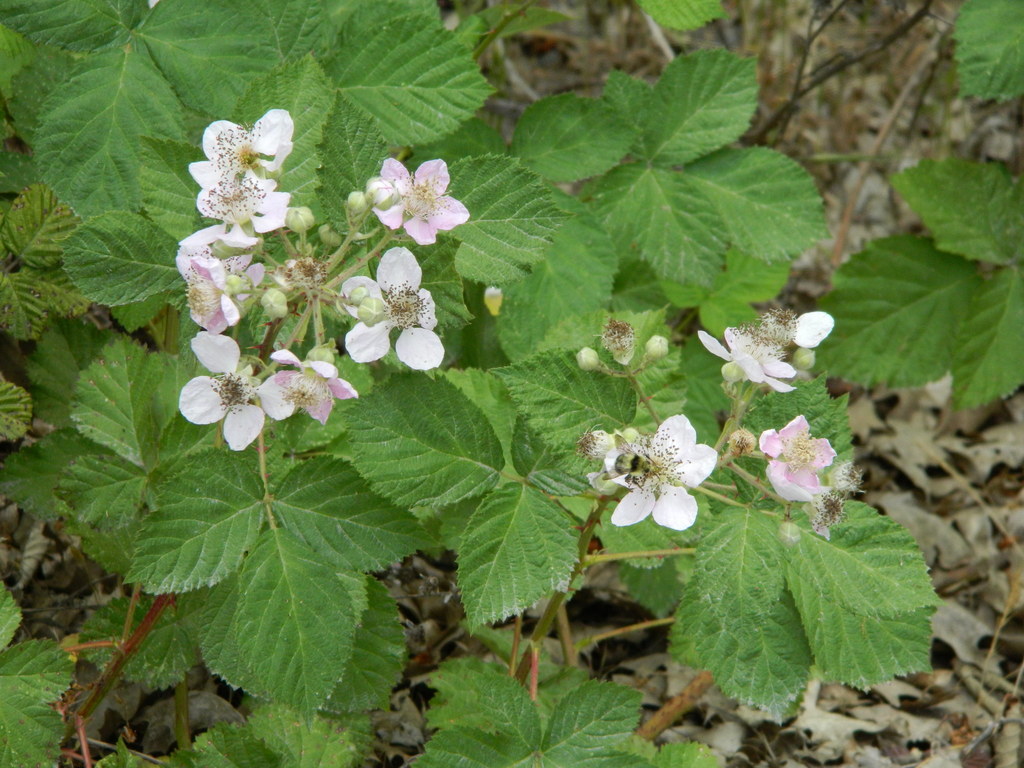
Armenian Blackberry
Rubus armeniacus
Rubus armeniacus, the giant blackberry, Armenian blackberry, or sometimes, misleadingly, "Himalayan blackberry", is a species of Rubus in the blackberry group Rubus subgenus Rubus series Discolores (P.J. Müll.) Focke. It is native to Armenia and northwestern Iran, and widely invasive elsewhere. Both its scientific name and origin have been the subject of much confusion.
It is known for its extreme vigour and tendency to spread rapidly over disturbed areas. It is considered an invasive species and a noxious weed in many regions, but is or was also widely cultivated for its edible fruit; this is large and sweet when ripe, and is one of the most popular blackberries. Its history of discovery and introduction into cultivation are poorly documented; its first definite cultivation was in Germany by 1889, but probably earlier, in 1835, under the name "Rubus fruticosus fr. maximo Booth".
From the article Rubus armeniacus on Wikipedia (CC BY-SA), quoted section by section
Description
Rubus armeniacus is a perennial plant that bears biennial stems ("canes") from the perennial root system. In its first year a new stem grows vigorously to its full length of 4–10 metres (13–33 ft), trailing along the ground or arching up to 4 m high. The stem is stout, up to 2–3 cm diameter at the base, and green; it is polygonal (usually hexagonal) in cross-section, with stout prickles up to 1.5 cm long forming along the ribs. The canes can turn more red/purple if they are exposed to bright sunlight. This is common in the summer. The leaves on first-year shoots are 7–20 cm (2.8–7.9 in) long, palmately compound with either three or more commonly five leaflets. The leaflets are moderately serrated. Flowers are not produced on first-year shoots. In its second year, the stem does not grow longer, but produces several side shoots, which bear smaller leaves with three leaflets (rarely a single leaflet). These leaflets are oval-acute, dark green above and pale to whitish below, with a toothed margin, and snaring, hooked thorns along the midrib on the underside. Both first- and second-year shoots are spiny, with short, stout, curved, sharp prickles. Mature plants form a tangle of dense arching stems, the branches rooting from the node tip when they reach the ground. …
What it does
The fleshy growing cane tips contain the antifeedant compounds, 2-heptanol and methyl salicylate at higher concentrations than mature leaves. At the concentration found in the growing cane tips, 2-heptanol is a banana slug (Ariolimax columbianus) antifeedant. The lack of phytophagous insects observed on the growing cane tips is likely due to the presence of methyl salicylate. This compound is a known aphid repellant and has been shown to attract predators in response to insect herbivory.
Spread. Luther Burbank, who coined the misleading name "Himalayan", introduced R. armeniacus to North America in 1885 in Santa Rosa, California, using seeds that he imported from India. The species thrived in its new environment, notably for the large amount of berries it produced. By 1915, it was widely grown and cultivated in the United States. It soon escaped from cultivation, and became an invasive species in most of the temperate world and the U.S. Pacific Coast by 1945. It is listed as an invasive species in the U.S. State of Missouri and prohibited in the U.S. state of Wisconsin. Because it is so hard to contain, it quickly gets out of control, with birds and other animals eating the fruit and then spreading the seeds. …
Wikipedia: “Ecology”
Where it lives
Recorded sightings
—
geo-referenced records in GBIF, from museums, herbaria and field observers.
Drag the globe to turn it. Dots are where records exist, not a range map; darker means more records.
In the stacks
Searching the stacks…
Every page naming Rubus armeniacus in the Biodiversity Heritage Library →
This page is assembled live from iNaturalist, GBIF, Wikipedia, the Source Library and the Internet Archive. It is not yet part of the hand-edited codex. iNaturalist taxon 61317.