- Animals
- ›Arthropods
- ›Hexapods
- ›Insects
- ›Winged and Once-winged Insects
- ›Dragonflies and Damselflies
- ›Damselflies
- ›Coenagrionoid Damselflies
- ›Narrow-winged Damselflies
- ›Pyrrhosoma
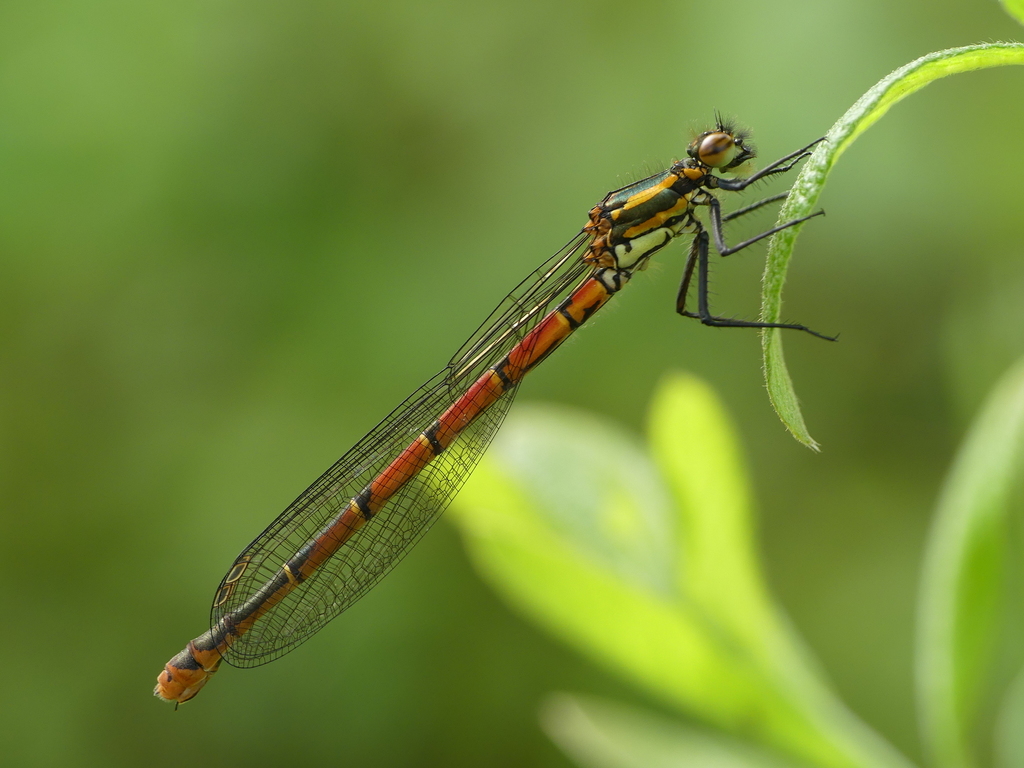
Large Red Damselfly
Pyrrhosoma nymphula
The large red damselfly (Pyrrhosoma nymphula) is a species of damselflies belonging to the family Coenagrionidae. It is native to the western Palearctic.
From the article Large red damselfly on Wikipedia (CC BY-SA), quoted section by section
Description
Pyrrhosoma nymphula can reach a body length of 33–36 millimetres (1.3–1.4 in). These large and robust damselflies show black legs and wing spots in both sexes. Mature males have red eyes and a black thorax with red shoulder stripes in mature specimen, but yellow stripes in immature. In fact ante-humeral stripes change to red with age. Abdomen is red with black small rings and bronze-black bands towards the apex (segments 7-9). Wings are hyaline, with a blackish pterostigma. Mature females occur in three colour forms (typical, fulvipes and melanotum), from mostly black to mostly red, but all have yellow bands around the abdominal segments. Some intermediate forms also exist. The form typica has more black on its abdominal segments than the form fulvipes, particularly on segment 6. Immatures have lighter eyes and have yellow stripes on the thorax, not red. In the form melanotum females show the upper surface of the abdomen almost entirely black. These damselflies can easily be confused with small red damselflies, but the latter has orange legs, while the large red damselfly has black legs. In Greece and Albania a closely related species occurs, the Greek red damsel (Pyrrhosoma elisabethae). They look very much the same, the females only having a slightly different pronotum with deep folds in the hind margin. …
Range & habitat
This species is a mainly European damselfly, with some populations in Northern Africa and Western Asia.
Wikipedia: “Distribution”
What it does
The great red damselfly is often the first damselfly to emerge, usually in April or May. Adults can be found until September, according to locality. Immature adults mature in about two weeks. Mating occurs in vegetation. The female during the laying of eggs is accompanied by the male, she immerses into the water only the abdomen. Eggs hatch in two-three weeks. Development of larvae takes two years. Larvae feed on aquatic insect larvae, protozoa, rotifers or small crustaceans.
Wikipedia: “Biology and behaviour”
Listen
Looking for field recordings…
Where it lives
Recorded sightings
—
geo-referenced records in GBIF, from museums, herbaria and field observers.
Drag the globe to turn it. Dots are where records exist, not a range map; darker means more records.
In the stacks
Searching the stacks…
Every page naming Pyrrhosoma nymphula in the Biodiversity Heritage Library →
This page is assembled live from iNaturalist, GBIF, Wikipedia, the Source Library and the Internet Archive. It is not yet part of the hand-edited codex. iNaturalist taxon 61152.