- Animals
- ›Arthropods
- ›Hexapods
- ›Insects
- ›Winged and Once-winged Insects
- ›Beetles
- ›Water, Rove, Scarab, Long-horned, Leaf, and Snout Beetles
- ›Scarabaeiform Beetles
- ›Scarabs, Stag Beetles, and Allies
- ›Stag Beetles
- ›Lucaninae
- ›Odontolabini
- ›Odontolabis
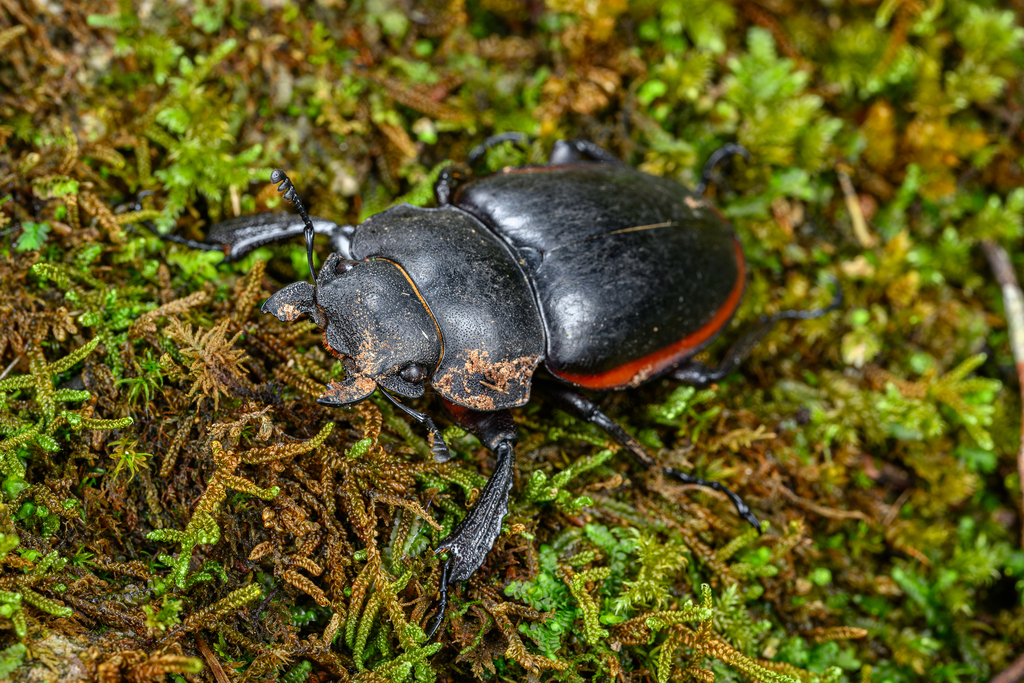
Golden Stag Beetle
Odontolabis cuvera
Odontolabis cuvera, the Golden Stag Beetle, is a beetle of the Family Lucanidae, stag beetles.
From the article Odontolabis cuvera on Wikipedia (CC BY-SA), quoted section by section
Description
Odontolabis cuvera can reach a length (mandibles included) of about 43–90 millimetres (1.7–3.5 in) in male, of about 41–51 millimetres (1.6–2.0 in) in females. Moreover, males have a conspicuously elongated and large pair of mandibles. The basic color of the body is black. Elytra have broad orange margins on the outer edge. The female closely resembles the male in coloration but it lacks long mandibles. The remarkably disparity between male and females (sexual dimorphism) evolved through sexual selection for securing mating females. The males have also three morphological forms with variations in the size of their mandibles. These three alternative phenotypes (male trimorphism) in the types of male weapons are considered conditional reproductive strategies. In Lucanidae, there has only been two species described with this trimorphic characteristic as of 2017, with the other one being Dorcus rectus. In the subspecies Odontolabis cuvera sinensis elytra are almost completely black, with a small orange border. These beetles can reach a length of about 80 millimetres (3.1 in).
Range & habitat
This beetle is native to southeast Asia and it is present in Bhutan, China, India, Laos, Myanmar, Nepal, Thailand, Vietnam.
Wikipedia: “Distribution”
What it does
The females lay their eggs into leaf litter substrate and rotten wood. Larvae build their cave system and stay inside it, feeding for several years on rotting wood.
Wikipedia: “Life cycle”
In human culture
The Latin species name Cuvera comes from a mythical king of riches (Kubera or "Kuvera") who lived in the Himalayas.
Wikipedia: “Etymology”
Listen
Looking for field recordings…
Where it lives
Recorded sightings
—
geo-referenced records in GBIF, from museums, herbaria and field observers.
Drag the globe to turn it. Dots are where records exist, not a range map; darker means more records.
In the stacks
Searching the stacks…
Every page naming Odontolabis cuvera in the Biodiversity Heritage Library →
This page is assembled live from iNaturalist, GBIF, Wikipedia, the Source Library and the Internet Archive. It is not yet part of the hand-edited codex. iNaturalist taxon 60821.