- Plants
- ›Vascular Plants
- ›flowering plants
- ›monocots
- ›Agaves, Orchids, Irises, and Allies
- ›Orchids
- ›Orchidoid Orchids
- ›Orchideae
- ›Orchidinae
- ›Dactylorhiza
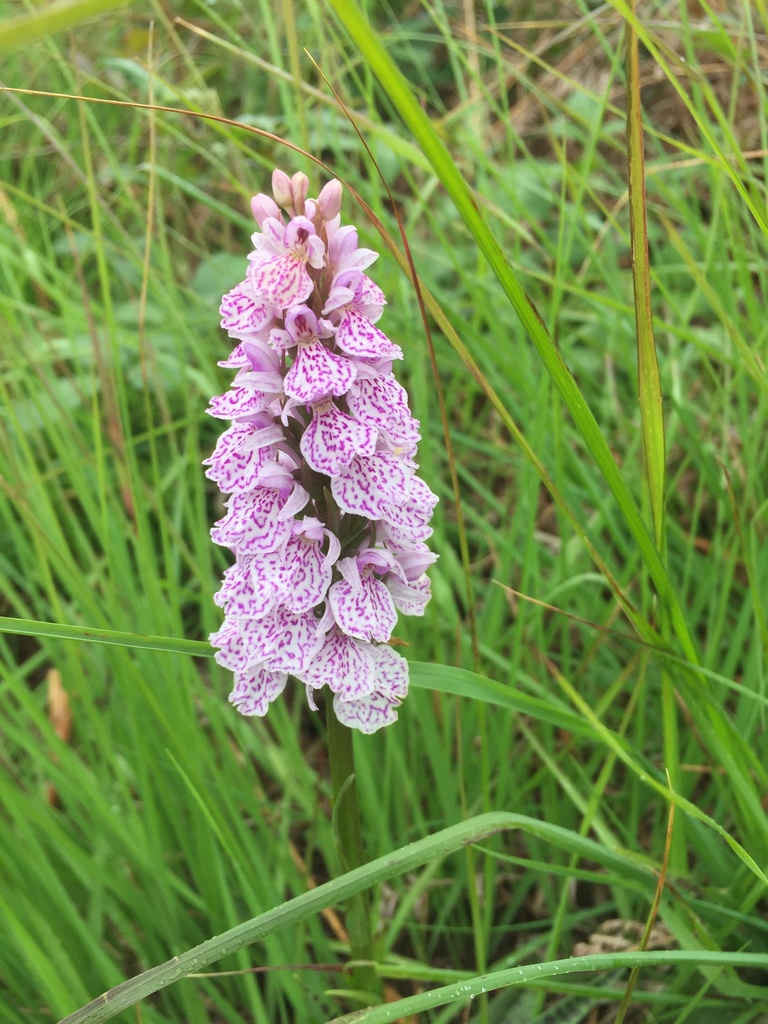
Dactylorhiza × grandis
Dactylorhiza is a genus of flowering plants in the orchid family Orchidaceae. Its species are commonly called marsh orchids or spotted orchids. Dactylorhiza were previously classified under Orchis, which has two round tubers.
From the article Dactylorhiza on Wikipedia (CC BY-SA), quoted section by section
Description
They are hardy tuberous geophytes. In a thickened underground stem, they can store a large amount of water to survive arid conditions. The tuber is flattened and finger-like. The long leaves are lanceolate and, in most species, also speckled. They grow along a rather long stem which reaches a height of 70–90 cm (28–35 in). Leaves higher on the stem are shorter than leaves lower on the stem. The inflorescence, compared to the length of the plant, is rather short. It consists of a compact raceme with 25-50 flowers. These develop from axillary buds. The dominant colors are white and all shades of pink to red, sprinkled with darker speckles.
Range & habitat
These terrestrial orchids grow in basic soils in wet meadows, bogs, heathland and in areas sparsely populated by trees. They are distributed throughout the subarctic and temperate northern hemisphere. It is found across much of Europe, North Africa and Asia from Portugal and Iceland to Taiwan and Kamchatka, including Russia, Japan, China, Central Asia, the Middle East, Ukraine, Scandinavia, Germany, Poland, Italy, France, the United Kingdom, etc. Inclusion of the widespread frog orchid, often called Coeloglossum viride, into Dactylorhiza as per some recent classifications, expands the genus distribution to include Canada and much of the United States.
Wikipedia: “Distribution and habitat”
In human culture
The name Dactylorhiza is derived from Greek words δάκτυλος daktylos 'finger' and ῥίζα rhiza 'root', referring to the palmately two- to five-lobed tubers of this genus.
Wikipedia: “Etymology”
Where it lives
Recorded sightings
—
geo-referenced records in GBIF, from museums, herbaria and field observers.
Drag the globe to turn it. Dots are where records exist, not a range map; darker means more records.
In the stacks
Searching the stacks…
Every page naming Dactylorhiza × grandis in the Biodiversity Heritage Library →
This page is assembled live from iNaturalist, GBIF, Wikipedia, the Source Library and the Internet Archive. It is not yet part of the hand-edited codex. iNaturalist taxon 606815.