- Plants
- ›Vascular Plants
- ›flowering plants
- ›Dicots
- ›Buttercups, Poppies, and Allies
- ›buttercup family
- ›Anemones, buttercups, larkspurs and allies
- ›anemones and allies
- ›Pulsatilla
- ›Preonanthus
- ›Preonanthopsis
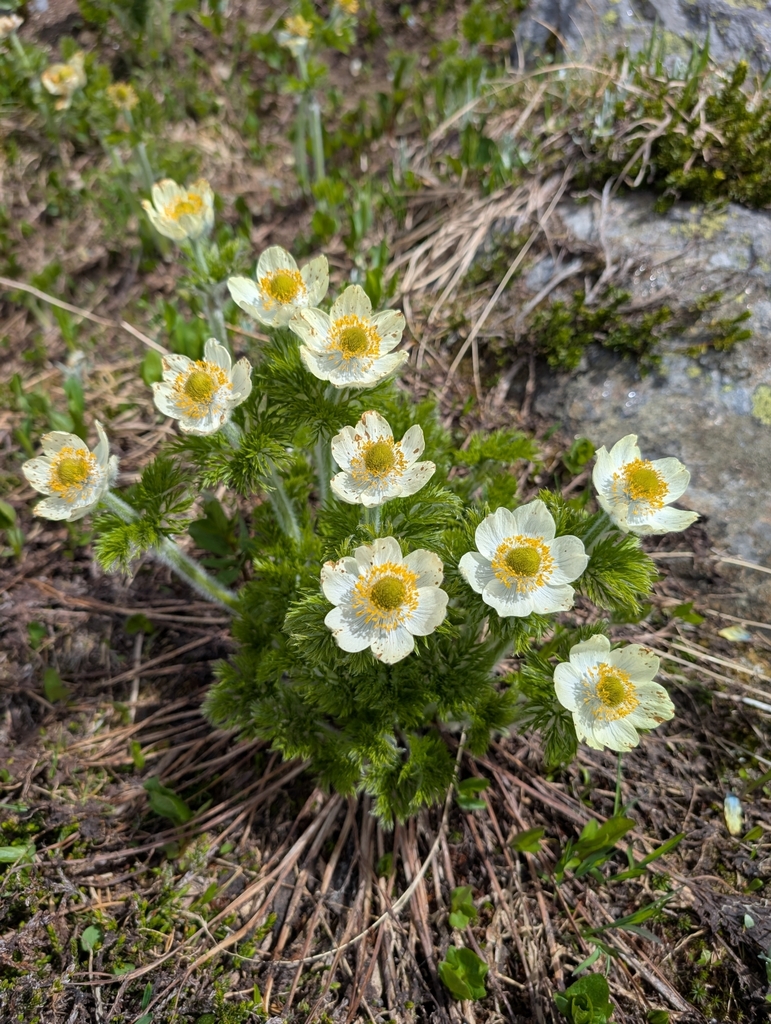
white pasqueflower
Pulsatilla occidentalis
Pulsatilla occidentalis, synonym Anemone occidentalis, the white pasqueflower or western pasqueflower, is a herbaceous species of flowering plant in the buttercup family Ranunculaceae. Individuals are 10–60 cm (3.9–23.6 in) tall, from caudices, with three to six leaves at the base of the plant that are 3-foliolate, each leaflet pinnatifid to dissected in shape. Leaf petioles are 6–10 cm (2.4–3.9 in) long. Leaves have villous hairs and their margins are pinnatifid or dissected. Plants flower briefly mid-spring to mid-summer, usually soon after the ground is exposed by melting snow. The flowers are composed of five to seven sepals (sometimes called tepals), normally white or soft purple, also mixed white and blueish purple, one flower per stem. The sepals are 15–30 mm (0.59–1.18 in) long and 10–17 mm (0.39–0.67 in) wide. Flowers have 150–200 stamens. The fruit occurs in heads rounded to subcylindric in shape, with pedicels 15–20 cm (5.9–7.9 in) long. The achenes are ellipsoid in shape, not winged, covered with villous hairs, with beaks curved that reflex as they age and 20–40 mm (0.79–1.57 in) long, feather-like. Generally, the fruit persists into fall.
Native to far western North America including British Columbia to California and Montana, it is found growing in gravelly soils on slopes and in moist meadows.
From the article Pulsatilla occidentalis on Wikipedia (CC BY-SA), quoted section by section
In medicine
The fresh stems and seeds of the plant are used traditionally in North America as analgesics, anxiolytics, and sedatives.
Wikipedia: “Traditional medicine”
Where it lives
Recorded sightings
—
geo-referenced records in GBIF, from museums, herbaria and field observers.
Drag the globe to turn it. Dots are where records exist, not a range map; darker means more records.
In the stacks
Searching the stacks…
Every page naming Pulsatilla occidentalis in the Biodiversity Heritage Library →
This page is assembled live from iNaturalist, GBIF, Wikipedia, the Source Library and the Internet Archive. It is not yet part of the hand-edited codex. iNaturalist taxon 60482.