- Plants
- ›Vascular Plants
- ›flowering plants
- ›Dicots
- ›Mustards, Capers, and Allies
- ›mustard family
- ›Brassicoideae
- ›Camelinodae
- ›Cardamineae
- ›Cardamine
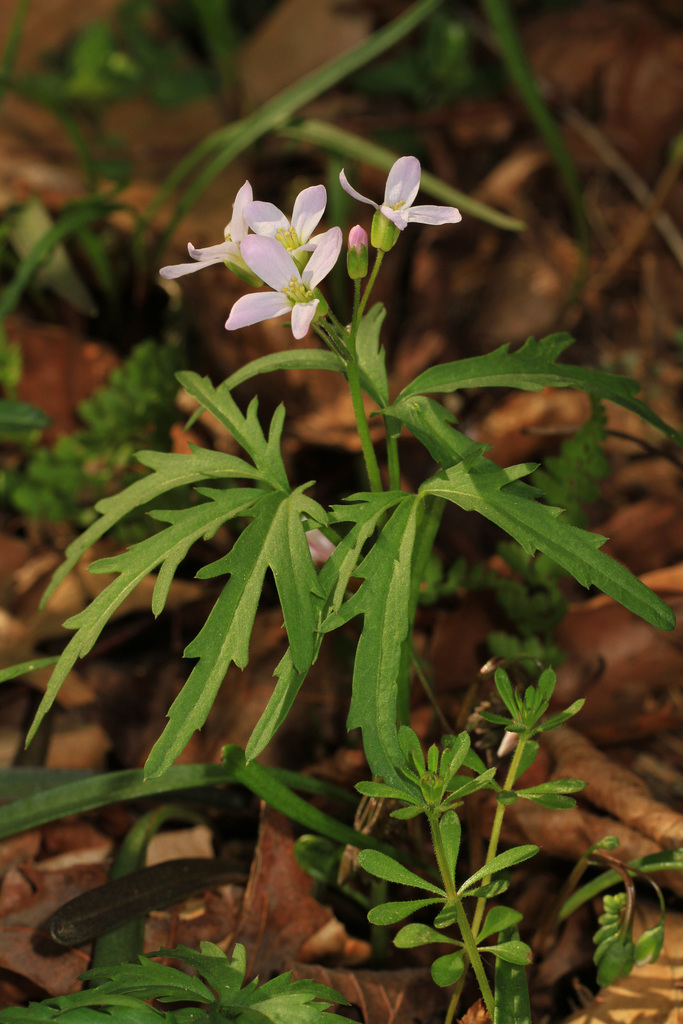
cut-leaved toothwort
Cardamine concatenata
Cardamine concatenata, the cutleaf toothwort, crow's toes, pepper root or purple-flowered toothwort, is a flowering plant in Brassicaceae. It owes its name to the tooth-like appearance of its rhizome. It is a perennial plant woodland wildflower native to eastern North America. It is considered a spring ephemeral and blooms in March, April, and/or May.
From the article Cardamine concatenata on Wikipedia (CC BY-SA), quoted section by section
Description
Cardamine concatenata is a member of the Cardamine concatenata alliance, a distinctive group of species that includes Cardamine angustata, Cardamine concatenata, Cardamine diphylla, Cardamine dissecta, Cardamine incisa, and Cardamine maxima. Members of the alliance are morphologically similar, with an elongated fleshy rhizome and either ternate or palmately compound leaves. The vegetative parts of this plant, which can reach 20–40 cm (7.9–15.7 in), arise from a segmented rhizome. The leaves are on long petioles, deeply and palmately dissected into five segments with large "teeth" on the margins. The white to pinkish flowers are held above the foliage in a spike. Fruit is an elongated pod which can be up to 4 cm (1.6 in) long.
Range & habitat
Cardamine concatenata, like all members of the Cardamine concatenata alliance, is native to eastern North America. It has the widest distribution of any member of the alliance, with a range that extends north to Québec and Ontario, south to Florida and Texas, and west to Kansas and Oklahoma. It is known to occur in the following provinces and states:
Canada: Ontario, Québec United States: Alabama, Arkansas, Connecticut, Delaware, District of Columbia, Florida, Georgia, Illinois, Indiana, Iowa, Kansas, Kentucky, Louisiana, Maine, Maryland, Massachusetts, Michigan, Minnesota, Mississippi, Missouri, Nebraska, New Hampshire, New Jersey, New York, North Carolina, Ohio, Oklahoma, Pennsylvania, South Carolina, Tennessee, Texas, Vermont, Virginia, West Virginia, Wisconsin In the eastern United States where the distribution of Cardamine concatenata is widespread, it occurs in most of the counties of Missouri, Illinois, Indiana, and Ohio. It occupies rich deciduous forest habitats such as rich woods, wooded bottomlands, limestone outcrops, and rocky banks and bluffs.
Wikipedia: “Distribution and habitat”
What it does
Cardamine concatenata blooms from February to May. It serves as a host plant for the imperiled butterfly Pieris virginiensis.
Wikipedia: “Ecology”
At the table
The roots can be washed, chopped and ground in vinegar to be used as a horseradish substitute. According to Hussey (1974), "the Indians ate the pungent root."
Wikipedia: “Uses”
Where it lives
Recorded sightings
—
geo-referenced records in GBIF, from museums, herbaria and field observers.
Drag the globe to turn it. Dots are where records exist, not a range map; darker means more records.
In the stacks
Searching the stacks…
Every page naming Cardamine concatenata in the Biodiversity Heritage Library →
This page is assembled live from iNaturalist, GBIF, Wikipedia, the Source Library and the Internet Archive. It is not yet part of the hand-edited codex. iNaturalist taxon 60438.