- Animals
- ›Arthropods
- ›Hexapods
- ›Insects
- ›Winged and Once-winged Insects
- ›Beetles
- ›Water, Rove, Scarab, Long-horned, Leaf, and Snout Beetles
- ›Staphyliniform Beetles
- ›Rove, Ant-like stone, and Carrion Beetles
- ›Rove Beetles
- ›Burying and Carrion Beetles
- ›Nicrophorini
- ›Nicrophorus
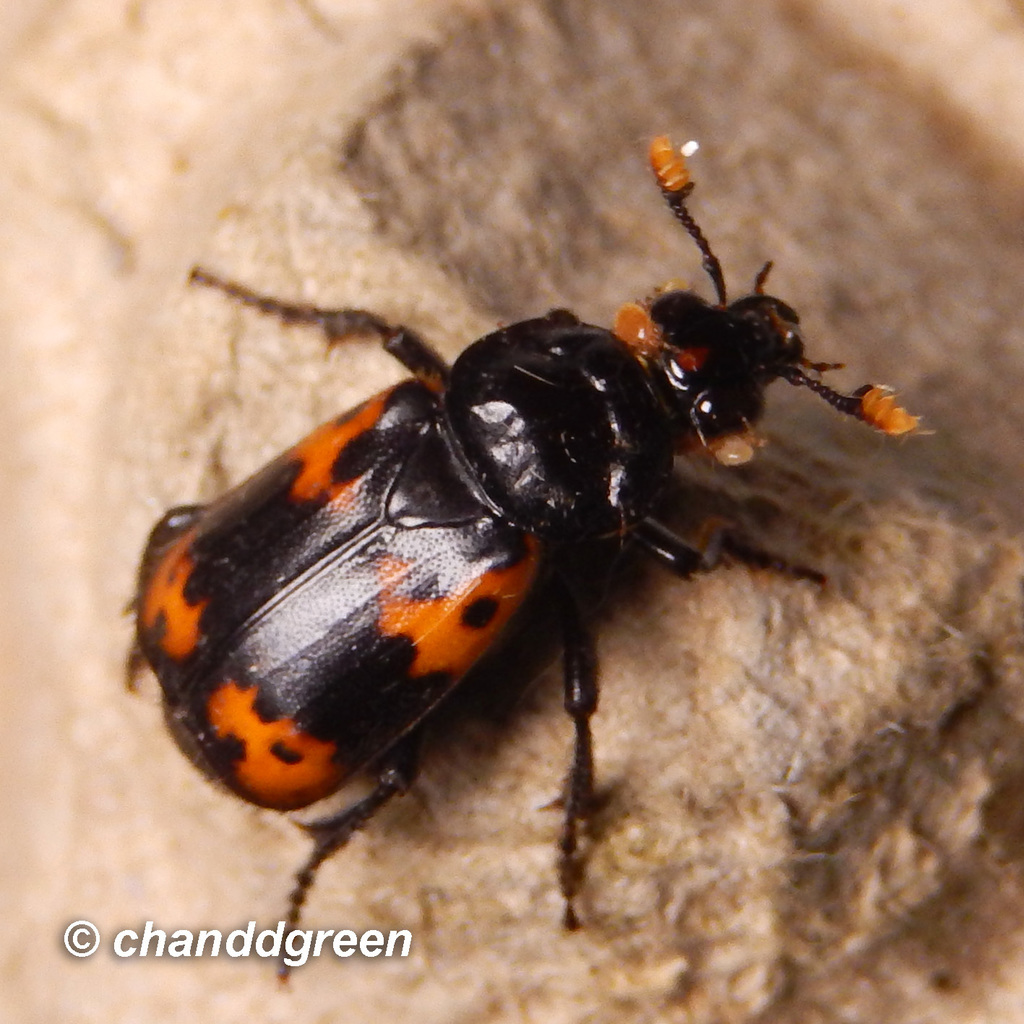
Nicrophorus nepalensis
Nicrophorus nepalensis, commonly known as burying beetle, is widespread across tropical and subtropical countries in Asia. It belongs to the order Coleoptera and the family Silphidae, and is part of the nepalensis species-group, which is the second largest species group within the genus Nicrophorus. N. nepalensis differs from some other beetles in that it exhibits biparental care. Its role as a decomposer is crucial in the energy cycle and energy transformation in the ecosystem.
From the article Nicrophorus nepalensis on Wikipedia (CC BY-SA), quoted section by section
Description
The body of N. nepalensis is shiny black and has unique elytral patterns with four separated scalloped, orange markings and black dots in both anterior and posterior fascia. The basal segment of the antennae is black and the tips are club shaped with three orange segments. Frons of the female have an elliptical shape, whereas those of the male are more rectangular. A distinct feature that separates males from females is the conspicuous orange spot on the clypeus near the mandible. Another feature is the post-ocular bulge found in males. Pronotal width is a common measurement of beetle size, and adult N. nepalensis can range from 3.6 to 7.0 mm, with no significant variations between male and female.
Range & habitat
N. nepalensis can be found primarily in the mountainous regions in eastern Asia and the Malay Archipelago, with a distribution ranging from 73°E (Pakistan) to 149°E (Papua New Guinea) longitudinally and from 51°N (Ussuri, Russia) to 9°48′S (Papua New Guinea) latitudinally. Countries within this range includes Pakistan, India, China, Laos, Burma, Thailand, Vietnam, Taiwan, Japan, Philippines, and Malaysia.
Wikipedia: “Distribution”
What it does
Intraspecies dynamics within populations of N. nepalensis has been forgone in most research settings and instead interspecific competition such as the competitive exclusion by small Indian mongoose populations has been more heavily investigated. Interspecies competition can be used as an influencing force on the transformation of intraspecies conflict to intraspecies competition in N. nepalensis. Only one chemical cue, the emittance of dimethyl disulfide or more commonly known as DMDS, can cause N. nepalensis to take on a more cooperative stance in terms of burying carcasses. This form of social cooperation becomes seemingly activated when populations of blowfly maggots start to digest the tissue of these carcasses claimed by N. nepalensis. This is because dimethyl disulfide is emitted from carcasses consumed by the blowfly maggots but is not emitted from control carcasses which had no interactions with blowflies. This social behavior has been quite difficult to empirically quantify since social animals like N. nepalensis engage commonly in shared investment over resources that benefit the entire group. In the experiment, researchers collected N. nepalensis from Nantou County, Taiwan, and utilized chromatography-mass spectrometry to quantify the dimethyl sulfide emitted from the blowflies. …
Wikipedia: “Social behavior”
Listen
Looking for field recordings…
Where it lives
Recorded sightings
—
geo-referenced records in GBIF, from museums, herbaria and field observers.
Drag the globe to turn it. Dots are where records exist, not a range map; darker means more records.
In the stacks
Searching the stacks…
Every page naming Nicrophorus nepalensis in the Biodiversity Heritage Library →
This page is assembled live from iNaturalist, GBIF, Wikipedia, the Source Library and the Internet Archive. It is not yet part of the hand-edited codex. iNaturalist taxon 604088.