On eBird ↗
Little Friarbird
Live sightings near you, the range map, bar charts of when it is seen, and Macaulay Library photos and recordings.
Little Friarbird
Philemon citreogularis
The little friarbird (Philemon citreogularis), also known as the little leatherhead or yellow-throated friarbird, is the smallest of the friarbirds within the Philemon genus. It is found throughout northern and eastern Australia as well as southern Papua New Guinea. It lives a very prominent life, whereby it can easily be seen chasing other honeyeaters, and also it is very vocal. However, the little friarbird is usually spotted high up in trees, rarely being seen on the ground.
From the article Little friarbird on Wikipedia (CC BY-SA), quoted section by section
Description
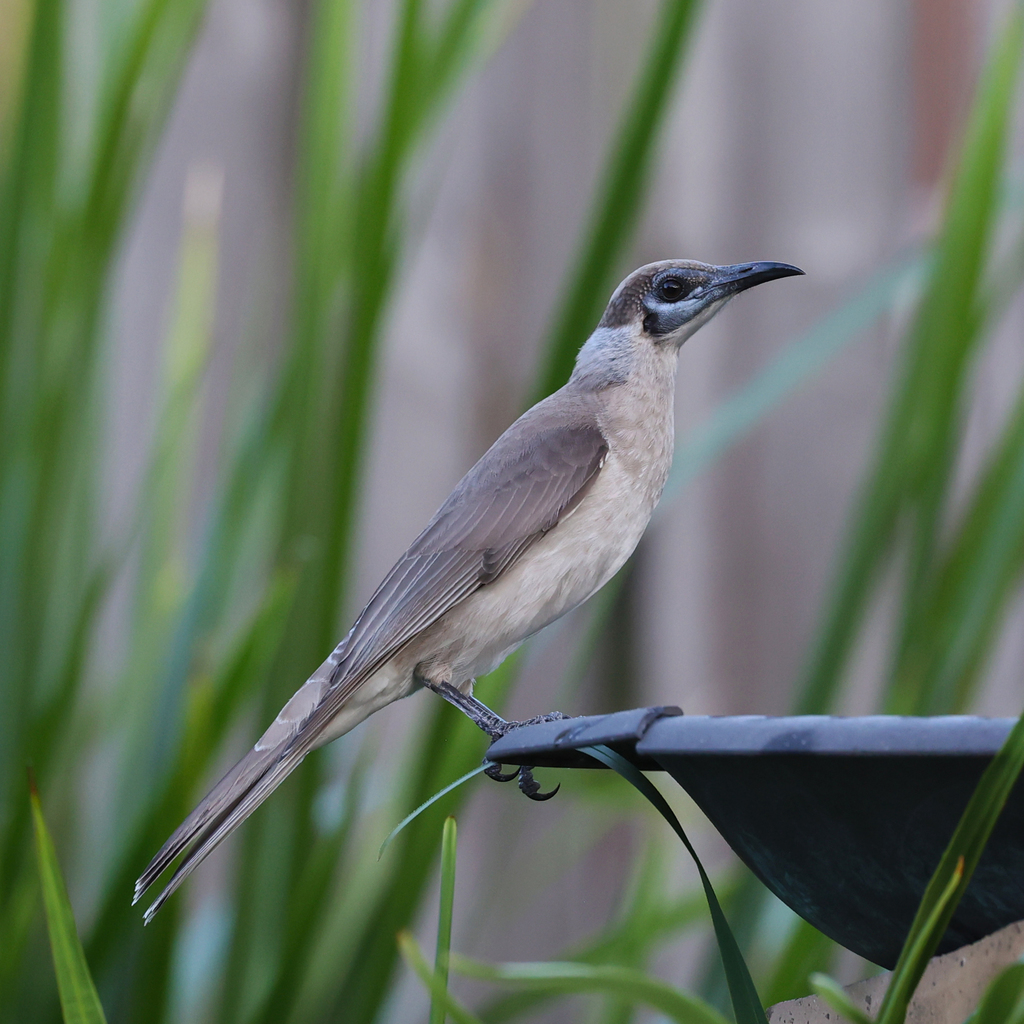
The little friarbird ranges from 25–30 centimetres (9.8–11.8 in) in length. The average size tends to be 27 centimetres (11 in) with an average weight of 67 grams (2.4 oz). Although males and females tend to be very similar in appearance, males are larger. The little friarbird can be easily distinguished from other friarbirds by the absence of a casque (a prominent ridge or bump present on the beak). Another key recognisable feature is the bare blue skin present under the eye which widens over the cheek. (The bare blue skin can vary from grey to black in tone.) Dark feathers are present both above and below the blue skin. The top of the head and body are a dark grey-brown with a dull white fringe present on the nape which flows around to a wide patch on the side of the neck. Fine silky white feathers are present under the chin with silvery white streaks flowing down the breast merging to pale grey for the underbody of the little friarbird. The little friarbird also has a black curved bill, dark brown eyes with bluish black legs. Its flight characteristics involve wing-beats which are shallow and quivering in nature. The tail is clearly square-cut when spread with slight pale tips present on the tail feathers.
Juveniles. Juvenile little friarbirds tend to have a paler appearance with a lighter facial skin. …
Range & habitat
The little friarbird is present most predominantly in northern Australia with seasonal movements to south-east Australia. They have been witnessed from the district of Broome in Western Australia through the Kimberleys into the northern portion of the Northern Territory. They have been sighted throughout most of Queensland going as far inland as Mount Isa and Opalton. In summer, they also spread throughout the south-east of Australia inhabiting the states of New South Wales, Victoria and South Australia, and the Australian Capital Territory. The little friarbird has been sighted along the Murray River and throughout the Riverina within New South Wales. In Victoria, the little friarbird is seen in the north-central region of the state, and near prominent bodies of water, such as Hattah Lakes. Sightings occur as far as Morgan on the Murray River in South Australia. They are also present in southern Papua New Guinea and on several islands adjacent to Australia. The little friarbird is found most predominantly around water bodies. They can be seen in swamp woodlands, mangroves, shrub communities, open forests and woodlands dominated by Eucalyptus tree species. They also inhabit orchards, vineyards and gardens during a good flowering season. They may also inhabit arid zones, but only where water bodies extend well into the area.
Wikipedia: “Distribution and habitat”
What it does
The little friarbird has been observed feeding alone, in pairs and small flocks. However, they are rarely seen feeding on the ground as they prefer to remain in the trees and feed with other honeyeaters in mixed groups. They feed on nectar, blossoms, fruit, invertebrates, and sometimes flowers and seeds.
Wikipedia: “Diet”
Listen
Looking for field recordings…
Where it lives
Recorded sightings
—
geo-referenced records in GBIF, from museums, herbaria and field observers.
Drag the globe to turn it. Dots are where records exist, not a range map; darker means more records.
In the stacks
Searching the stacks…
Every page naming Philemon citreogularis in the Biodiversity Heritage Library →
This page is assembled live from iNaturalist, GBIF, Wikipedia, the Source Library and the Internet Archive. It is not yet part of the hand-edited codex. iNaturalist taxon 603527.