- Plants
- ›Vascular Plants
- ›flowering plants
- ›monocots
- ›Agaves, Orchids, Irises, and Allies
- ›agave and allies
- ›Asparagus subfamily
- ›Asparagus
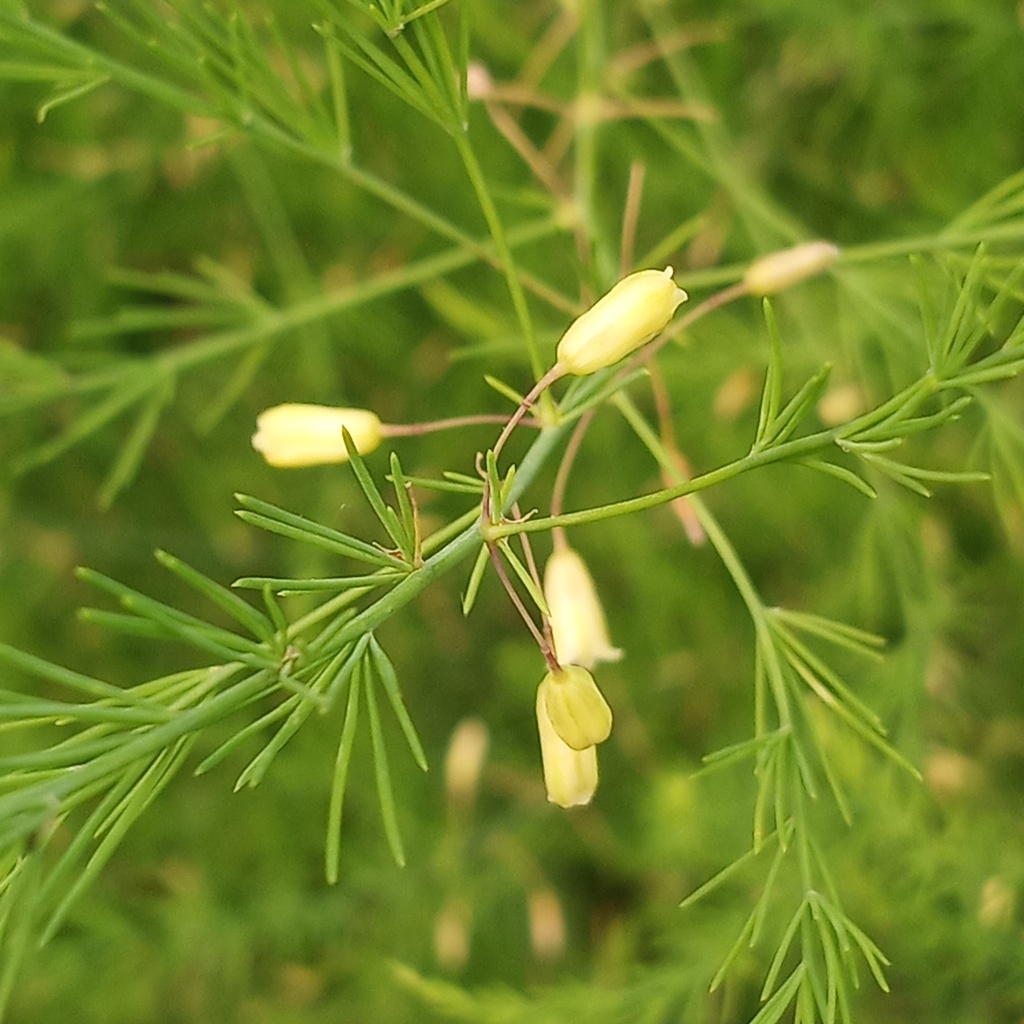
wild asparagus
Asparagus officinalis
Asparagus (Asparagus officinalis) or garden asparagus is a perennial flowering plant species in the genus Asparagus native to Eurasia. Widely cultivated as a vegetable crop, its young shoots are used as a spring vegetable. In 2024, world production of asparagus was 8.9 million tonnes, led by China with 87% of the total.
From the article Asparagus on Wikipedia (CC BY-SA), quoted section by section
Description
Asparagus is an herbaceous, perennial plant growing typically to 100–150 centimetres (3–5 feet) tall, with stout stems with much-branched, feathery foliage. It has been known to grow as long as 3.5 metres (11 ft). The 'leaves' are needle-like cladodes (modified stems) in the axils of scale leaves; they are 6–32 millimetres (1⁄4–1+1⁄4 inches) long and 1 mm (1⁄32 in) broad, and clustered in fours, up to 15, together, in a rose-like shape. The root system, often referred to as a 'crown', is adventitious; the root type is fasciculated. The flowers are bell-shaped, greenish-white to yellowish, 4.5–6.5 mm (3⁄16–1⁄4 in) long, with six tepals partially fused together at the base; they are produced singly or in clusters of two or three in the junctions of the branchlets. It is usually dioecious, with male and female flowers on separate plants, but sometimes hermaphrodite flowers are found. The fruit is a small red berry 6–10 mm (1⁄4–13⁄32 in) in diameter, which is toxic to humans. Asparagus grown natively to the western coasts of Europe (from northern Spain to northwest Germany, north Ireland, and Great Britain) are treated as A. officinalis subsp. prostratus (Dumort.) Corb., distinguished by its low-growing, often prostrate stems growing to only 30–70 cm (12–28 in) high, and shorter cladodes 2–18 mm (3⁄32–23⁄32 in) long. Some authors treat it as a distinct species, A. …
Range & habitat
Sources differ as to the plant's native range, but generally include most of Europe and western temperate Asia.
Wikipedia: “Distribution and habitat”
At the table
The genome of the species has been sequenced as a model to study the evolution of sex chromosomes in plants and dioecy.
Nutrition. Raw asparagus is 93% water, 4% carbohydrates, 2% protein, and contains negligible fat (table). In a reference amount of 100 g (3.5 oz), raw asparagus supplies 20 calories, and is a rich source (20% or more of the Daily Value) of copper and vitamin K (35% DV), and a moderate source (11–13% DV) of iron, thiamine, riboflavin, and folate, with no other micronutrients in significant content (table).
Culinary. Only young asparagus shoots ("spears") are commonly eaten: once the buds start to open ("ferning out"), the shoots quickly turn woody. The shape of edible spears can vary according to variety; typical shapes are long thin spears from 8mm to 24mm diameter, no longer than 22cm. The roots contain starch. The shoots are prepared and served in a number of ways around the world, typically as an appetizer or vegetable side dish. In Asian-style cooking, asparagus is often stir-fried. Cantonese restaurants in the United States often serve asparagus stir-fried with chicken, shrimp, or beef. It may also be quickly grilled over charcoal or hardwood embers, and is also used as an ingredient in some stews and soups. Asparagus can be pickled and stored for several years. …
Wikipedia: “Uses”
How it is grown
Since asparagus often originates in maritime habitats, it thrives in soils that are too saline for normal weeds to grow. Thus, a little salt was traditionally used to suppress weeds in beds intended for asparagus; this has the disadvantage that the soil cannot be used for anything else. Some regions and gardening zones are better-suited for growing asparagus than others, such as the west coast of North America and other more maritime, "Mediterranean" environments. The fertility of the soil is a large factor. "Crowns" are planted in winter, and the first shoots appear in spring; the first pickings or "thinnings" are known as sprue asparagus. Sprue has thin stems. A breed of "early-season asparagus" that can be harvested two months earlier than usual was announced by a UK grower in early 2011. This variety does not need to lie dormant and blooms at 7 °C (45 °F), rather than the usual 9 °C (48 °F). Purple asparagus differs from its green and white counterparts in having high sugar and low fibre levels. Purple asparagus was originally developed in Italy, near the city of Albenga and commercialized under the variety name 'Violetto d' Albenga'. Purple asparagus can also turn green while being cooked due to its sensitivity to heat.
Companion planting. Asparagus is said to be a useful companion plant for tomatoes, as the tomato plant repels the asparagus beetle. …
Wikipedia: “Cultivation”
In human culture
The English word asparagus derives from classical Latin but the plant was once known in English as sperage, from the Medieval Latin sparagus. This term itself derives from the Ancient Greek: ἀσπάραγος (aspáragos), a variant of Ancient Greek: ἀσφάραγος (aspháragos). The Greek terms are of uncertain provenance; the former form admits the possibility of a Proto-Indo-European root meaning "to jerk, scatter", directly or via a Persian descendant meaning "twig, branch"; but the Ancient Greek word itself, meaning "gully, chasm", seems to be of Pre-Greek origin instead. Asparagus was corrupted by folk etymology in some places to "sparrow grass"; indeed, John Walker wrote in 1791 that "Sparrowgrass is so general that asparagus has an air of stiffness and pedantry". The name 'sparrow grass' was still in common use in rural East Anglia, England well into the twentieth century.
Wikipedia: “Etymology”
Where it lives
Recorded sightings
—
geo-referenced records in GBIF, from museums, herbaria and field observers.
Drag the globe to turn it. Dots are where records exist, not a range map; darker means more records.
In the old herbals & bestiaries


In the stacks
Searching the stacks…
Every page naming Asparagus officinalis in the Biodiversity Heritage Library →
This page is assembled live from iNaturalist, GBIF, Wikipedia, the Source Library and the Internet Archive. It is not yet part of the hand-edited codex. iNaturalist taxon 60265.