- Plants
- ›Vascular Plants
- ›flowering plants
- ›Dicots
- ›Roses, Elms, Figs, and Allies
- ›rose family
- ›brambles, roses, strawberries, and allies
- ›strawberries, cinquefoils, and allies
- ›strawberry subtribe
- ›Drymocallis
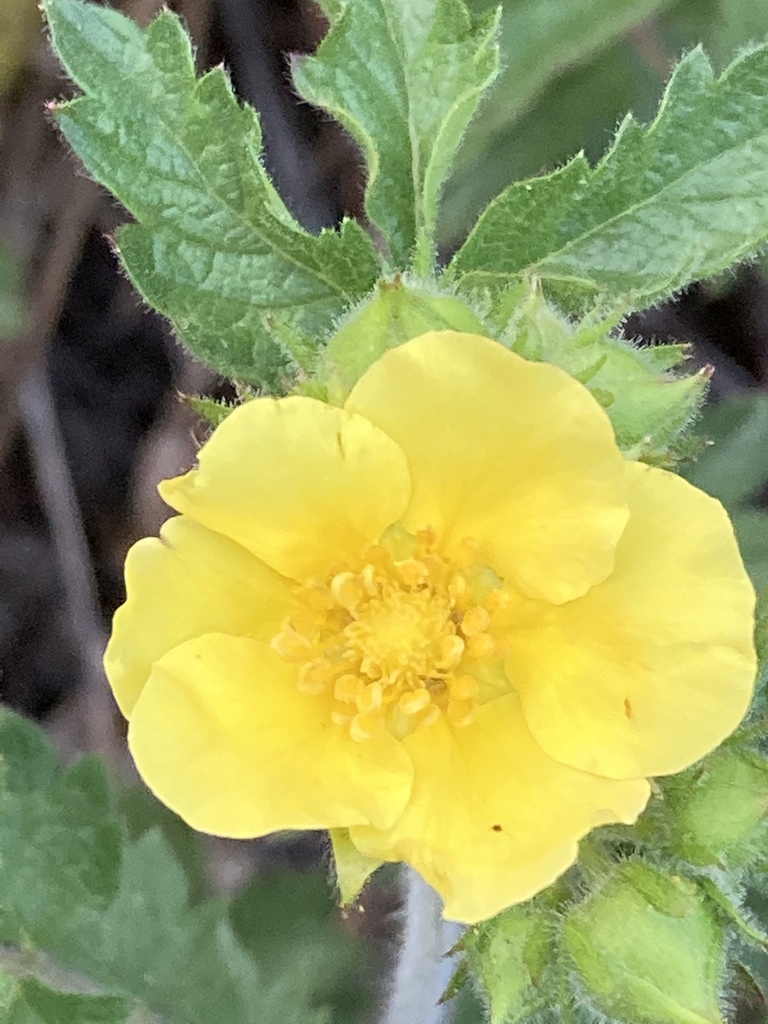
Big-flower Cinquefoil
Drymocallis fissa
Drymocallis fissa, the bigflower cinquefoil, also known as the leafy cinquefoil, leafy drymocallis, or wood beauty, is a small plant also sometimes classified as Potentilla fissa. It is a herbaceous plant with a thick taproot known for its moderately hairy leaves, redish leaf stems, and relatively large yellow flowers. It is native to foothills and lower mountains the Rocky Mountain region in the western United States.
From the article Drymocallis fissa on Wikipedia (CC BY-SA), quoted section by section
Description
Individuals of this species have numerous stems that come from the top of a single rootstalk with branched persistent woody stems (caudex). The leaves are pinnate with 7-13 slightly hairy leaflets. Leaflet edges are incised to small points. The stems are hairy and redish. Plant usually most often has a cyme with multiple flowers per stem that is taller than the leaves coming up from the plant's base. Plants usually grow between 15–35 cm tall, but occasionally will be as short as 12 cm or as tall as 45 cm.
Flowers and fruit. The flowers are large as the common name suggests, 1.9 to 2.5 cm across, with five petals, colored bright yellow to creamy yellow. The center of the flower is also yellow and the anthers are long, helping to distinguish it from other species. In Colorado Drymocallis fissa blooms in late spring to the very beginning of summer. The dry seed heads follow in July.
Range & habitat
Drymocallis fissa can be found from northern New Mexico to Alberta, Canada, but is most commonly found in the Front Range mountains and lower foothills in Colorado and Medicine Bow Mountains of Wyoming. It has also been reliably observed in the Black Hills of South Dakota. The USDA records observations in San Miguel County, New Mexico; Carbon County, Montana; Stillwater County, Montana; and Custer County, Idaho as well as Oregon and Utah, but these are suspected of being misidentifications of other species.
Wikipedia: “Distribution”
What it does
Bigflower cinquefoil is a perennial plant that often grows in mixed woodland habitats in the lower foothills, with sagebrush, on rocky slopes, and in open meadows at higher elevations. It is found from 1600–3000 meters in altitude. It prefers disturbed and rocky areas with more water, but not waterlogged soils. Drymocallis fissa was evaluated by NatureServe as apparently secure (G4) in 1994. This means that at a global level they think it has fairly low risk of extinction or collapse due to an extensive range and/or many populations, but with possible cause for some concern. It was additionally rated as vulnerable (S3) in Wyoming.
== References ==
Wikipedia: “Habitat and ecology”
Where it lives
Recorded sightings
—
geo-referenced records in GBIF, from museums, herbaria and field observers.
Drag the globe to turn it. Dots are where records exist, not a range map; darker means more records.
In the stacks
Searching the stacks…
Every page naming Drymocallis fissa in the Biodiversity Heritage Library →
This page is assembled live from iNaturalist, GBIF, Wikipedia, the Source Library and the Internet Archive. It is not yet part of the hand-edited codex. iNaturalist taxon 602519.