- Plants
- ›Vascular Plants
- ›flowering plants
- ›Dicots
- ›Mustards, Capers, and Allies
- ›mustard family
- ›Brassicoideae
- ›Camelinodae
- ›Lepidieae
- ›Lepidium
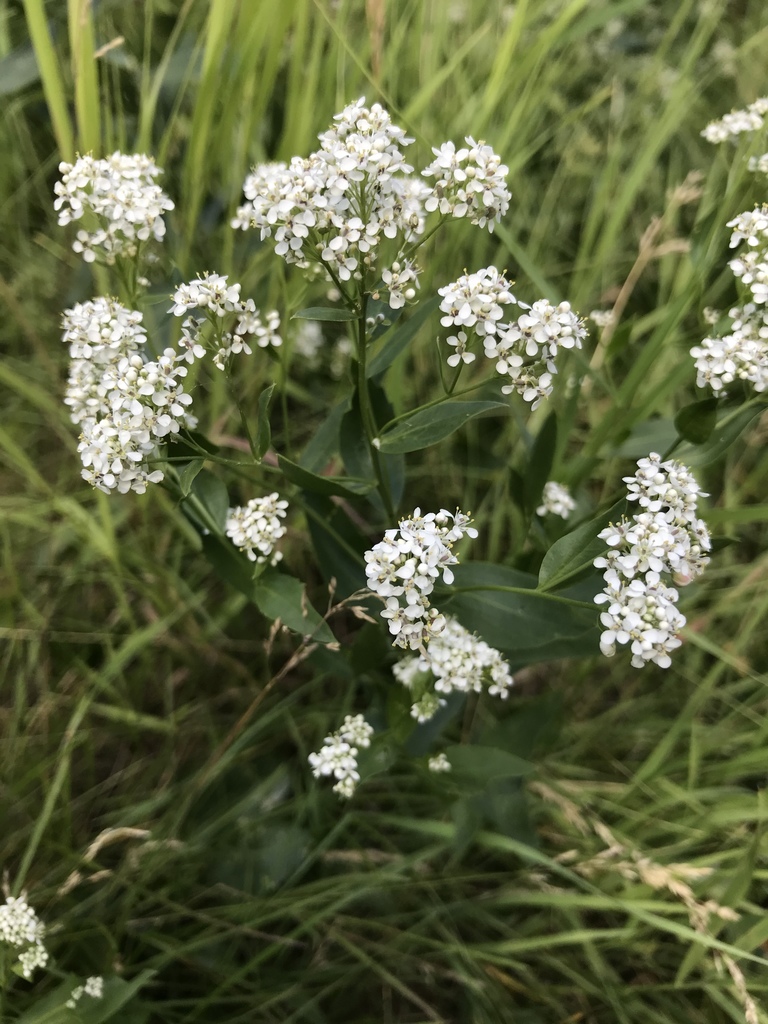
broadleaved pepperweed
Lepidium latifolium
Lepidium latifolium, known by several common names including perennial pepperweed, broadleaved pepperweed, pepperwort, peppergrass, dittander, dittany, and tall whitetop, is a perennial plant that is a member of the mustard and cabbage family.
From the article Lepidium latifolium on Wikipedia (CC BY-SA), quoted section by section
Description
Lepidium latifolium normally grows to 30–100 cm (12–39 in), but may grow as tall as 2 m (6.6 ft). It has numerous woody stems, alternating waxy leaves and clusters of small white flowers. It produces small (1.6 mm) fruits which each contain two reddish seeds. It has an extensive root network, known to reach 9 ft (2.7 m) in depth, and constituting 40% of the total biomass of the plant.
Range & habitat
This plant is native to southern Europe, Mediterranean countries and Asia as far east as the Himalayas. It is an introduced species in Australia and North America, growing throughout the United States and Mexico. It may have been introduced to the U.S. when its seed got into a shipment of sugar beet seeds.
Wikipedia: “Distribution”
At the table
The leaves, shoots, and fruits of this plant are all edible. In Ladakh in the Himalayas, the spring leaves are prized as a vegetable. The peppery edge or bitterness is removed by first boiling the young shoots and leaves, and then soaking in water for two days. Cooked like spinach, it makes a nutritious vegetable. The dried stems are sometimes used in flower arrangements.
Wikipedia: “Uses”
Where it lives
Recorded sightings
—
geo-referenced records in GBIF, from museums, herbaria and field observers.
Drag the globe to turn it. Dots are where records exist, not a range map; darker means more records.
In the stacks
Searching the stacks…
Every page naming Lepidium latifolium in the Biodiversity Heritage Library →
This page is assembled live from iNaturalist, GBIF, Wikipedia, the Source Library and the Internet Archive. It is not yet part of the hand-edited codex. iNaturalist taxon 60153.