- Plants
- ›Vascular Plants
- ›flowering plants
- ›Dicots
- ›borages
- ›borage family
- ›Cynoglossoideae
- ›Asperugeae
- ›Mertensia
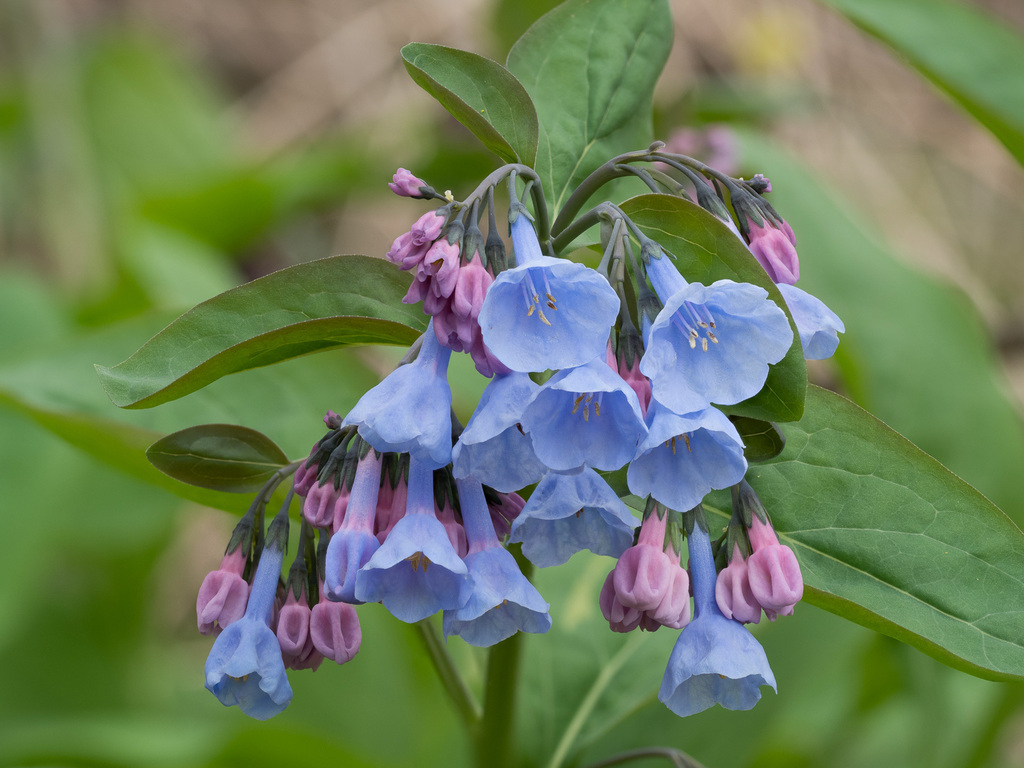
Virginia bluebells
Mertensia virginica
Mertensia virginica (common names Virginia bluebells, Virginia cowslip, lungwort oysterleaf, Roanoke bells) is a spring ephemeral plant in the Boraginaceae (borage) family with bell-shaped sky-blue flowers, native to eastern North America.
From the article Mertensia virginica on Wikipedia (CC BY-SA), quoted section by section
Description
Virginia bluebells have rounded (ovate) and gray-green leaves, borne on stems up to 24 in (60 cm) tall. The leaves are up to 5 in (13 cm) long, smooth (entire) along their margins, petiolate at the bottom of the flower stem, and sessile at the top. The inflorescence is a nodding group, or cyme of flowers located at the end of the arched stems. The flower buds are pink, and the opened flowers are usually light blue, but occasionally pink and rarely white. The flowers have 5 shallow lobes fused into a tube at the base of the flower, five stamens, and a central pistil (carpel).
Range & habitat
M. virginica is native in the United States from Kansas in the west, to Mississippi, Alabama, and Georgia in the south, and to Maine in the northeast. It is native in Canada in Ontario and Quebec. The plant can be found in rich, moist woods and on low, wooded hillsides. They often form large groups.
Wikipedia: “Distribution and habitat”
What it does
The plant develops very early in the spring and flowers mid-spring. In early summer, each fertilized flower produces four seeds within wrinkled nuts. The plant then goes dormant till the next spring. The flowers attract long-tongued bees like bumblebees, and also butterflies, moths, skippers, hummingbird moths, flower flies, bee flies, and hummingbirds.
Wikipedia: “Ecology”
At the table
Virginia bluebells had several uses in traditional Native American medicine, including as a pulmonary aid, tuberculosis treatment, and treatment for whooping cough (Cherokee), root infusion antidote for treating poison, and root decoction to treat venereal issues (Iroquois). Native Americans believed a tonic made from this plant could help heal those who were under-the-weather. Mertensia virginica is edible, including the flowers. In cultivation, M. virginica has gained the Royal Horticultural Society's Award of Garden Merit.
Wikipedia: “Uses”
Where it lives
Recorded sightings
—
geo-referenced records in GBIF, from museums, herbaria and field observers.
Drag the globe to turn it. Dots are where records exist, not a range map; darker means more records.
In the stacks
Searching the stacks…
Every page naming Mertensia virginica in the Biodiversity Heritage Library →
This page is assembled live from iNaturalist, GBIF, Wikipedia, the Source Library and the Internet Archive. It is not yet part of the hand-edited codex. iNaturalist taxon 59771.