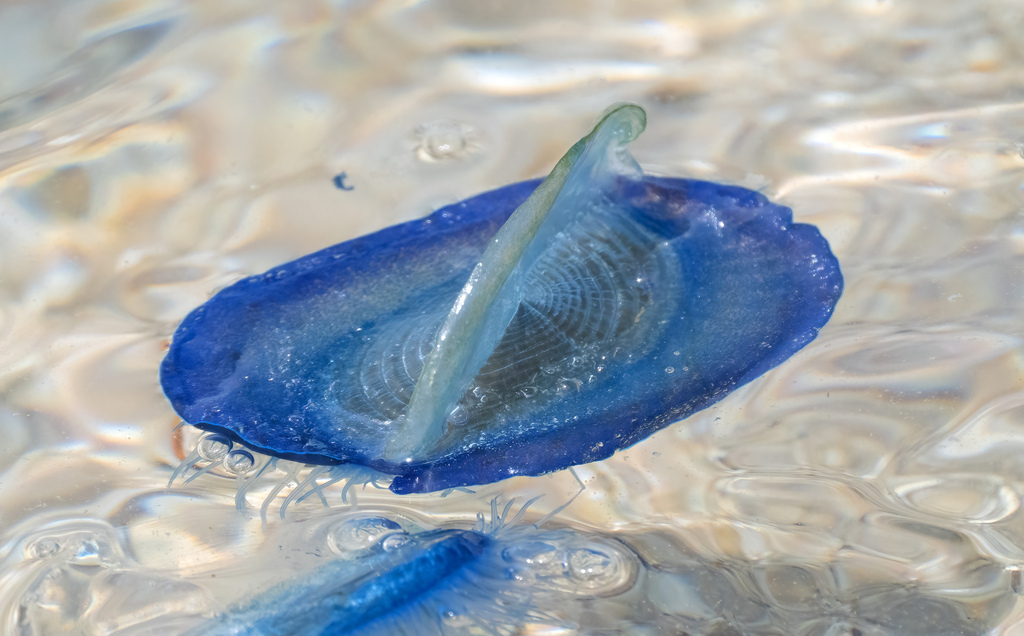
By-the-wind Sailor
Velella velella
Velella is a genus of hydrozoa (a group of small, predatory marine cnidarians) in the family Porpitidae. Its only known species is Velella velella, a widely-distributed free-floating colonial animal that lives on the surface of the open ocean. It is commonly known by the names sea raft, by-the-wind sailor, purple sail, little sail, or simply Velella.
It is a member of a specialised ocean surface community that includes the better-known Portuguese man o' war. Specialized predatory molluscs prey on these cnidarians. Such predators include nudibranchs (sea slugs) in the genus Glaucus and purple snails in the genus Janthina.
From the article Velella on Wikipedia (CC BY-SA), quoted section by section
Range & habitat
V. velella lives in warm and temperate waters in all the world's oceans. They live at the water/air interface, with the float above the water, and polyps hanging down about a centimetre below. Organisms that live partly in and partly out of the water like this are known as neuston. Offshore boaters sometimes encounter thousands of V. velella on the water surface. The small rigid sail projects into the air and catches the wind. However, V. velella sails always align along the direction of the wind where the sail may act as an aerofoil, so that the animals tend to sail downwind at a small angle to the wind. Having no means of locomotion other than its sail, V. velella is at the mercy of prevailing winds for moving around the seas, and are thereby also subject to mass-strandings on beaches throughout the world. For example, a mass stranding occurs most years in the spring along the West Coast of North America, from British Columbia to California, beginning in the north and moving south over several weeks' time. In some years, so many animals are left at the tide line by receding waves, that the line of dying (and subsequently rotting) animals may be many centimetres deep, along hundreds of kilometres of beaches. …
Wikipedia: “Distribution and habitat”
What it does
Like many Hydrozoa, V. velella has a bipartite life cycle, with a form of alternation of generations. The deep blue, by-the-wind sailors that are recognized by many beach-goers are the polyp phase of the life cycle. Each "individual" with its sail is really a hydroid colony connected by a canal system that enables the colony to share whatever food is ingested by individual polyps. Each by-the-wind sailor is a colony of all-male or all-female polyps. The colony has several different kinds of polyps, some of which are both feeding and reproductive, called gonozooids, and others protective, called dactylozooids. The gonozooids each produce numerous tiny jellyfish by an asexual budding process, so that each V. velella colony produces thousands of tiny jellyfish (medusae), each about 1 mm (0.039 in) high and wide, over several weeks. The tiny medusae are each provided with many zooxanthellae, single-celled endosymbiotic organisms typically also found in corals and some sea anemones, that can utilize sunlight to provide energy to the jellyfish. Curiously, although a healthy captive V. velella will release many medusae under the microscope, and are expected to do the same in the sea, the medusae of V. velella are rarely captured in the plankton and very little is known about their natural history. …
Wikipedia: “Life cycle”
Where it lives
Recorded sightings
—
geo-referenced records in GBIF, from museums, herbaria and field observers.
Drag the globe to turn it. Dots are where records exist, not a range map; darker means more records.
In the stacks
Searching the stacks…
Every page naming Velella velella in the Biodiversity Heritage Library →
This page is assembled live from iNaturalist, GBIF, Wikipedia, the Source Library and the Internet Archive. It is not yet part of the hand-edited codex. iNaturalist taxon 59698.