- Animals
- ›Arthropods
- ›Hexapods
- ›Insects
- ›Winged and Once-winged Insects
- ›Butterflies and Moths
- ›Geometrid and Swallowtail Moths
- ›Geometer Moths
- ›Ennominae
- ›Rumiini
- ›Opisthograptis
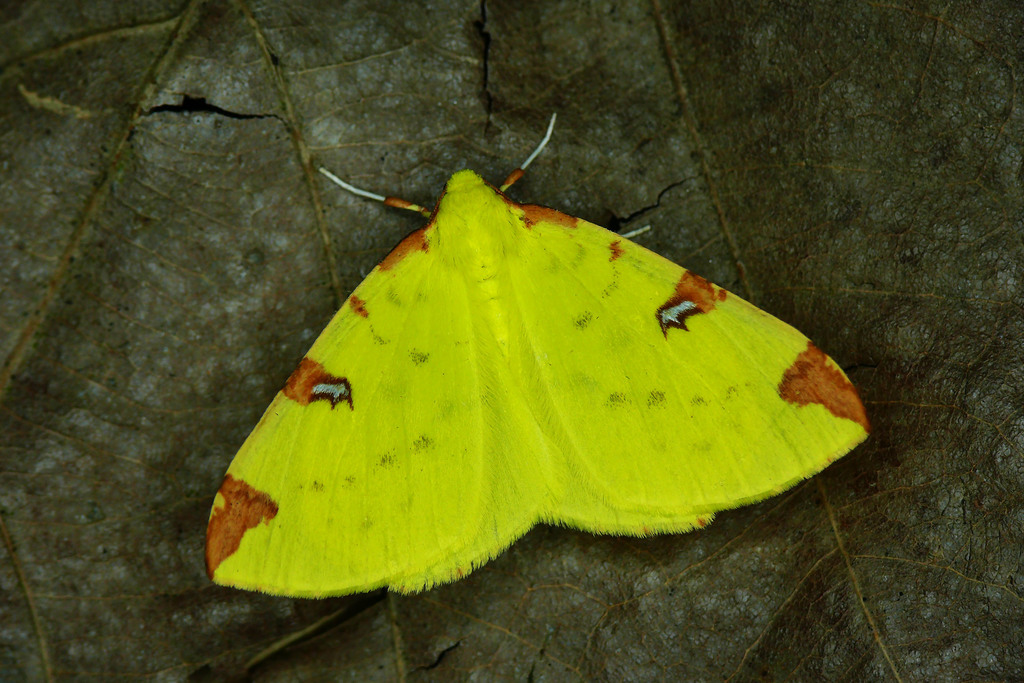
Brimstone Moth
Opisthograptis luteolata
The brimstone moth (Opisthograptis luteolata) is a moth of the family Geometridae. The species was first described by Carl Linnaeus in his 1758 10th edition of Systema Naturae. It should not be confused with the brimstone butterfly Gonepteryx rhamni.
From the article Brimstone moth on Wikipedia (CC BY-SA), quoted section by section
Description
This species is unmistakable within its range, with bright yellow wings marked with small brown patches along the costa of the forewing and a small brown-edged white stigma, also on the forewing. The wingspan is 33–46 mm. "0. luteolata L. The only European species. The name-typical form has on the forewing red-brown costal markings at the base, at the discal mark and triangularly at the apex; faint, irregularly grey antemedian and postmedian lines, interrupted at the veins. Hindwing with dark discal dot and faint grey postmedian line. — aestiva Vorh. & Müll.-Rutz is a smaller, more deeply coloured summer brood form. It seems to be the principal or only form in Tunis. — ab. flavissima Krulik. is almost entirely yellow, only with slight remnants of the costal markings. — ab. albescens Ckll. has the ground colour pure white instead of yellow. Very pale yellow examples have been separated as intermedia Harrison. — ab. niko Chr. is according to. Staudinger an extraordinary aberration with both wings broadly fuscous margined and the basal part of the forewing brownish. Perhaps accidental, as the yellow of this species is highly susceptible to various kinds of chemical action.- provincialis Ob. is a pale, weakly marked form from Provence. — emaculata Graes. lacks the apical patch of the forewing. Prevalent in Central Asia, accidental elsewhere. — mimulina Btlr. …
Wikipedia: “Description and life cycle”
Listen
Looking for field recordings…
Where it lives
Recorded sightings
—
geo-referenced records in GBIF, from museums, herbaria and field observers.
Drag the globe to turn it. Dots are where records exist, not a range map; darker means more records.
In the stacks
Searching the stacks…
Every page naming Opisthograptis luteolata in the Biodiversity Heritage Library →
This page is assembled live from iNaturalist, GBIF, Wikipedia, the Source Library and the Internet Archive. It is not yet part of the hand-edited codex. iNaturalist taxon 59588.