- Plants
- ›Vascular Plants
- ›flowering plants
- ›Dicots
- ›nightshades, bindweeds, gooseweeds, and allies
- ›bindweed family
- ›Bindweeds, Morning-glories and Allies
- ›Ipomoeeae
- ›Ipomoea
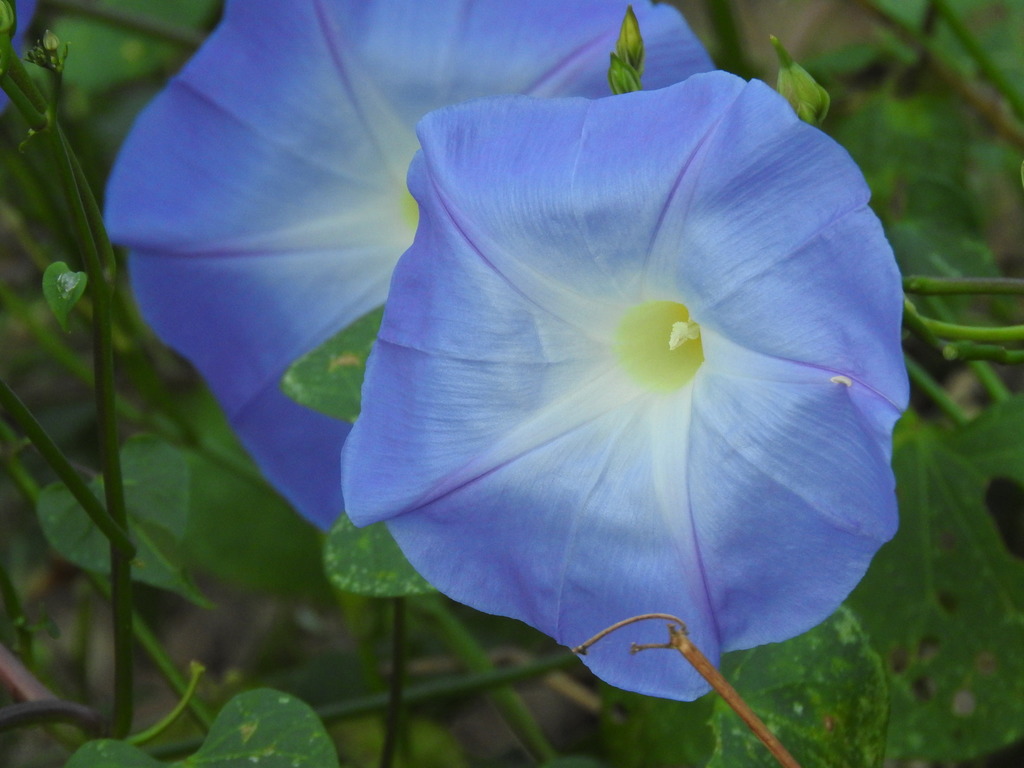
Garden Morning Glory
Ipomoea tricolor
Ipomoea tricolor, the Mexican morning glory, is a species of flowering plant in the family Convolvulaceae, native to the New World tropics, and widely cultivated and naturalised elsewhere. It is an herbaceous annual or perennial twining liana growing to 2–4 m (7–13 ft) tall. The leaves are spirally arranged, 3–7 cm long with a 1.5–6 cm long petiole. The flowers are trumpet-shaped, 4–9 cm (2–4 in) in diameter, most commonly blue with a white to golden yellow centre.
From the article Ipomoea tricolor on Wikipedia (CC BY-SA), quoted section by section
Description
It is an herbaceous annual or perennial twining liana growing to 2–4 m (7–13 ft) tall. The leaves are spirally arranged, 3–7 cm (1–3 in) long with a 1.5–6 cm (1⁄2–2+1⁄2 in) long petiole. The flowers are trumpet-shaped, 4–9 cm (2–4 in) in diameter, most commonly blue with a white to golden yellow centre. I. tricolor and many rarer species of morning glory, contain ergoline alkaloids, predominantly ergine. Some supermarkets have stopped carrying I. tricolor seeds because of this.
At the table
In cultivation, the species is very commonly grown misnamed as Ipomoea violacea, which is actually a different, though related, species. I. tricolor does not tolerate temperatures below 5 °C (41 °F), and so in temperate regions is usually grown as an annual. It is in any case a relatively short-lived plant. It prefers a warm, sheltered, sunny position such as a south- or west-facing wall. Ingesting any part of the plant may cause discomfort. Numerous cultivars of I. tricolor with different flower colours have been selected for use as ornamental plants; widely grown examples include:
The cultivar 'Heavenly Blue' has gained the Royal Horticultural Society's Award of Garden Merit.
Weed control. Ipomoea tricolor has phytotoxic effects which inhibit seedling growth in weeds. In Mexico, farmers promote the growth of I. tricolor as a cover plant. It prevents weeds and unwanted plants from growing. When it is time to plant crops, this plant is incorporated into the soil. Although it is toxic to weeds, it does not affect crops such as sugarcane.
Chemical deterrent used to discourage ingestion. It is rumored that I. tricolor seeds are coated with a chemical that induces sickness so as to dissuade people from using them as a drug, but this is probably a rumor that stems from several factors: - I. …
Wikipedia: “Cultivation and uses”
Where it lives
Recorded sightings
—
geo-referenced records in GBIF, from museums, herbaria and field observers.
Drag the globe to turn it. Dots are where records exist, not a range map; darker means more records.
In the stacks
Searching the stacks…
Every page naming Ipomoea tricolor in the Biodiversity Heritage Library →
This page is assembled live from iNaturalist, GBIF, Wikipedia, the Source Library and the Internet Archive. It is not yet part of the hand-edited codex. iNaturalist taxon 59561.