- Plants
- ›Vascular Plants
- ›flowering plants
- ›Dicots
- ›Legumes, Milkworts, and Allies
- ›Legumes
- ›Faboideae
- ›brooms, lupines, and allies
- ›Lupinus
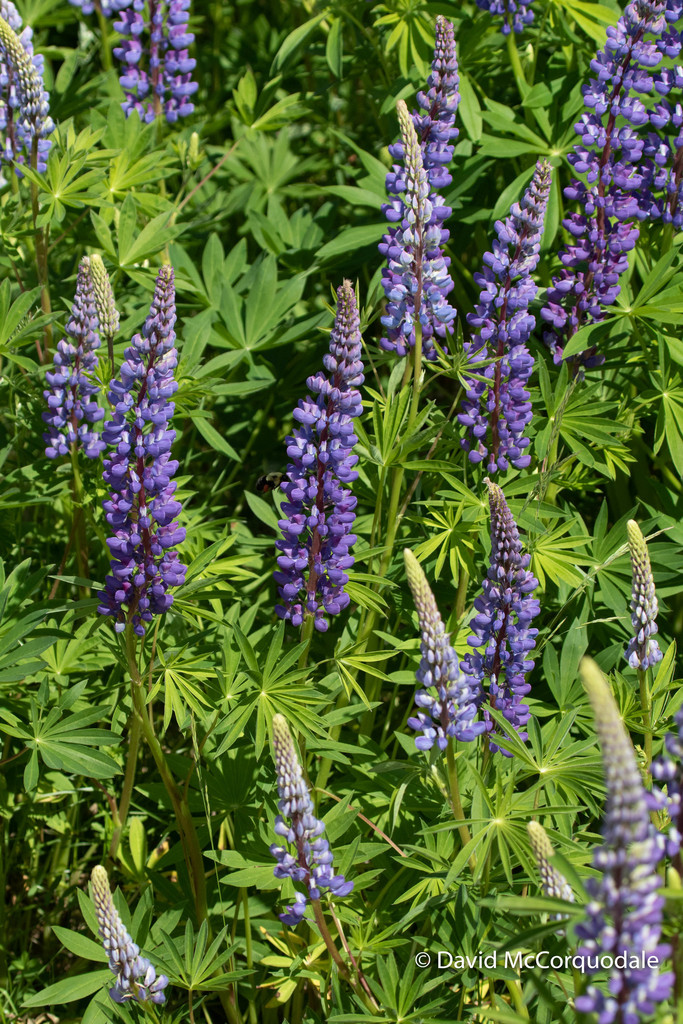
Large-leaved lupine
Lupinus polyphyllus
Lupinus polyphyllus, the large-leaved lupine, big-leaved lupine, many-leaved lupine, blue-pod lupine, or, primarily in cultivation, garden lupin, is a species of lupine (lupin) native to western North America from southern Alaska and British Columbia and western Wyoming, and south to Utah and California. It commonly grows along streams and creeks, preferring moist habitats.
From the article Lupinus polyphyllus on Wikipedia (CC BY-SA), quoted section by section
Description
It is a perennial herbaceous plant with stout stems growing to 1.5 metres (4.9 ft) tall. The leaves are palmately compound with 9–17 leaflets 3–15 centimetres (1.2–5.9 in) long. The flowers are produced on a tall spike, each flower 1–1.5 centimetres (0.39–0.59 in) long, most commonly blue to purple in wild plants. The flowers are mostly visited by bumblebees. The polyphyllus variety in particular make up a great number of the hybrids which are generally grown as garden lupines, which can vary dramatically in colours. The majority of lupines do not thrive in rich heavy soils, and often only live for a matter of years if grown in such places, because crown contact with manure or rich organic matter encourages rotting.
What it does
This lupine may represent a significant threat to the survival of the endangered Karner blue butterfly, due to its ease of hybridization with the Karner's food plant, Lupinus perennis, the wild perennial lupine. Some sources argue that commercial lupine seeds are already questionable for the Karner due to hybridization. Additionally, incompatible lupines continue to be introduced by humans into places where the Karner lives or once lived.
Wikipedia: “Ecology”
At the table
It is commonly used in gardens for its attractiveness to bees, as well as its ability to improve poor sandy soils with its nitrogen fixing ability and flowers. Numerous cultivars have been selected for differing flower colour, including red, pink, white, blue, and multicoloured with different colours on different petals. Often hybrids between L. polyphyllus and L. arboreus are used, and sold under hybrid names such as Rainbow Lupins, Lupin Tutti Fruitti, and Band of Nobles (mixed), Chandelier (yellow), My Castle (red), Noble Maiden (white), The Chatelaine (pink), and The Governor (blue). They are very hardy plants, surviving extreme temperatures and withstanding frost to at least −25 °C (−13 °F). The wild varieties can easily become invasive and hard to dispose of unless kept in check on a regular basis. Growing lupins in pots can help prevent them from growing invasively in the ground. They need a reasonable level of sun to survive, and do best in light soils, suffering in heavy and clay types. Once fully established they are extremely resilient and may be divided. Seeds taken from the mother plant will never be a true replica of the original even if they produce similar colourings. Low alkaloidal or sweet cultivars of this lupine suitable for fodder crops have been bred. …
Wikipedia: “Cultivation and uses”
Where it lives
Recorded sightings
—
geo-referenced records in GBIF, from museums, herbaria and field observers.
Drag the globe to turn it. Dots are where records exist, not a range map; darker means more records.
In the stacks
Searching the stacks…
Every page naming Lupinus polyphyllus in the Biodiversity Heritage Library →
This page is assembled live from iNaturalist, GBIF, Wikipedia, the Source Library and the Internet Archive. It is not yet part of the hand-edited codex. iNaturalist taxon 59549.