- Plants
- ›Vascular Plants
- ›flowering plants
- ›Dicots
- ›Legumes, Milkworts, and Allies
- ›Legumes
- ›Faboideae
- ›milkvetches, locoweeds, and allies
- ›Astragalus
- ›Diphysi
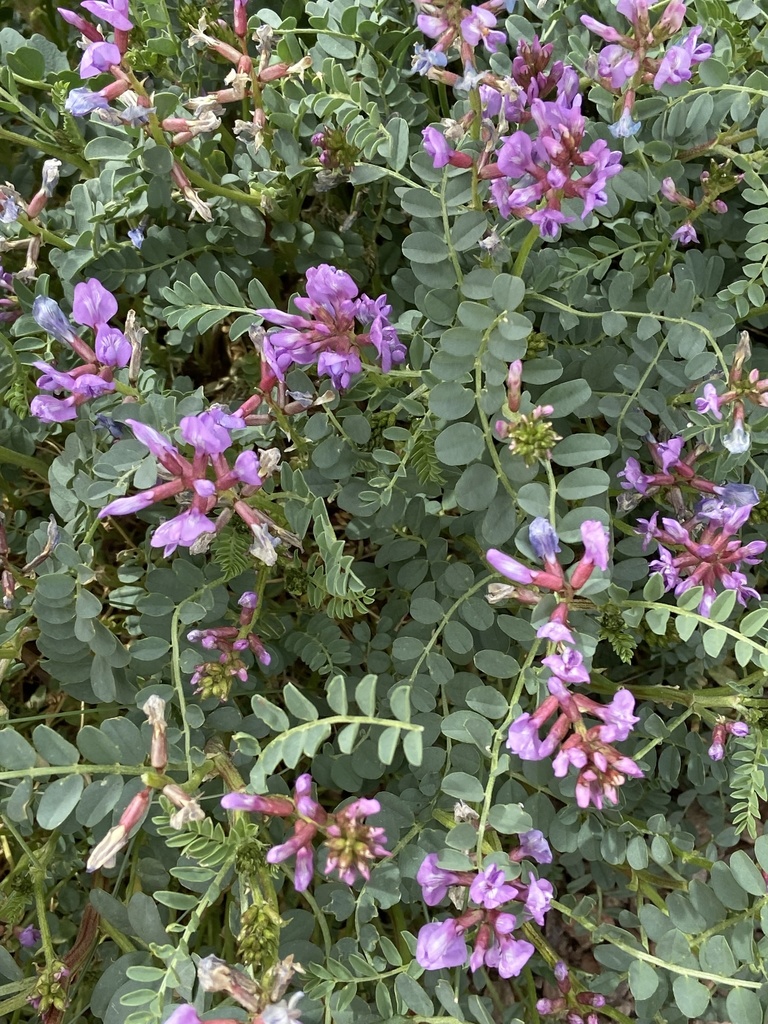
Freckled Milkvetch
Astragalus lentiginosus
Astragalus lentiginosus is a species of legume known by the common names spotted locoweed and freckled milkvetch. It is native to western North America, where it grows in many habitat types. There are a great number of wild varieties of this species, and they vary in appearance. The flower and the fruit of a given individual are generally needed to identify it down to the variety.
From the article Astragalus lentiginosus on Wikipedia (CC BY-SA), quoted section by section
Description
Astragalus lentiginosus is a perennial or occasionally annual herb with leaves up to 15 centimetres (5.9 inches) long divided into many pairs of small leaflets. The plant is prostrate to erect in form and quite woolly to nearly hairless. The inflorescence holds up to 50 pea-like flowers which may be purplish or whitish or a mix of both. A unifying character among most of the varieties is an inflated, beaked legume pod with a groove along the side. The pod dries to a papery texture and dehisces starting at the beak to release the seeds. The epithet lentiginosus refers to the red mottling commonly found on the pods which resemble freckles. The bloom period is between the months of March, April, and May.
Range & habitat
As a species, Astragalus lentiginosus is distributed throughout the Great Basin of North America, west from the Rocky Mountains to the California Coast Ranges, south to Mexico, and north to British Columbia. Varieties are largely limited to marginal habitats such as disturbed sites in the arid regions of the continent. The group also contains a number of edaphic specialists which occur at desert seeps, which frequently exhibit high levels of calcium carbonate.
Wikipedia: “Distribution”
At the table
The Zuni people eat the pods of the diphysus variety fresh, boiled, or salted. They are also dried and stored for winter use.
Wikipedia: “Uses”
How it is grown
Astragalus lentiginosus is currently not cultivated commercially. Propagation from seed requires scarification of the seed coat in order for the embryo to absorb water.
Wikipedia: “Cultivation”
Where it lives
Recorded sightings
—
geo-referenced records in GBIF, from museums, herbaria and field observers.
Drag the globe to turn it. Dots are where records exist, not a range map; darker means more records.
In the stacks
Searching the stacks…
Every page naming Astragalus lentiginosus in the Biodiversity Heritage Library →
This page is assembled live from iNaturalist, GBIF, Wikipedia, the Source Library and the Internet Archive. It is not yet part of the hand-edited codex. iNaturalist taxon 59501.